
event:decision
  • Home
  • Our Products
    • Track
    • Impact
    • Navigator
    • Evolve
  • About Us
    • Our Company
    • Clients
  • Resources
    • Quiz
    • Blog
    • Most Sustainable Agencies
  • Contact Us
  • Client Login
  • Search
  • Menu Menu
  • LinkedIn
  • Instagram

The No-fuss Carbon Footprint Calculator for Events

March 28, 2023/in Track

A carbon footprint calculator with no data input, no training and no tech integration. Can this be a thing?

Time and time again we hear from event professionals that they want to plan and put on more sustainable events. But the time and effort involved in all accurate carbon footprint calculations to help their planning process is just prohibitive. The events industry has been under huge pressure for the past couple of years and anything that adds to that pressure, or pulls anyone in the team away from the core business, is going to struggle to get buy-in.

Which is where our clever carbon footprint calculator track comes in.

“1,000x easier than your competition” – Agency Sales Director

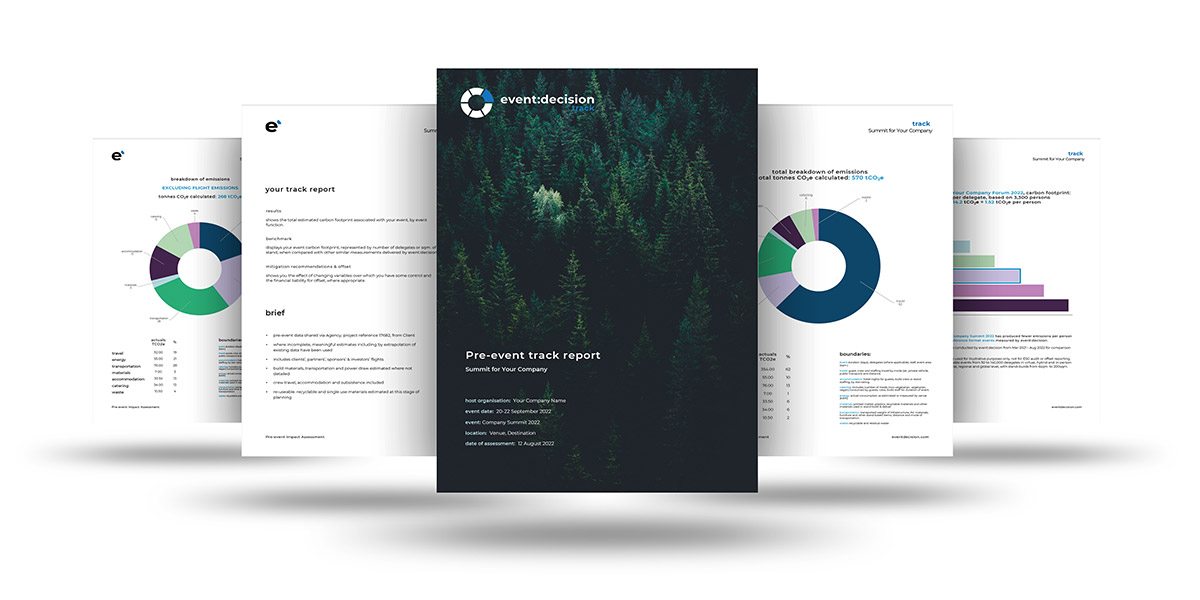
Track measures and reports on the sustainability of any event, large or small. It shows you which event factors are significant for the carbon footprint and sustainability of the event and which are less so. It’s a carbon footprint calculator that was specifically designed so that we, not you, do all ‘heavy-lifting’ on the calculations, so that you don’t have to. All that’s needed to carry out the calculations is an event brief. No spreadsheets, no data inputting from you, no report-building.  Here are four things we think makes it unique:
What makes track fuss-free?

  1. A service-based approach, not a platform – the best analogy we’ve heard was from one of our clients who described it as a bit like the HMRC website and process for UK tax returns. You can of course do your tax return yourself, using the online data input forms and facilities provided online. Or, you could pay an accountant to put all the information together for you in the right format. Simpler, quicker and undoubtedly with less potential for errors.
  2. No data entry – when we say ‘no data entry’ we mean it. There are no hidden requirements for anyone in your team to sit and input any the data from your event. We do the lot.
  3. No tech integration, a standalone service – integrations are the bane of most IT department’s lives. Someone buys in a new tool and then finds it won’t ‘talk’ to other key pieces of software in the business. track is completely stand-alone, so you never need to worry about that.
  4. No training required – not only do your staff not need to input any data, they won’t need any training on track either. That’s because it’s a service, not a platform. and we do it all for them.

“We’ve been looking for this product” -Brand Head of Events
“Finally, someone who tells us how it is. So glad I found you.” – Senior Planner, Europe

What does track report on?

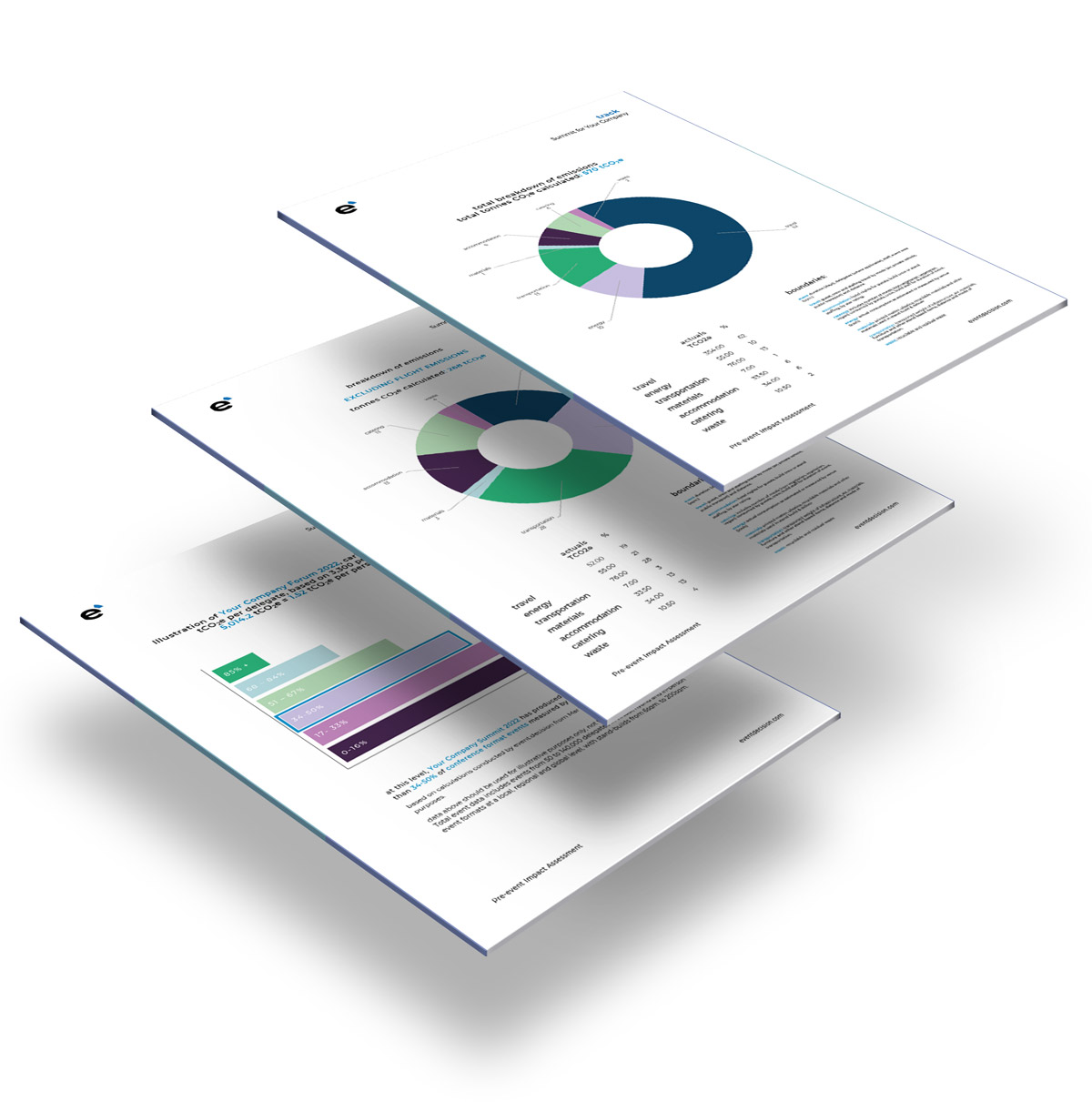
There are two sets of reports, the pre-event report means events can be assessed at the planning stage with the impact predicted. It’s perfect for RFPs, briefs and for the start of your event planning process. The post-event report then measures the actual carbon footprint after the event. The two reports can of course be compared to assess how much of your careful event planning contributed to the sustainability of the event. Our reports are simple, easy to interpret and beautifully designed.

“The user-friendliness of your service and detail was incredible” – Exhibition Owner

Don’t just take our word for it though, we have hundreds of happy clients who tell us how easy track is to use and how simple it has been for their team.

“Value & simplicity” – Agency Director
“We actively recommend to our clients” – Head of Venue Sales & Marketing

To find out more about our no-fuss carbon footprint and sustainability tool track, please get in touch, we can give you a demo and show you some more sample reports to illustrate just what it could do for you.


https://eventdecision.com/wp-content/uploads/2023/03/3.jpg 768 1024 eventdec https://eventdecision.com/wp-content/uploads/2022/07/mainlogo-ed.png eventdec2023-03-28 06:25:402023-04-22 06:40:20The No-fuss Carbon Footprint Calculator for Events

Sustainable Suppliers for the Events Industry

March 21, 2023/in Track

Choosing sustainable suppliers can help the events industry reduce its environmental impact.

The choice of sustainable suppliers is increasingly crucial to achieving the events industry’s goal of hosting fully sustainable events. Selecting suppliers that focus on sustainability use eco-friendly materials, reduce waste, conserve energy, and promote social responsibility can help event professionals minimise the environmental impact of any event – large or small.

The careful selection of suppliers that promote sustainability can also provide a competitive advantage. Visitors and guests are more and more environmentally conscious themselves and more likely to choose events to attend that reflect their values. By choosing sustainable suppliers, event professionals can attract environmentally conscious consumers, enhance their brand reputation, and differentiate themselves from their competitors.

What should event professionals consider when selecting suppliers to optimise their event sustainability?

When selecting suppliers that promote sustainable practices, consider the following:

  1. Environmental impact: the environmental impact of suppliers is the most crucial factor to consider when selecting sustainable suppliers. Event professionals should look for suppliers that use sustainable materials, reduce waste, and conserve energy. For example, selecting a catering supplier that sources local and organic produce, uses compostable plates and utensils, and recycles waste can significantly reduce the environmental impact of an event.
  2. Certifications and accreditations: look for suppliers that have environmental certifications and accreditations, such as the ISO 14001 certification. These certifications indicate that the supplier has implemented environmental management systems that comply with recognised international standards.
  3. Social Responsibility: consider the social responsibility of suppliers, look for suppliers that promote fair labour practices, support local communities, and contribute to social causes.
  4. Reputation: research the reputation of suppliers before selecting them. Look for suppliers that have a proven track record of delivering sustainable products and services.

Four new (ish) sustainable suppliers for event professionals 

These companies have been specifically created to help you deliver your events more sustainably:

  1. Event Cycle – take unwanted event material and give it a second life, repurposing and redistributing items to charities and community groups as well putting them back into the events industry. From graphics to giveaways, planks of wood to plants, they find a new home for them all. Their mission is to lead the events industry into a circular economy where landfill waste is reduced, and by doing so a social impact is made.
  2. You.Smart.Thing – host a travel demand management platform that generates personalised low-carbon travel plans that enhance visitor experience & increase revenues. Their ‘travel assistant’ can be tailored to enable organisations to offer content-enhanced wayfinding and low-carbon door-to-door travel plans that nudge visitors towards net-zero travel to events.
  3. Green Voltage – provide ‘green’ mobile power and support to the film, television, broadcast and live event industries. Created specifically to address the demand for environmentally conscious solutions, their emissions-free, silent, generators are available to hire or buy.
  4. event:decision – help event professionals measure the environmental impact of any event – both at the planning stage and after the event with track, the carbon footprint management tool.

To find out more about our carbon footprint and sustainability tool track, or to nominate a sustainable events supplier to be included in our list, please get in touch.

https://eventdecision.com/wp-content/uploads/2023/03/4.jpg 768 1024 eventdec https://eventdecision.com/wp-content/uploads/2022/07/mainlogo-ed.png eventdec2023-03-21 06:35:462023-04-14 12:08:32Sustainable Suppliers for the Events Industry

7 Clever Ways to Make Your Event More Sustainable

March 14, 2023/in Track

Sustainable events adopt eco-friendly practices which reduce the event’s carbon footprint.

We have become much more aware of our impact on the environment, and events in particular can have a significant ecological footprint. So it’s important for event owners and organisers to consider ways in which they can make their events more sustainable. In this article, we’ll explore seven clever – and practical – ways to make your event more sustainable and environmentally friendly.

  1. Waste management and recycling – waste management is one of the most critical aspects of sustainability. It is important to ensure that waste generated during the event is managed responsibly. One way to achieve this is by separating waste into different streams such as food waste, plastics, paper and glass. Providing appropriate bins, clear signage and helping educating attendees about where to dispose of waste is key. A study conducted by the University of Minnesota found that an event with 500 attendees can generate up to 1.89 tons of waste. By properly managing this waste, you can significantly reduce the amount that ends up in landfill. By recycling materials, you can reduce others’ need for virgin materials and save both energy and reduce the amount of material in landfill. You can encourage recycling at your event by providing recycling bins in easily accessible areas, such as near food and drink stations. This will help attendees to dispose of waste responsibly – ask a local waste carrier what they can accept, it’s only one web-search away. Also look for services provided by companies like Event Cycle who can turn your materials into social donations.
  2. Choice of venue – your choice of venue will have a huge impact on the emissions associated with your event. How your delegates or visitors travel to your event is almost certainly the largest factor you an control. When choosing a venue, look at where your audience is based & search for venues within that area and accessible by public transport. Then consider factors such as renewable energy provision, water usage and waste management. A venue with green credentials such as solar panels or a rainwater harvesting system, or better-still LEED-certified, can significantly reduce your event’s carbon footprint. Studies have shown that LEED-certified buildings deliver a 25%-30% reduction in energy compared to non-LEED certified buildings, for example. When choosing & speaking to your possible venues, make sure to ask them about these – and which certifications they hold.
  3. Sustainable travel & transport – transportation is  probably the most significant source of event-related greenhouse gas emissions. Therefore, it’s important to encourage sustainable modes of transport to and from your event. One way to achieve this is by promoting public transport, such as trains or buses. You could also encourage attendees to carpool to an event. Offering incentives such as discounted tickets or digital swag for carpoolers & those using public transport can be used to encourage people to do so. According to the UN, transport accounts for approximately 28% of global greenhouse gas emissions.
  4. Sustainable suppliers – choosing sustainable suppliers is another crucial aspect of sustainable event planning. Consider the sustainability practices of the companies that you work with, such as their use of renewable energy, waste management practices, and their commitment to reducing their ecological footprint. You could also consider suppliers who use eco-friendly materials and packaging, and who have a strong social and environmental commitment. By working with sustainable suppliers, you can ensure that your event aligns with your sustainability goals.
  5. Sustainable materials – choosing sustainable materials for your event is another way to reduce your event’s ecological footprint. For example, you can choose decorations made from recyclable materials, or you could opt for reusable cutlery, plates and cups rather than disposable options. You could also consider using eco-friendly materials such as bamboo, which is renewable and biodegradable. An Italian study found that using biodegradable and compostable cutlery and plates resulted in 10 fold energy savings and 3 fold CO2 emission reductions compared to using single-use plastic cutlery. As you know, venues already have reusable cutlery and crockery on-site!
  6. Water management – water is a precious resource, and it’s essential to manage it responsibly at events. You can do this by providing water stations where attendees can refill their water bottles rather than using single-use plastic bottles. This will also significantly reduce the amount of plastic waste generated at the event.
  7. Energy Conservation  – energy conservation is another critical aspect of sustainable event planning. You can conserve energy by using energy-efficient lighting, such as LED lights, and by turning off equipment when it’s not in use. You could also consider using venues with renewable energy tariffs. This can significantly reduce your event’s carbon footprint and help to conserve natural resources.

    Sustainability has become a key consideration when planning an event. By implementing these seven very practical suggestions, you can significantly reduce your event’s environmental footprint and make your event more sustainable. Don’t forget – a sustainable event is also an efficient event, financially. Accessible venues, sustainable suppliers, waste management and recycling, sustainable materials, sustainable transport, water management and energy conservation are all crucial elements of sustainable event planning. By making small changes and encouraging responsible behaviour from attendees, we can all work towards a more sustainable future.

To find out more about our carbon footprint and sustainability tool track, and how it can help plan and execute more sustainable events, please get in touch.

https://eventdecision.com/wp-content/uploads/2023/03/5.jpg 768 1024 eventdec https://eventdecision.com/wp-content/uploads/2022/07/mainlogo-ed.png eventdec2023-03-14 06:29:322023-04-14 12:08:427 Clever Ways to Make Your Event More Sustainable

Buying Local is the Key to Sustainability for Events

March 7, 2023/in Track

‘Buy local’ isn’t just a mantra for supporting the local economy, it can reduce your carbon footprint too.

Improving sustainability for events is a hot topic. The problem is, how best to achieve it without affecting the quality of the event and diminishing the visitor or guest experience. One solution may be right under your nose – using suppliers and materials local to your event venue. This not only benefits the local economy, it also offers significant efficiency gains that can help make your event more sustainable.

The benefits of using local suppliers are obvious, and the environmental advantages are significant. By sourcing goods and services locally, event organisers can significantly reduce their carbon footprint and deliver events more efficiently.

Formula 1, currently top of the Netflix charts, can be seen as a great case study on how not to achieve event sustainability. Each race team ships materials and products around the world as every year, Formula 1 races are held across different racetracks worldwide, with millions of fans watching live, and millions more watching on television. It’s no secret that the logistics of running a Formula 1 event are incredibly complex, with vast amounts of materials, equipment, and personnel required to execute a race weekend. And it’s not just the cars, drivers and engineering teams – hospitality suites, brand materials and catering support can also cover thousands of miles during a season.

In the past, F1 has come under criticism for its environmental impact, especially concerning the transportation of goods and personnel across the globe. The carbon footprint of Formula 1 is significant, with an estimated 256,000 tonnes of CO2 emitted every year, primarily due to the transportation of materials, equipment, and personnel around the world. In fact, a study by Carbon Trust found that around 45% of the sport’s carbon footprint is related to logistics, which includes transportation.

Formula E (the electric car version of F1) goes to some lengths to address this issue;

“Engaging with local suppliers in order to build acceptance, consent and support for Formula E’s events.”

But even Formula E’s footprint is made up of 86% freight and flights.

F1 has acknowledged the need to address their carbon footprint, and in recent years, they have made significant strides towards this goal. The sport has made a commitment to have a net-zero carbon footprint by 2030, and they have already taken some steps towards achieving this target. F1 introduced hybrid engines back in 2009, which are more fuel-efficient and have reduced the number of personnel required to travel to races. Fewer travellers translates into fewer hotel rooms, reduced local transport and subsistence. It’s well known that advances in tech in F1 translate into mass-production cars during their lifecycle. However, there is still room for improvement, particularly concerning the transportation of goods and equipment.

Formula 1 could improve its environmental impact is by sourcing goods and equipment locally. For instance, rather than shipping materials and equipment from one end of the world to another and back, (several times), F1 organisers could work with local suppliers to source the items they are currently shipping. This approach has several advantages. Firstly, it reduces the carbon emissions associated with transportation. Secondly, it supports the local economy, creating jobs and boosting the local community’s economy.

Sourcing locally is not only beneficial for Formula 1, but it is also relevant for any event owner of organiser looking to improve sustainability for events.  Concerts, festivals, and other large events require vast amounts of equipment and personnel, making logistics a crucial aspect of the planning process. By sourcing as much as possible locally, rather than shipping in from HQ, event organisers can significantly reduce the environmental impact of their events and contribute to a more sustainable future.

One example of how local sourcing helped events more sustainable is Green Point Stadium in Cape Town, South Africa. During its construction, the stadium’s designers made a concerted effort to source materials locally, reducing the carbon footprint associated with transporting materials to the site. The stadium’s design incorporated sustainable features, such as rainwater harvesting and energy-efficient lighting, further reducing its environmental impact. The result was a state-of-the-art stadium that not only supported the local economy but also contributed to a more sustainable future.

All of these ideas can be adopted at various scale for events of any size when planning and executing events. It just takes some thought and planning to work out where shipping can be replaced by local solutions – but the effort is more than repaid by the environmental benefits. And visitors and guests will appreciate the extra efforts put into making the event more sustainable.

To find out more about our carbon footprint and sustainability tool track, and how it can help optimise sustainability for events, please get in touch.

https://eventdecision.com/wp-content/uploads/2023/03/6.jpg 768 1024 eventdec https://eventdecision.com/wp-content/uploads/2022/07/mainlogo-ed.png eventdec2023-03-07 07:10:342023-04-14 12:08:51Buying Local is the Key to Sustainability for Events

More News

  • The State of Sustainability in the Event Sector: A Responsible PerspectiveNovember 4, 2025 - 6:40 am
  • Sustainability is not the new normal…October 13, 2025 - 10:35 am
  • Business Travel Growth ForecastOctober 7, 2025 - 9:20 am
  • Better by designSeptember 23, 2025 - 9:00 am
  • Introducing ‘Factor-30’ BenchmarkingSeptember 5, 2025 - 1:50 pm
  • Sustainability in focusAugust 26, 2025 - 9:00 am
  • Region watch: US & EMEAAugust 12, 2025 - 9:00 am
  • Every story has a number, every number has a storyJuly 22, 2025 - 9:00 am
  • Who should pay for sustainable events?July 8, 2025 - 9:00 am
  • 1st & 2nd Quarter 2025 – Sustainability ReviewJune 24, 2025 - 9:00 am
  • The end of sustainability? Errr….nope.June 4, 2025 - 10:35 am
  • Hoteliers…win more MICE businessMay 27, 2025 - 12:04 pm
  • About Us
  • Partners
  • Resources
  • Client Login
  • Create An Account
  • Track
  • Impact
  • Navigator
  • Evolve
  • Tel: +44 (0)333 202 6985
  • Email: hello@eventdecision.com
© Copyright 2024 Event Decision | Privacy Policy
  • LinkedIn
  • Instagram
Scroll to top