

event:decision
  • Home
  • Our Products
    • Track
    • Impact
    • Navigator
    • Evolve
  • About Us
    • Our Company
    • Clients
  • Resources
    • Quiz
    • Blog
    • Most Sustainable Agencies
  • Contact Us
  • Client Login
  • Search
  • Menu Menu
  • LinkedIn
  • Instagram
Let's ban the phrase 'wherever possible'

Let’s Ban ‘Wherever Possible’

May 31, 2023/in Track

It’s time to turn talk into action

There’s one phrase we hear on the lips of event planners all the time that we need to consign to the bin. That phrase is ‘wherever possible’ when discussing implementing sustainable practices. It’s time to stop seeing sustainable choices as an optional extra and start seeing them as the only option.

Despite the growing awareness and urgency surrounding sustainability, event planners still find themselves making excuses to avoid implementing sustainable practices. One reason is the misconception that sustainable choices are costly and time-consuming. While some sustainable alternatives may require initial investments or additional planning, they often prove to be cost-effective and more profitable in the long run. Another reason could be resistance to change within our industry. We talk as a dynamic and nimble industry, but as event profs we may be comfortable with tried and tested methods and resistant to adopting new practices, fearing disruptions or resistance from clients. A lack of knowledge and awareness about sustainable options and their impact could also be contributing to a general reluctance to take sustainability more seriously and to keep trotting out the sentence ‘we’ll implement sustainable practices wherever possible’. Overcoming excuses requires a shift in mindset, a willingness to explore innovative solutions, and proactive education about the benefits and feasibility of sustainable event planning – the latter is where we come in.

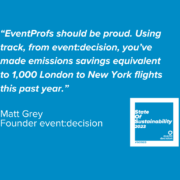
“Sustainable event planning is no longer an option but an imperative. It’s time to transform words into actions and take responsibility for the impact our events have on the planet and in society. Sustainable events are efficient events, so we’ll be able increase event ROI at the same time – push back to your clients & stakeholders.”

Matt Grey, Founder, event:decision

As event planners, we hold the power to make a significant impact on the environment and society through our actions. Sustainable event planning is no longer a trend but a necessity. While it’s easy to make excuses for not implementing changes, it’s crucial to recognise that these choices have far-reaching consequences. It’s time to turn our words into action and take responsibility for creating events that leave a positive legacy.
  1. Start with small steps – implementing sustainable practices may seem overwhelming, but the key is to start with small steps. Begin by evaluating your event’s impact on the environment and identify areas where improvements can be made. Consider elements such as waste management, energy consumption, transportation, and sourcing of materials. By making small changes in these areas, you can quickly build a more sustainable event.
  2. Collaborate with sustainable suppliers – event planning is a collaborative effort, and partnering with sustainable suppliers can make a significant difference. Seek out suppliers who prioritise eco-friendly practices, use renewable resources, and minimise waste. From caterers who source sustainable food choices to venues that prioritise energy-efficient systems, there are plenty of options available. By choosing responsible suppliers, you not only support their sustainable initiatives but also set a positive example for the industry.
  3. Educate and engage participants – sustainability is a collective effort, and involving event participants is crucial. Educate attendees about the importance of sustainable practices and inspire them to contribute. Encourage them to carpool or use public transportation to reduce emissions, provide recycling and composting facilities, and avoid single-use plastic items. Engage participants through interactive sessions, workshops, or nudges that encourage sustainable lifestyles and innovations. By creating an inclusive and environmentally conscious event culture, you can inspire long-lasting change.
  4. Embrace technology – technology offers a plethora of opportunities to reduce our ecological footprint. Embrace digital invitations and registration systems to minimise paper waste. Utilise event apps or virtual platforms to provide schedules, maps, and resources, eliminating the need for printed materials. There are tons of vendors in this area. Additionally, leverage technology such as our carbon footprint measurement tool track, to track and measure the environmental impact of your event, allowing you to make data-driven decisions for future improvements.
  5. Leave a positive legacy – every event leaves a lasting impact, and it’s essential to consider the legacy you want to create. Sustainable event planning involves minimising negative effects and maximising positive outcomes. Explore opportunities for social and environmental initiatives within your event. Partner with local charities, organise community clean-ups, or support causes aligned with your event’s theme. By leaving a positive legacy, you inspire others to follow suit and make a difference in their own events.
Sustainable event planning is no longer an option, a ‘wherever possible’, but an imperative. It’s time to transform words into meaningful actions and take responsibility for the impact our events have. And sustainable events are efficient events so prioritising this will result in increasing profits too – a win:win.  By starting with small steps, collaborating with sustainable suppliers, educating participants, embracing technology, and leaving a positive legacy, we can create a ripple effect of change throughout the event planning industry. Let’s make sustainability the standard for events and leave a lasting positive impact on the world, one event at a time.

If you’re interested in finding out more about the practicalities of sustainable event planning, you can use track  to calculate your own event’s projected carbon footprint. Please get in touch, we can give you a demo and show you some more sample reports to illustrate just what it could do for you.
https://eventdecision.com/wp-content/uploads/2023/05/zip.png 768 1024 eventdec https://eventdecision.com/wp-content/uploads/2022/07/mainlogo-ed.png eventdec2023-05-31 05:57:522023-06-12 13:08:18Let’s Ban ‘Wherever Possible’
event sustainability quote

Turning Measurement into Action on Event Sustainability #SOS23

May 23, 2023/in Track

event:decision is helping the events industry deliver on sustainability

Last week we released the findings of our first annual State of Sustainability report, the aggregated data from the hundreds of events and planners that are using our sustainability tool track to deliver more sustainable and efficient events. But simply measuring the carbon footprint of an event, while a crucial first step, isn’t enough. That measurement must then lead to action to reduce emissions impact.

“TRACK isn’t just about measurement – it’s about action too. Our aggregate data shows that in the last year we’ve helped the events industry save emissions equivalent to 1,000 London to New York flights”.

Matt Grey, Founder event:decision

The illusion of progress

Think about a chef who measures ingredients but then fails to use their skills to create a memorable dish. Or, a doctor diagnosing their patient’s illness but then not prescribing any treatment. In both those cases measuring, or assessing, without follow-up action is fairly ineffectual. The same applies to the measurement of a carbon footprint in the events industry. Measuring provides valuable insights into the environmental impact of an event, allowing event planners to identify the major areas of concern. However, without any accompanying action, measuring alone can create a dangerous illusion of progress. To use yet another analogy; a company that tracks customer satisfaction through surveys and questionnaires but doesn’t take the necessary steps to address any dissatisfaction, may feel they are doing enough by listening but will probably rapidly lose their customers.

Pre and post event measurement highlights action

Our sustainability tool track is unique (we believe globally), in that it allows for both pre and post event measurement which highlights exactly what action has been taken and the subsequent reduction in carbon emissions which have resulted. Findings from our State of Sustainability report across all the aggregated data revealed an impressive 8% average reduction in the carbon footprints of events using the tool. That’s between the footprint projected at the planning stage versus the final footprint of the actual event.

Action taken varies from event to event but typically includes:

  • Re-thinking the location of the venue to ensure sustainable travel options are available
  • Considering hybrid real and online options where appropriate
  • Planning accommodation choices carefully to maximise walking and public transport options
  • Offering sustainably-sourced food and a comprehensive waste and recycling plan on-site

Any or all of these choices, together with many other smaller decisions, can make a big impact on sustainability if factored in at the planning stage of any event, as the event planners who use our tool track have been able to demonstrate.

The results of taking action

That 8% average reduction across the hundreds of events that were planned using our tool is equivalent to 1,000 London to New York flights, or a whole two and a half day Europe-wide 450 delegate in-person conference with flights, transfers, accommodation, stage-set, AV and all food and beverage. Or, the same as filling up 3,576 London double deckers! All of which goes to show that when you move from measurement to action you really can make a big difference.

If you’re interested in finding out more about sustainable event planning, you can use track  – the tool used by the event planners in our report – to calculate your own event’s projected carbon footprint. Please get in touch, we can give you a demo and show you some more sample reports to illustrate just what it could do for you.
https://eventdecision.com/wp-content/uploads/2023/05/Event-Decision-quote-1.png 768 1024 eventdec https://eventdecision.com/wp-content/uploads/2022/07/mainlogo-ed.png eventdec2023-05-23 05:19:012023-06-12 13:08:27Turning Measurement into Action on Event Sustainability #SOS23
State of Sustainability

State of Sustainability 2023 #SOS23

May 16, 2023/in Track

event:decision launches an annual report on the state of sustainability in events.

At event:decision we’re now mid-way through our second year in business measuring the carbon impact of the event industry through our sustainability tool track. With unparalleled access to a wealth of hugely useful data from across the industry, the launch of an annual State of Sustainability report releases for the first time findings from the hundreds of events and planners that are using track to deliver more sustainable and efficient events.

SOS ’23 Findings

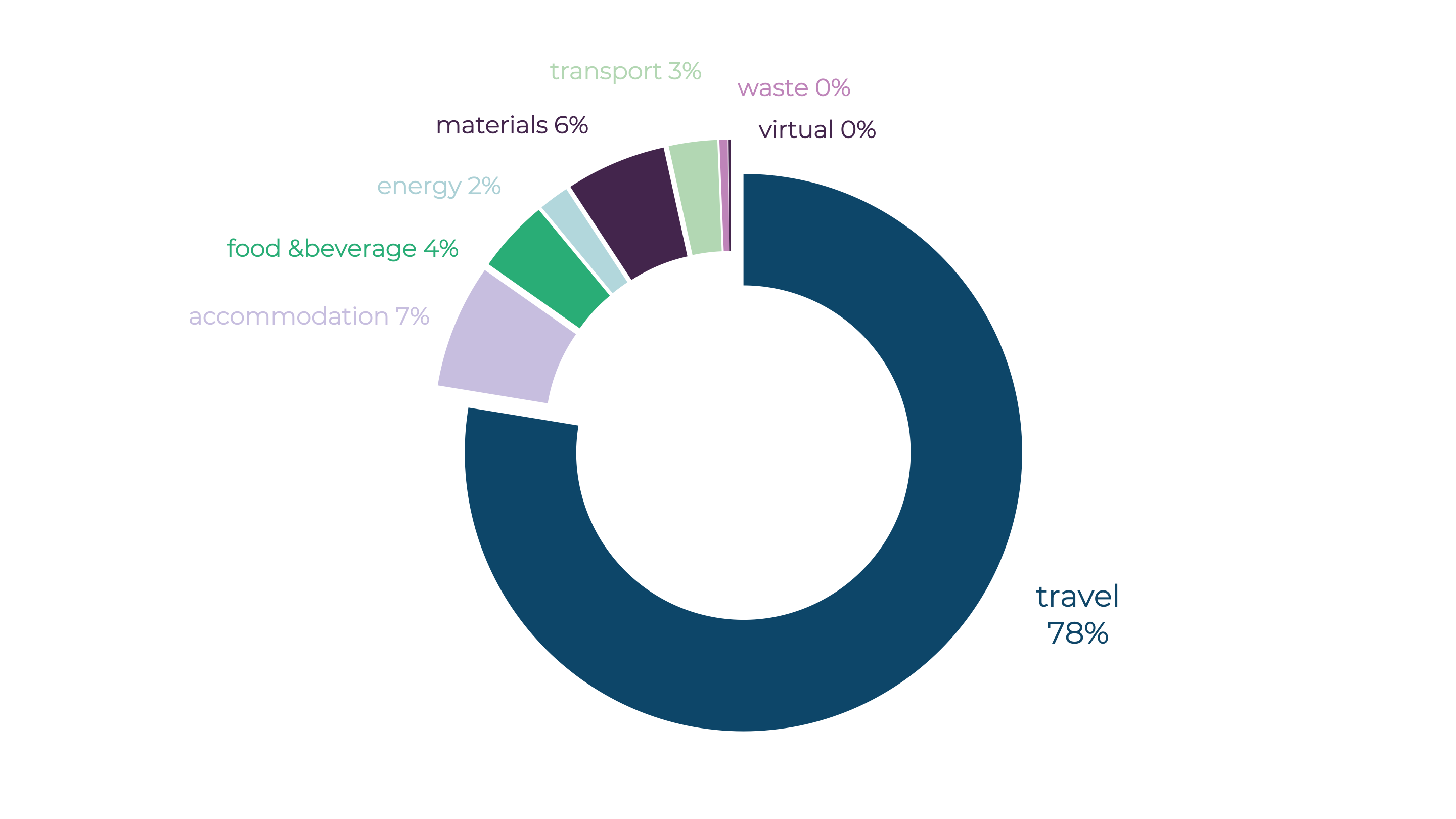
Data runs from April 2022 to May 2023 and shows an average event carbon footprint of 117 tCO2e. This is broken down into the key event components as follows:

State of Sustainability Report 2023

  • 78% of the overall footprint from travel
  • 7% from accommodation
  • 6% from materials
  • 4% from food and beverage

Of events reported on within this time period, 54% are UK events, and 46% elsewhere globally.  89% are in-person events, with 6% hybrid and 5% fully virtual.

NB Removing global events (with high flight emissions profiles) does not typically significantly alter the proportions of flights, accommodation, F&B, energy, materials, freight and waste.

Perhaps the most striking finding from the data however, comes in the comparison between pre and post event carbon footprints. Using track at the planning stage has empowered hundreds of event planners to make decisions which have resulted in a significant reduction in the climate impact of their event. As event:decision founder Matt Grey explains

“Our data shows that reductions in carbon footprints, through pre-event planning, range from 4% to 44% across agency portfolios. And the largest single-event mitigation was an impressive 95%”.

Matt Grey, Founder event:decision

What areas have the greatest impact?

Unsurprisingly, the data shows that there is a significant impact on emissions associated with getting to and from events, with travel accounting for an average of 78% of all events’ carbon footprints (we measure a large number of events with significant flight profiles). There are relatively small proportions associated with materials, freight and waste, however, which may come as a surprise to event planners.

Matt comments that the data highlights that event planners may be focusing their current sustainability efforts in the wrong places;

“It’s very easy to devote a lot of time and effort on factors that are visible at an event (badges, lanyards, menus etc) which, of course, we still need to do. It’s much harder though to devote significant effort to the mitigation of invisible factors, such as travel and accommodation, which affect the meeting format as a whole. But these are the areas which desperately need our industry focus.”

Matt Grey, Founder event:decision

Progress in sustainability is being made

It’s important to emphasise that huge progress is being made in sustainability for events. Only four years ago, just prior to Covid, no event specific carbon footprint measurement tools were available. Sustainability was a small section, if included at all, within brand event briefs, while very few venues were accredited to sustainability standards – in fact, few standards existed. Into this environment event:decision was founded in Mar 2021 with Net Zero Carbon Events following in Aug 2021. Matt comments

“A fundamental shift has started. Whether due to concern for climate change or fear of the brand risk associated with conspicuous consumption – change is happening. The next trick, is how to make it meaningful?”

Matt Grey Founder event:decision

So, armed with the knowledge from this data, what do event planners need to do? We suggest our seven point action plan, which starts and ends with measurement.

A Sustainability Action Plan for event planners

  1. Measure – create a projected carbon footprint.
  2. Select destinations carefully (think ‘access’)  – plan with travel in mind, event:decision can accurately predict travel footprints for specific venues and destinations and compare them.
  3. Select venues carefully (think ‘power’) – using renewable venue power makes a significant difference.
  4. Consider F&B – move away from meat where you can (especially beef), it makes a difference to the F&B element, if not a hugely significant one to the event as a whole.
  5. Use local supply for kit & crew (not just for transport mitigation, but crew accommodation and subsistence also).
  6. Build stands locally – using local materials and labour.
  7. Measure – post event, measure the projected carbon footprint to demonstrate your savings.

This is the first of our State of Sustainability reports and we will be using these annually to track how we are performing as an industry. The timing is significant as just on the horizon is the Corporate Sustainability Reporting Directive (CSRD), an EU directive requiring large and listed companies to publish regular reports on the social and environmental risks they face, and on how their activities impact people and the environment. It is EU legislation but will affect all companies of a significant size operating in the UK. Measurement will become even more important in order to accurately report progress in sustainability.

“There is no way to tell how well you are doing unless you measure!”

Matt Grey, Founder event:decision

If you’re interested in finding out more about sustainable event planning, you can use the carbon footprint calculator track  – used by the event planners in our report – to calculate your own event’s projected and actual carbon footprint. Please get in touch, we can give you a demo and show you some more sample reports to illustrate just what it could do for you.

https://eventdecision.com/wp-content/uploads/2023/05/State-of-Sustainability-.png 768 1024 eventdec https://eventdecision.com/wp-content/uploads/2022/07/mainlogo-ed.png eventdec2023-05-16 11:00:312023-05-16 15:26:43State of Sustainability 2023 #SOS23
sustainability

The Events Industry Can Lead the World in Sustainability

May 10, 2023/in Track

The events industry has lagged but now has the chance to become a world-leading exemplar in sustainability

The events industry has been slow to engage with the issue of sustainability, but there are welcome signs of change. The COVID-19 pandemic provided an opportunity (albeit an unwelcome one) for the industry to take a step back and rethink how events are planned and executed, and to be more flexible and creative as a result. With a global focus on environmental impact, there is suddenly a real opportunity for the industry to transform itself to become a leading sector in sustainability.

Three key areas provide the key to unlocking best practices: reducing waste, reducing carbon emissions, and promoting sustainable actions.

Reducing Waste

One of the biggest challenges facing the events industry is waste reduction. Events generate large amounts of waste, including single-use plastics, food waste, and materials used in event production. To reduce waste, event organisers must focus on reducing, reusing, and recycling.

Reducing waste can be achieved through a range of strategies, such as sourcing local and sustainable materials, reducing the amount of packaging used, and encouraging attendees to bring their own reusable water bottles and coffee cups. Reusing materials, such as event signage and decorations, can also help to reduce waste, as can recycling materials such as paper, cardboard, and plastics.

Some events have already made big progress in reducing waste. The Glastonbury Festival in the UK has implemented a range of sustainability initiatives, including a reusable cup scheme, composting toilets, and a food waste reduction program.

Reducing Carbon Emissions

Another key area where the events industry can make a significant impact on sustainability is by reducing carbon emissions. Events generate large amounts of carbon emissions through travel, energy consumption, and event production. To reduce carbon emissions, event organisers must focus on reducing energy consumption, promoting sustainable transportation, and only then by offsetting emissions.

Reducing energy consumption can be achieved through a range of strategies, such as hosting virtual events where appropriate, either wholly or within a hybrid format. On-site things to consider include; using LED lighting on-site, reducing the use of air conditioning, and encouraging attendees to use public transportation or carpool to the event. Promoting sustainable transportation, such as cycling or walking, is a key part of helping to reduce carbon emissions.

Offsetting carbon emissions is another strategy for reducing the environmental impact of events (although not producing the emissions in the first place is always the preferred strategy). This could be initiatives such as investing in renewable energy, carbon capture (well-known as planting trees)), or supporting community projects that promote sustainability.

Promoting Sustainability

The events industry needs to not just pay lip service but actively promote sustainability, raising awareness of the importance of sustainability among attendees, suppliers, and partners. This can be achieved through a range of strategies, such as providing information on sustainability initiatives, offering sustainability training, and promoting sustainable products and services. Working with suppliers and partners to promote sustainability is also key, through initiatives such as sustainability clauses in contracts, supplier audits, and sustainability scorecards.

Social sustainability is an important aspect to consider – evaluating the impact of events on local communities and working to ensure that events benefit everyone involved.

For example, events can partner with local charities or businesses to provide opportunities for attendees to give back to the community. It’s also important for the events industry to consider the impact of events on the mental and physical well-being of attendees and your event staff – including those who serve your lunch and drinks, take away your rubbish and service your hotel bedrooms.

One major challenge in achieving sustainability in the events industry is the lack of standardised metrics and reporting. There is currently no consistent way to measure the environmental and social impact of events, which makes it difficult for companies and event planners to set goals and track progress. However, the United Nations has developed a set of sustainable development goals (SDGs) that provide a framework for sustainable development across a range of industries. These goals can be used to guide the events industry in developing sustainable practices. For example, SDG 12 focuses on responsible consumption and production, while SDG 13 addresses climate action.

The events industry has a long way to go to become a world-leading sustainability exemplar. However, by implementing sustainable practices in areas such as waste, the reduction of carbon emissions, and promoting sustainability, it can reduce its environmental impact and demonstrate its commitment to sustainability – showing other industries how it can be done.

If you’re interested in finding out more about sustainable event planning, our carbon footprint calculator – track – can calculate your own event’s projected and actual carbon footprint. Please get in touch, we can give you a demo and show you some more sample reports to illustrate just what it could do for you.

https://eventdecision.com/wp-content/uploads/2023/05/new-pic.png 768 1024 eventdec https://eventdecision.com/wp-content/uploads/2022/07/mainlogo-ed.png eventdec2023-05-10 06:00:022023-05-09 18:47:19The Events Industry Can Lead the World in Sustainability
Sustainable Event Food

What you’re getting wrong about sustainable event food

May 3, 2023/in Track

When considering sustainable event food there are plenty of pitfalls. Plan your sustainable food choices carefully.

When planning a sustainable event the menu and catering are amongst the most important elements. Food choices can significantly impact the overall carbon footprint of your event. And even though most of the industry is aware of this, there are still some pretty large pitfalls that event profs can fall into if we don’t educate ourselves about the wider implications of our choices. We’ve come up with four areas that we think every event organiser needs to consider carefully;

1. Eat local?

‘Eat local’ is a mantra often repeated by those looking to enhance sustainability, whether for individual lifestyle choices, or for an event, with ‘buy local’ a frequent recommendation to reduce the carbon footprint of catering.

But, from an emissions perspective, ‘buy local’ can be one of the most misguided pieces of advice. Yes, buying and eating food from local suppliers is great for the local economy but actually the transportation of food tends to account for a relatively small share of its overall greenhouse gas emissions. You may be surprised to know that the food grown in the UK for UK consumers can actually have a larger carbon footprint than the footprint of similar food grown overseas

That’s because agriculture in the UK tends to rely more heavily on energy-intensive inputs, such as fertilisers and machinery, which can significantly increase the carbon footprint of domestically produced food. In addition, many crops can only be grown during certain times of the year in the UK, and out-of-season production requires heated greenhouses or the use of artificial lighting to keep plants growing. All of this increases the energy consumption required to produce domestic food, thereby increasing its carbon footprint.

While importing food from overseas may require transportation which contributes to the carbon footprint, it is often more energy efficient to transport food that isn’t a product of energy intensive agricultural practices over long distances in bulk by ship or rail, than by individual trucks for local or regional distribution. Surprised? It might be time to take a look at exactly where your food is coming from.

2. The menu

Bearing in mind the above and with seasonality and sourcing in mind, you should certainly try and choose your ingredients carefully to try and minimise your event menu’s carbon impact. You probably already know that beef has a high carbon impact, followed by lamb, farmed prawns, pork, poultry, fish (both farmed and wild catch). The debate about whether to go fully vegetarian is alive and well in the European events’ market and it’s a choice that’s very much down to you and your event. But for pure sustainability a vegetarian menu probably can’t be beaten.

Companies like Klimato are working with venues such as Exclusive Collection to add food impacts to event menus to help your guests make more informed decisions and to emphasise the thought that has gone into planning the menu.

3. Cutlery, crockery and glasses

According to estimates, England uses 2.7 billion items of single-use cutlery — most of which are plastic — and 721 million single-use plates per year, with only 10% of these recycled. To give you an idea of the scale, if 2.7 billion pieces of cutlery were lined up they would go round the world over eight and a half times.

The UK Government is banning single-use items completely from October 2023 (that’s a mere five months from now). But what materials should you be thinking about using instead? It isn’t as simple as just not using single-use. Your choice of material actually comes down to how often you think your items will be reused. To minimise your event carbon footprint the following calculations might be useful:

  • Use glass plates and bowls if they will be reused at least 15x
  • Use stainless steel plates and bowls if they will be reused at least 24x
  • Use ceramic plates and bowls if they will be reused at least 118x

4. Food waste

Drinks, snacks and tea and coffee breaks are a central feature of any event as they allow your guests to network and mingle as well as giving event organisers a bit of a breathing space to ensure everything is running smoothly. Unfortunately, because of their ubiquity, it often means events are over-catered. That means a lot of food waste. In the UK it’s estimated there are about 10 million tonnes of food waste generated annually. The average event actually wastes around 15%-20% of all the food, contributing significantly to its carbon footprint. and of course it’s a significant part of the overall event budget – wasted.

How can you minimise food waste, yet ensure your guests get a good choice of food and refreshments? Companies such as Olio can help by using food waste post event. And chefs are becoming far more adept at using ‘all-of-animal’ and vegetable offcuts which previously would have been binned. So, involve your chefs in your sustainability planning and get their input on what’s possible.

If you’re interested in finding out more about sustainable event planning, our carbon footprint calculator – track – can calculate your own event’s projected and actual carbon footprint. Please get in touch, we can give you a demo and show you some more sample reports to illustrate just what it could do for you.

https://eventdecision.com/wp-content/uploads/2023/05/Sustaianable-Event-Food.png 768 1024 eventdec https://eventdecision.com/wp-content/uploads/2022/07/mainlogo-ed.png eventdec2023-05-03 07:50:392023-05-03 07:55:59What you’re getting wrong about sustainable event food

More News

  • The State of Sustainability in the Event Sector: A Responsible PerspectiveNovember 4, 2025 - 6:40 am
  • Sustainability is not the new normal…October 13, 2025 - 10:35 am
  • Business Travel Growth ForecastOctober 7, 2025 - 9:20 am
  • Better by designSeptember 23, 2025 - 9:00 am
  • Introducing ‘Factor-30’ BenchmarkingSeptember 5, 2025 - 1:50 pm
  • Sustainability in focusAugust 26, 2025 - 9:00 am
  • Region watch: US & EMEAAugust 12, 2025 - 9:00 am
  • Every story has a number, every number has a storyJuly 22, 2025 - 9:00 am
  • Who should pay for sustainable events?July 8, 2025 - 9:00 am
  • 1st & 2nd Quarter 2025 – Sustainability ReviewJune 24, 2025 - 9:00 am
  • The end of sustainability? Errr….nope.June 4, 2025 - 10:35 am
  • Hoteliers…win more MICE businessMay 27, 2025 - 12:04 pm
  • About Us
  • Partners
  • Resources
  • Client Login
  • Create An Account
  • Track
  • Impact
  • Navigator
  • Evolve
  • Tel: +44 (0)333 202 6985
  • Email: hello@eventdecision.com
© Copyright 2024 Event Decision | Privacy Policy
  • LinkedIn
  • Instagram
Scroll to top