Credibility can’t be bought. But you can earn it.

Buy the badge. Join the scheme. Add the logo to the deck. Sponsor the award. Put “passionate about sustainability” in the bio and let the halo do the rest.
It doesn’t work like that. Credibility isn’t a purchase. It’s a balance you build up slowly and lose in an afternoon. And the only currency that pays into it is evidence.
LinkedIn’s 2025 B2B Marketing Benchmark found that 94% agree that trust is the most important factor in achieving B2B brand success.
The good news is that evidence is earnable. Here’s how.
The say-do gap
Ask almost any organisation whether sustainability is a top priority, and the answer is yes. Survey after survey says the same thing: it’s on the board agenda, it’s in the values statement, it’s “central to how we operate.” Stated intent has never been higher.
Then look at what actually gets measured.
That’s where the gap appears. Across the events we’ve measured and benchmarked with Impact and Track, the pattern is stubbornly consistent: the thing everyone says matters most is the thing fewest people can put a number against.
In carbon terms it’s Travel, that much is well-known. Travel is by far the largest slice of nearly every event footprint we calculate, routinely 70% and not rarely above 90% – is the category most often left unmeasured, unmanaged and unmentioned in the post-event report. Organisations declare the priority; the data shows the priority hasn’t reached the events floor yet.
This isn’t an accusation. It’s an opportunity. Because the gap between what organisations say and what they can show is precisely the space where credibility is won.
If everyone is claiming priority and almost no one is producing proof, then proof is the differentiator.
Credibility is a metric, not a mood
A pledge is…well ask any politician how many pledges are kept. A score is a fact. The difference matters because your clients have stopped accepting words and are looking for deeds.
The questions coming down the line are harder than they were even two years ago. Not “are you sustainable?” -mwhich invites a yes – but “show me.” Show me the number. Show me how this event compares to my last one. Show me how it compares to everyone else’s. Show me what you’d change, and by how much it would move.
You cannot answer those questions with a badge. You can answer them with metrics and outputs. That’s what Impact was built to produce.
What Impact actually puts on the table
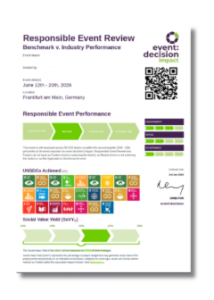
Impact assesses an event against 30 defined criteria spanning all three ESG pillars – environmental, social and governance – and turns them into things you can hand to a client without flinching:
A benchmark, because a score in isolation is meaningless. Impact compares your event against the wider event industry, against your sector, against your event type – so “good” stops being a self-assessment and starts being a relative, defensible position.
A gap analysis, because credibility isn’t claiming you’re perfect; it’s knowing exactly where you aren’t, and saying so first. The highest-priority improvements, named and ranked.
An SDG view, with every factor now mapped to the UN Sustainable Development Goals and shown by event – so you can tell a client not just how you scored, but which of the world’s seventeen agreed goals each choice advanced. That’s the language their board and their delegates already use.
And increasingly, a Social Value Yield – a real number against the “S” in ESG that most events leave entirely unclaimed, where credible programmes are generating value worth 10–30% of budget and simply not counting it.
Those are outputs. They’re comparable, repeatable and external. They survive scrutiny because they were built to be scrutinised.
Outputs beat intentions, every time
Here’s the quiet test of whether something earns credibility: could a sceptic check it?
Intent fails that test instantly. A logo fails it. A certificate that describes how a building was constructed tells you nothing about how your event ran inside it. But a per-event score, benchmarked against peers and traced back to source data, holds up – because the sceptic can check it, and it still stands.
That’s also why measurement beats accreditation as a credibility strategy. Accreditation tells the world you cleared a bar once. Measurement tells the world what happened this time, and the next, and the time after that. Credibility compounds through repetition, and only measurement repeats.
Track keeps the carbon side honest
On the environmental pillar, Track is the reality check. It produces the carbon footprint without the data-entry burden that stops most agencies before they start – which matters, because the say-do gap is, more than anything, a measurement-effort gap. People don’t avoid the number because they don’t care. They avoid it because it’s been hard.
Remove the friction and the evidence appears. And the evidence Track produces tends to tell organisations the uncomfortable, useful truth: that the footprint they assumed was about materials and waste is actually about travel, and that the lever they’ve been pulling isn’t the one that moves the number. That’s not a comfortable finding. It is a credible one – and credible beats comfortable every time you’re in front of a client who’s done their homework.
Earn it, one measured event at a time
Credibility can’t be bought because it was never for sale. It’s the accumulated weight of evidence you’ve been willing to produce, publish and be judged against – event after event, score after score, gap honestly named and then closed.
So if sustainability really is a top priority, prove it the only way that counts.
Measure the event. Benchmark it. Show the gaps. Put a number on the value. Then do it again.
That’s not a badge. That’s a track record. And a track record is the one thing nobody can buy out from under you.