It all matters, but some matters more.
Event carbon, without the spreadsheet, for the professional event planner…
Most conversations about a conference’s carbon footprint start with the water bottles. The water bottles are one-tenth of one per cent. Here is where the footprint actually sits – and the handful of decisions that genuinely move it.
If you have ever sat in a sustainability briefing for an event, you will recognise the shape of it. Someone raises reusable cups. Someone else asks whether the delegate bags can be made locally. There is a long and sincere discussion about recycling bins, and everybody leaves feeling that something has been done.
None of this is wrong, exactly. It is just wildly out of proportion to the thing being discussed.
We modelled a fairly ordinary event: a two-day conference, 500 delegates, one overnight, single venue, and around 40% of the audience flying in. The whole thing comes out at roughly 120 tonnes of CO₂e – about what fifteen people in the UK are responsible for in an entire year. Here is how it splits.
Where 120 tonnes actually sits
Modelled two-day conference · 500 delegates · UK venue
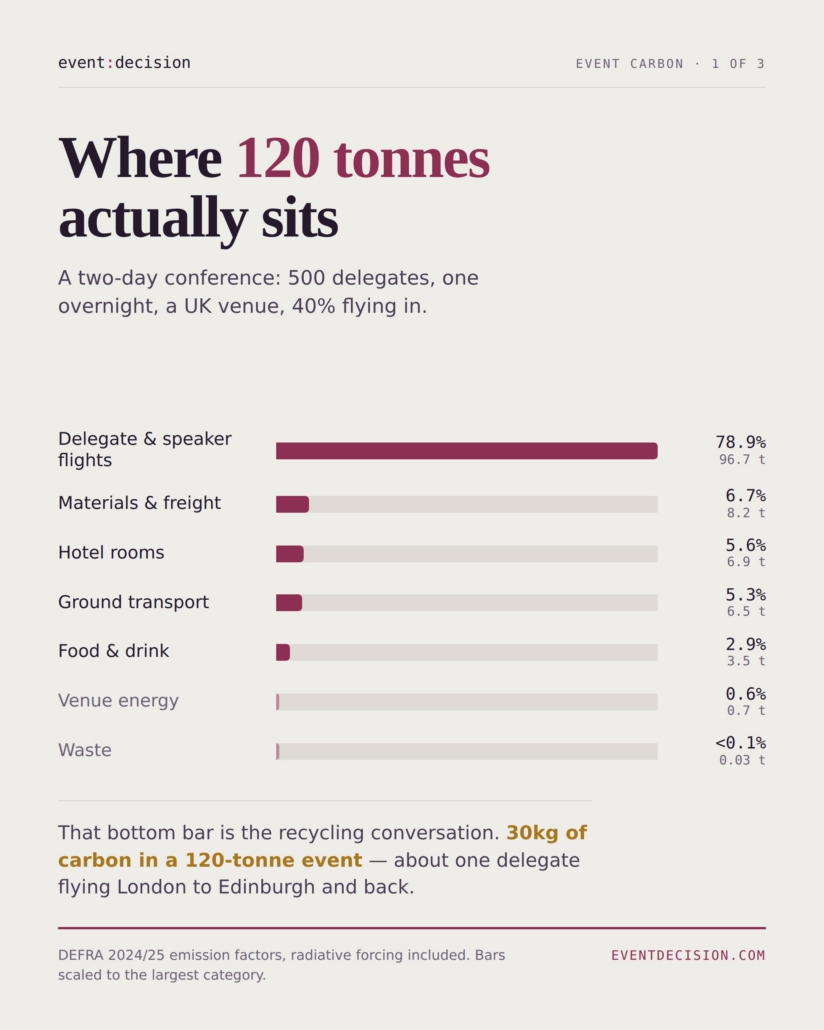 Calculated on DEFRA 2024/25 emission factors. Bars are scaled to the largest category; waste is shown at a minimum width so it remains visible at all.
The useful question isn’t “what’s big”
Knowing that flights dominate is the easy half. The harder and more useful question, if you are the person actually gathering data for a footprint, is: how much detail do I need before the number stops changing?
Because that is where the real cost sits. Chasing a delegate-by-delegate breakdown of who drank which coffee is days of work for an answer that does not move. Meanwhile a single unasked question about flight bookings can shift the total by 40%.
The rule is simpler than it sounds. Detail pays off where the range inside a category is wide — not where the category is large. A category can be enormous and still need only rough data, if everything inside it emits at roughly the same rate. And a small category can demand precision if the options inside it differ by a factor of twenty.
Three questions clear that bar comfortably.
1. Who flew, from where, and in which cabin
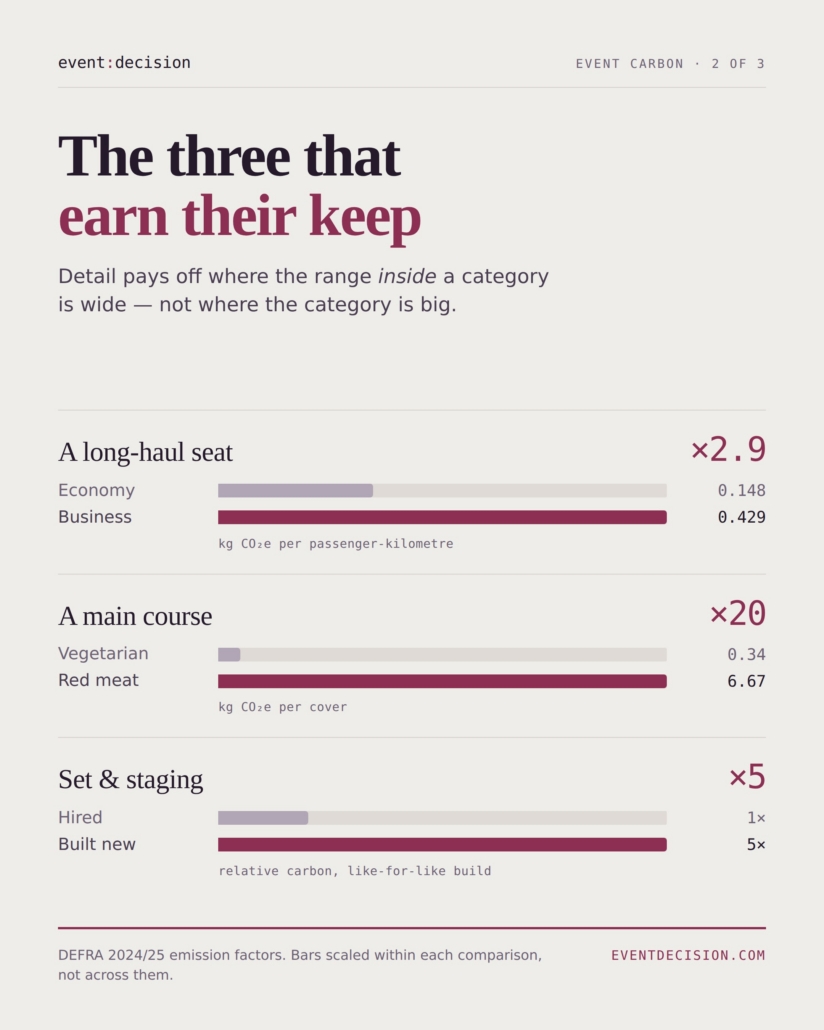
A business-class seat takes up roughly three times the aircraft’s fuel per passenger that an economy seat does, because it takes up roughly three times the floor. In our modelled conference, twenty long-haul delegates turning left instead of right adds 73 tonnes – more than half the footprint of the entire event, from a booking decision nobody thinks of as environmental.
So flight data needs to be person-level, or at least route-and-cabin level. What it does not need is precision about airports. Getting the exact terminal pairing rather than a city estimate changes the answer by a percent or two. Getting the cabin wrong changes everything.
2. What was on the plate
Food and drink is under 3% of this event, which surprises people who have been told to feel bad about catering. But the range inside it is the widest of any category on the list: a red-meat main course carries roughly twenty times the carbon of a vegetarian one. Swing the menu from beef-led to a standard 80/20 chicken-and-vegetarian split and the category drops from 8.8 tonnes to 1.9.
Which means all you need from catering is the protein split – how many meat, how many fish, how many vegetarian, per service.
Ingredient-level menus, provenance, food miles, organic certification: interesting, occasionally worth doing for other reasons, but essentially invisible in the number.
3. Whether it was built or hired
Set, staging, exhibition stands and branding are the second-largest category here, and the single biggest variable is not what they are made of but whether they already existed.
Hiring a stand and re-skinning it, versus fabricating one from scratch, is around a five-fold difference. Air-freighting it rather than sending it by road is another six-fold difference on the transport leg.
Both are decisions made early, by procurement, usually on cost and schedule grounds — which is exactly why they need to be visible before the contracts are signed rather than reported afterwards.
Worth knowing, second tier
Three more that matter more than you’d think
- Which country the hotel is in. A room-night in France is 7.7 kg; the same room-night in Australia is 41.8 kg. That is a six-fold spread driven entirely by the national electricity grid. The hotel’s star rating, by contrast, moves it by about a third – worth capturing, not worth arguing about.
- How many rooms were genuinely slept in. Assuming every delegate stays every night, when in fact 60% did, overstates accommodation by more than a third. Ask for the rooming list.
- Whether the venue is on a renewable tariff. This is a yes/no question that can zero out an entire category. It takes one email.
And what you can genuinely stop chasing
This is the liberating part. In a footprint of this shape, the following are all rounding errors, and collecting them to three decimal places is time you will never get back:
- Coffee, pastries and bottled water counts – about 1.6 tonnes across two days, roughly 1%. This can all be included empirically.
- Item-by-item AV power draw. A full 60kW rig over a two-day conference comes to 0.3 tonnes. event:decision will calculate this for you.
- Waste tonnage by stream. 0.03 tonnes. More on this below.
- Square metreage of every breakout room, and the exact courier distance for every individual delivery.
To be clear: waste still matters.
It is the most visible thing you do, it is what delegates and clients actually see, and it changes behaviour in ways that carry well beyond the event.
Just be honest in the reporting that it is a cultural win rather than a carbon one – otherwise clients spend their sustainability budget where it feels best rather than where it works, and nobody ever tells them.
One important caveat
Everything above describes one event shape: a conference with a meaningful fly-in audience. Change that and the order changes with it. A city conference drawing 90% of its audience from within city limits inverts the whole table – ground transport and materials become the swing factors, and flight precision stops mattering almost entirely. A gala dinner has a fraction of the accommodation and twice the catering intensity. An exhibition stand is mostly materials and freight from the start.
The method survives the change even when the ranking doesn’t. Work out where the wide ranges are for the event in front of you, spend your data-gathering effort there, and use documented defaults for everything else.
Three questions, asked early
- Which cabin are we booking, and for whom? The single largest lever on the largest category.
- Are we building this, or hiring it? Ask before the design is signed off, not after.
- What’s the protein split at each service? The catering team knows. It takes one line on the BEO.
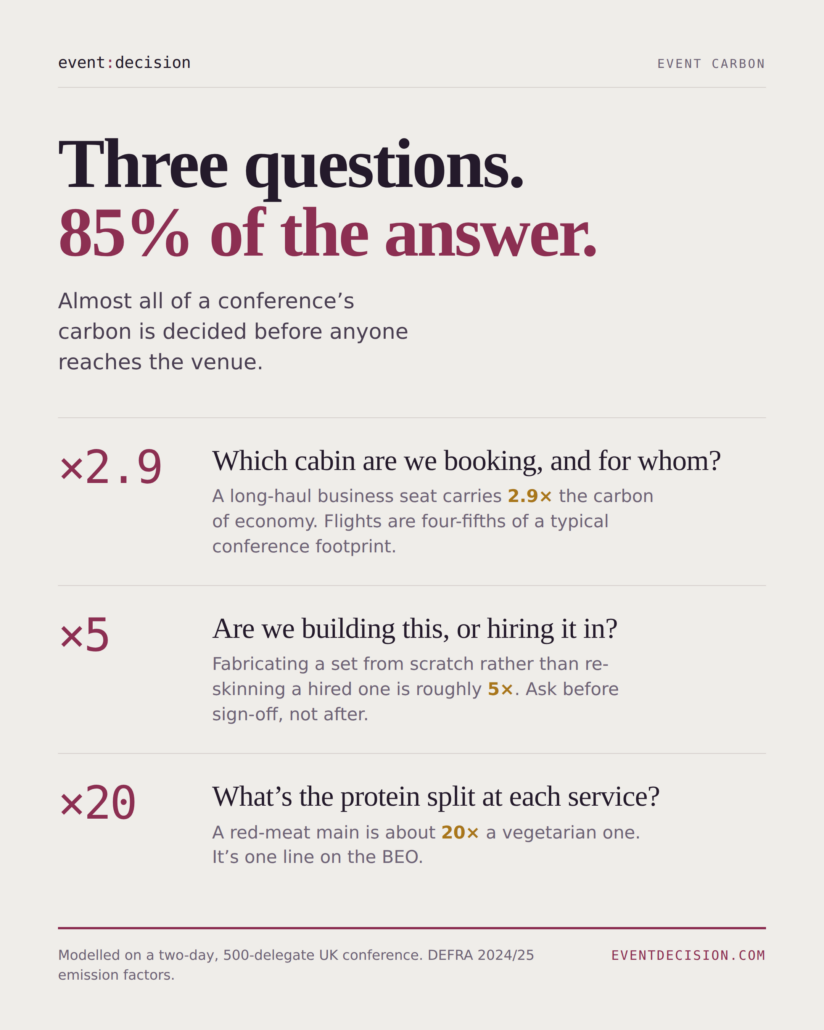
Get those three right, and you have roughly 85% of the answer – and, more to the point, you have it at the stage where you can still do something about it.
Figures throughout are modelled on a reference two-day, 500-delegate UK conference using DEFRA 2024/25 emission factors, including radiative forcing on aviation. They are illustrative of proportion and sensitivity, not a benchmark for any specific event.