event:decision
  • Home
  • Our Products
    • Track
    • Impact
    • Navigator
    • Evolve
  • About Us
    • Our Company
    • Clients
  • Resources
    • Quiz
    • Blog
    • Most Sustainable Agencies
  • Contact Us
  • Client Login
  • Search
  • Menu Menu
  • LinkedIn
  • Instagram

Beyond the big numbers

July 7, 2026/in event:decision, Impact, Third-party Content

The UK events sector is £68 billion big – but it is, first and last, a people business. Now we can prove both.

Matt Grey, event:decision  ·  written at The Business of Events

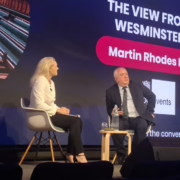
At The Business of Events Policy Forum today, MP Martin Rhodes gave the sector a clear, and I think correct, challenge. Keep using our big numbers – the UK Events Report put the industry at around £68 billion in November 2025, and figures like that earn us a seat at the table with government, Ministers and decision-makers.

But don’t stop there.

Tell stories. Because a number that big is impossible to feel, and the things that actually change minds – a minister’s, a corporate client’s, a finance director’s – are specific, human and evidenced.

He’s right. And the reason he’s right goes to what this industry actually is. Strip away the £68 billion and events is a people business: local suppliers hired, regional economies fed, crews paid, communities included, relationships built face to face. It always has been. What’s new is that we can finally put a number on the human value — the local investment, the fair pay, the social good – that was always the real product.

The big number proves scale. The people stories prove our worth. And now they’re measurable.

£68 billion tells a policymaker the events industry matters to the economy. It doesn’t tell your client whether the money they spent with you last quarter did any good beyond the room hire – whether it reached real people, in real places. For that, you need to look them in the eye and say something like this:

“The two events we’ve managed for you have generated $687,500 in social value.”

“92% of crew used in the last year were paid at or above a living wage – up 15% on the previous year.”

“64% of the events we managed took place in venues using renewable power.”

“100% of events in the last quarter had appropriate cancellation terms in place.”

“74% of your events included a nominated sustainability lead.”

“58% of your UK events redistributed unused food and drink to the local community.”

And then the line that turns a report into a relationship:

“…and here’s exactly how we plan to increase every single one of those metrics across your portfolio next year.”

That’s sticky.

Look closely and almost every one of those is a story about people and place. Living wage is a story about the freelancer on the build. Food redistribution is a story about the community down the road from the venue. Social value with a currency sign is the local investment your event made, counted. These aren’t soft claims — they’re specific, measurable, and told with a commitment to do better. A percentage that moved 15 points in a quarter is a story a CFO will repeat.

The £68bn earns attention. The people stories earn trust.

Local, regional, personable – and now demonstable

We’ve always sold ourselves on service: professional, personable, close to the client, rooted in the places we operate. The best agencies and venues invest locally by instinct – regional crews, nearby caterers, independent suppliers — because it’s good practice and good business. The problem was never the doing. It was that we couldn’t evidence any of it, so the most human, most valuable part of what we deliver stayed invisible on the balance sheet.

That’s what changes when the human value is quantified. Local hiring becomes a living-wage percentage. Regional spend becomes a social-value figure a client can report upward. Personable, professional service becomes a track record of outcomes rather than a promise on a pitch slide. Demonstration is now the differentiator: venues and agencies that can hand a client hard, comparable, audit-ready outcomes will win the work — and help their clients tell their own story to their own boards. Every other sector a client buys from already gives them that evidence. Events, the most human sector of all, is finally catching up.

How event:decision turns people-work into proof

This is the entire point of the Impact suite – to make each of those human story-lines a measured fact rather than a claim.

Impact: Event measures what a delivered event actually achieved for people and place – carbon, social value in pounds and dollars, living-wage coverage, food redistribution, sustainability leads, cancellation terms. It’s where the $687,500 and the 87% come from, event by event, then rolled up across a portfolio.

Impact: VenueLens moves the evidence upstream to the sourcing decision, comparing venues on their credentials – renewable power, local supply, accreditation – so “99% of events in renewable-powered venues” is a choice you make deliberately and prove afterwards, not a happy accident.

Impact: AdVantage for Av & technical production, turns that performance into a comparative advantage – benchmarking a client’s portfolio against the wider dataset, showing where they lead, where the next gain sits, and giving the account team the evidenced “here’s how we’ll improve every metric” narrative to put in front of the client.

Behind all three sits the data: more than 6,000 event ESG data points, from over 200 clients across agency, corporate, brand, venue, association and destination planning, measuring thousands of events a year across the US, EMEA and APAC – and every event decision mapped to the UN Sustainable Development Goals.

Use both numbers

So take Martin Rhodes’ advice – all of it. Keep saying £68 billion; it opens doors. But walk through those doors carrying the people paid fairly, the communities fed, the local money invested – and the plan to push each one higher. The macro number proves the sector deserves to be heard. The people’s stories prove it deserves to be trusted.

We’re a people business that can finally quantify what it does for people. Event planning and delivery behaviours are changing for the better — our job, and our clients’ opportunity, is to make sure that change is understood, measured, evidenced and, above all, told.

https://eventdecision.com/wp-content/uploads/2026/07/tboe-martin-rhodes.avif 597 966 Matt Grey https://eventdecision.com/wp-content/uploads/2026/04/mainlogo-ed.png Matt Grey2026-07-07 12:42:182026-07-08 12:10:17Beyond the big numbers

Hey venues! Buyers are losing faith in venues. Here’s how to win it back.

July 1, 2026/in event:decision, Impact, Third-party Content

Not our words.

The latest Cvent and Northstar Meetings Industry Pulse Survey (EMEA, May 2026) carries good news and a warning for M&E venues. Confidence is back: 43% of planners are more optimistic than they’ve been in a year, and 70% expect to run more meetings than last year. But dig into how planners rate the venues they’re working with, and the picture turns uncomfortable.

Satisfaction has fallen on almost every measure. Value for money is now the lowest-rated service of all, at 2.96 out of 5. Sales support, food and beverage, tech and AV, on-site production and sustainability have all slipped year on year. In short: demand is returning, but trust in what venues deliver is going the other way.

That’s the market Impact: VenueLens is built for.

Stop describing. Start proving.

When every venue’s ratings are sliding, every venue’s brochure sounds the same. Buyers have heard the claims before, and the numbers say they no longer believe them. Impact: VenueLens turns what your venue actually delivers into decision-grade intelligence – benchmarked against comparable spaces, evidenced across Environmental, Social and Governance. It’s the difference between telling a buyer you’re sustainable, safe and good value, and showing them a scorecard that proves it against your peers.


Escape the race to the bottom

Cost pressure dominates this survey. More than a third of planners say they’ll switch to lower-cost venues when budgets tighten, and value for money is where they’re least satisfied. Compete on rate alone and you lose. Impact: VenueLens gives you a different currency: the Social Value Yield (SaVY) of your proposition, which and how many UN SDGs you align with in your event and how well your sustainability infrastructure is used on that specific event.. This reframes the conversation from “cheapest room” to “most value per pound” – and, just as importantly, it arms the planner with the evidence to justify choosing you to their own boardroom, at a time when only 17% expect revenue to grow. Help buyers make their internal case and you become the easy “yes.”

Get your proof in early

The biggest structural shift in the survey is timing. Planners are now sourcing seven to twelve months out, and Cvent is clear that buyers are shortlisting on performance, not just capacity and rate. Longer lead times mean more scrutiny, earlier. A pre-event Impact: VenueLens review means your evidence is ready to drop into the bid before the buyer even asks – while your competitors are still scrambling to answer ESG questions late on.

More than carbon

Look beyond emissions and the survey rewards it. Duty of care and emergency planning is a rising concern, and health and safety is the factor buyers are most satisfied with – proof they care. Those are Social and Governance strengths VenueLens evidences directly, turning “we’re safe and well-run” into a benchmarked, audited score.

Demand is back. Trust isn’t – yet. The venues that win the next cycle won’t be the ones with the best story. They’ll be the ones with the proof.

Prove your performance. Make it the reason you win the business. Talk to event:decision about Impact: VenueLens.

https://eventdecision.com/wp-content/uploads/2026/07/faith.png 600 1080 Matt Grey https://eventdecision.com/wp-content/uploads/2026/04/mainlogo-ed.png Matt Grey2026-07-01 14:19:492026-07-02 07:33:16Hey venues! Buyers are losing faith in venues. Here’s how to win it back.

Credibility can’t be bought. But you can earn it.

June 29, 2026/in event:decision, Impact, Third-party Content


Buy the badge. Join the scheme. Add the logo to the deck. Sponsor the award. Put “passionate about sustainability” in the bio and let the halo do the rest.

It doesn’t work like that. Credibility isn’t a purchase. It’s a balance you build up slowly and lose in an afternoon. And the only currency that pays into it is evidence.

LinkedIn’s 2025 B2B Marketing Benchmark found that 94% agree that trust is the most important factor in achieving B2B brand success.

The good news is that evidence is earnable. Here’s how.

The say-do gap

Ask almost any organisation whether sustainability is a top priority, and the answer is yes. Survey after survey says the same thing: it’s on the board agenda, it’s in the values statement, it’s “central to how we operate.” Stated intent has never been higher.

Then look at what actually gets measured.

That’s where the gap appears. Across the events we’ve measured and benchmarked with Impact and Track, the pattern is stubbornly consistent: the thing everyone says matters most is the thing fewest people can put a number against.

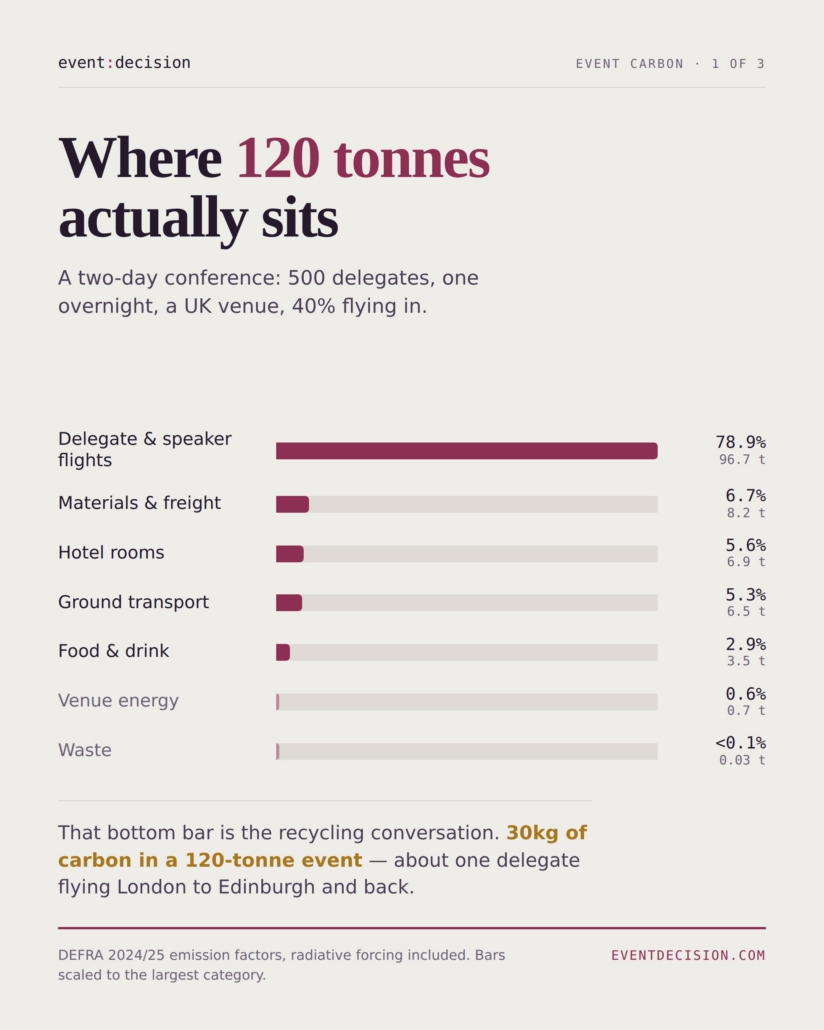
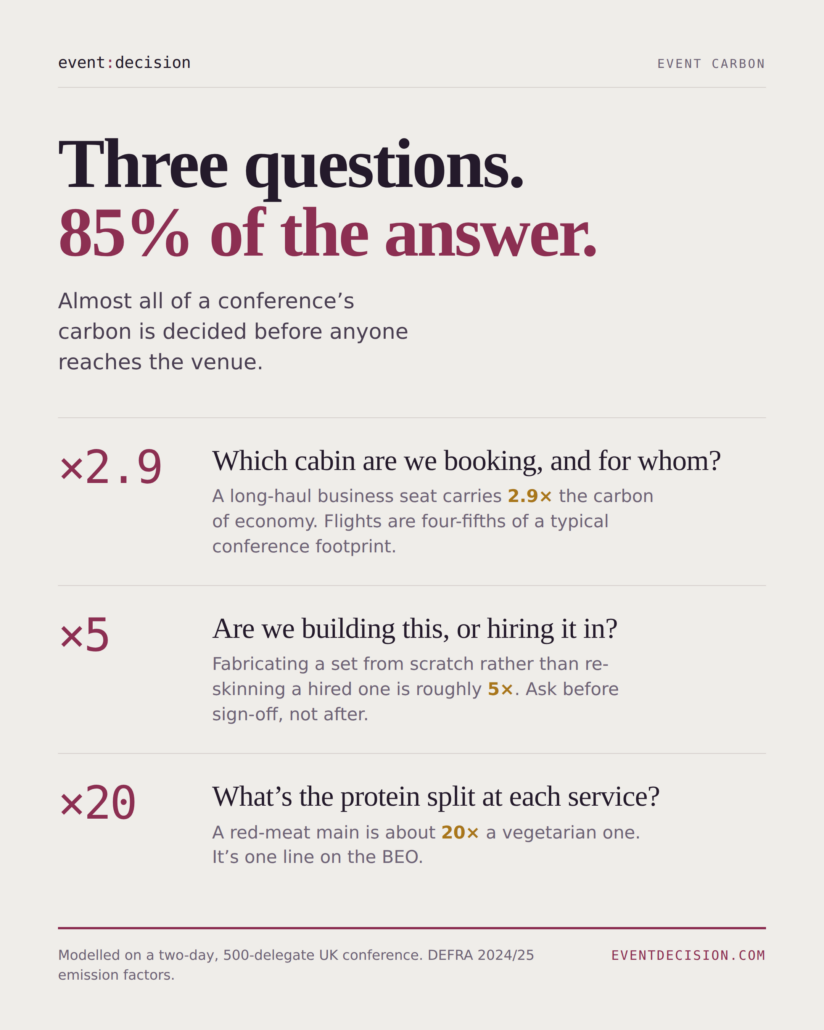
In carbon terms it’s Travel, that much is well-known. Travel is by far the largest slice of nearly every event footprint we calculate, routinely 70% and not rarely above 90% – is the category most often left unmeasured, unmanaged and unmentioned in the post-event report. Organisations declare the priority; the data shows the priority hasn’t reached the events floor yet.

This isn’t an accusation. It’s an opportunity. Because the gap between what organisations say and what they can show is precisely the space where credibility is won.

If everyone is claiming priority and almost no one is producing proof, then proof is the differentiator.

Credibility is a metric, not a mood

A pledge is…well ask any politician how many pledges are kept. A score is a fact. The difference matters because your clients have stopped accepting words and are looking for deeds.

The questions coming down the line are harder than they were even two years ago. Not “are you sustainable?” -mwhich invites a yes – but “show me.” Show me the number. Show me how this event compares to my last one. Show me how it compares to everyone else’s. Show me what you’d change, and by how much it would move.

You cannot answer those questions with a badge. You can answer them with metrics and outputs. That’s what Impact was built to produce.

What Impact actually puts on the table

Impact assesses an event against 30 defined criteria spanning all three ESG pillars – environmental, social and governance – and turns them into things you can hand to a client without flinching:

A benchmark, because a score in isolation is meaningless. Impact compares your event against the wider event industry, against your sector, against your event type – so “good” stops being a self-assessment and starts being a relative, defensible position.

A gap analysis, because credibility isn’t claiming you’re perfect; it’s knowing exactly where you aren’t, and saying so first. The highest-priority improvements, named and ranked.

An SDG view, with every factor now mapped to the UN Sustainable Development Goals and shown by event – so you can tell a client not just how you scored, but which of the world’s seventeen agreed goals each choice advanced. That’s the language their board and their delegates already use.

And increasingly, a Social Value Yield – a real number against the “S”  in ESG that most events leave entirely unclaimed, where credible programmes are generating value worth 10–30% of budget and simply not counting it.

Those are outputs. They’re comparable, repeatable and external. They survive scrutiny because they were built to be scrutinised.

Outputs beat intentions, every time

Here’s the quiet test of whether something earns credibility: could a sceptic check it?

Intent fails that test instantly. A logo fails it. A certificate that describes how a building was constructed tells you nothing about how your event ran inside it. But a per-event score, benchmarked against peers and traced back to source data, holds up – because the sceptic can check it, and it still stands.

That’s also why measurement beats accreditation as a credibility strategy. Accreditation tells the world you cleared a bar once. Measurement tells the world what happened this time, and the next, and the time after that. Credibility compounds through repetition, and only measurement repeats.

Track keeps the carbon side honest

On the environmental pillar, Track is the reality check. It produces the carbon footprint without the data-entry burden that stops most agencies before they start – which matters, because the say-do gap is, more than anything, a measurement-effort gap. People don’t avoid the number because they don’t care. They avoid it because it’s been hard.

Remove the friction and the evidence appears. And the evidence Track produces tends to tell organisations the uncomfortable, useful truth: that the footprint they assumed was about materials and waste is actually about travel, and that the lever they’ve been pulling isn’t the one that moves the number. That’s not a comfortable finding. It is a credible one – and credible beats comfortable every time you’re in front of a client who’s done their homework.

Earn it, one measured event at a time

Credibility can’t be bought because it was never for sale. It’s the accumulated weight of evidence you’ve been willing to produce, publish and be judged against – event after event, score after score, gap honestly named and then closed.

So if sustainability really is a top priority, prove it the only way that counts.

Measure the event. Benchmark it. Show the gaps. Put a number on the value. Then do it again.

That’s not a badge. That’s a track record. And a track record is the one thing nobody can buy out from under you.

https://eventdecision.com/wp-content/uploads/2026/06/credibility.png 600 1080 Matt Grey https://eventdecision.com/wp-content/uploads/2026/04/mainlogo-ed.png Matt Grey2026-06-29 11:36:492026-06-30 11:25:05Credibility can’t be bought. But you can earn it.

Is event planning a science or an art?

May 25, 2026/in event:decision, Impact, Third-party Content

Is event planning a science or an art?

There’s a long-running discussion in the industry that splits neatly down the middle. One camp insists event planning is an art – that the people who do it best work on instinct, simply create emotions within the room and craft moments of magic from a feel for narrative, design, and human energy. The other camp insists it’s a science – that great events come from logistics, measurement, frameworks, and discipline, and that the people who do them best are operations professionals who happen to work in marketing.

Both camps are right, of course. But neither is enough on its own.

The art case

The art is real, and it matters. A good event opens with a precisely judged silence; a great one ends with a moment guests are still talking about, perhaps years later. That doesn’t come from a checklist. It comes from creative direction, narrative instinct, an eye for room dynamics, and the kind of taste that takes a decade to develop. Events that win awards win them on these grounds.

Without the art, you have a meeting.

The science case

But art alone doesn’t get you to smooth, engaging events. Art alone doesn’t tell you whether your suppliers pay a living wage, whether your delegate travel mix is improving year-on-year, or whether your sustainability narrative is something you can defend in front of a client’s ESG team. Art alone doesn’t survive a Freedom of Information request from a sustainability journalist or a procurement question from a Fortune 500 buyer. For that, you need science: measurement, evidence, frameworks, repeatable methods.

We had a bit of fun recently – laying all of our responsible-delivery factors out in the style of the periodic table of elements. Ninety factors, three rows of thirty, colour-coded against the three ESG pillars. It looks the part. It is also, deliberately, a joke at our own expense – nobody is going to use a wall chart to plan a conference. But the chart makes a point that’s harder to argue with once you see it written out: there are ninety different things that quietly underpin a single sentence in a sustainability report. Carbon and travel. Power and lighting. Local supply chain and food approach. Locality and accessibility, wellbeing and fair pay. KPIs and risk assessment and named accountability and lessons learned. That’s the size of the science problem – across the whole event ecosystem.

Now both the art and the science can be measured.

But here’s the relief: no single person is running ninety decisions. The ninety divide cleanly into three sets of thirty, and which thirty you own depends on your role. An event planner owns one set. An AV or production supplier owns another. A venue operations or sales planner owns the third. If you’re any one of those people, you’re running thirty small decisions, not ninety. Which is a much more manageable science problem to start with.

Three lenses on the same event

The ninety factors don’t all sit with one team. They sit with three. event:decision’s Impact suite is structured as three lenses on the same event – each tool covering one of those three sets of thirty factors, each pointed at one function:

Impact: Event is the lens for the event itself. Carbon, attendee and crew travel, waste, food approach, biodiversity, locality and inclusion, wellbeing, legacy, KPIs and ROI, sustainability leadership, governance and accreditations. This is the tool for event organisers, in-house event teams, brand experience leads, and the agencies running events on their behalf. If you commission, design, or run the event, Impact: Event is for you.

Impact: AdVantage is the lens for the Technical Production and AV chain. Power and lighting specification, project carbon, vehicle movements, reusable build, subcontractor briefing, welfare provisions, local crew, fair pay, working hours, RAMS, compliance documentation, named accountability. This is the tool for production agencies, exhibition contractors, AV suppliers, stand builders, freight and logistics partners – the people who turn the brief into a physical reality. It gives suppliers a structured way to evidence what they’ve done, and gives organisers a clear standard to procure against.

Impact: VenueLens is the tool for the venue. Mass transport access, renewable energy, water management, single-use plastics, F&B approach, delegate accessibility, venue fair pay, inclusion hiring, community projects, surplus distribution, public reporting, supplier due diligence, ESG targets. This is the tool for venues themselves – operators, conference centres, hotels, stadiums, exhibition halls. It lets venues show with evidence what they actually deliver, and gives organisers a like-for-like way to compare venues at the procurement stage.

Why three tools, not one

Because both spend and responsibility in events don’t sit just with one party. The event organiser commissions and pays for the show. The suppliers and agencies deliver it. The venue hosts it. Each controls a different slice of the impact picture, and a single tool aimed at any one of them would miss most of the footprint.

Between them, the Impact suite covers approximately 98% of event spend – the client commission, the supplier delivery, and the venue cost together account for nearly every pound that flows through an event. The remaining 2% is the long tail of incidental costs that, even if measured, would not materially change the conclusion.

So — science or art?

Both. Always both.

The art is what makes an event worth attending. The science is what makes it responsible and sustainable. The art delivers the moment of magic in the keynote, the goosebump from a perfectly cued lighting state, the gasp at the reveal. The science delivers the carbon report your client’s CFO can put in their annual filings, the accessibility statement your delegate community can trust, the legacy figure your sponsor can quote to their board.

You don’t choose between them. You do both – or you fall behind the audiences, the clients, and the regulators who increasingly expect both.

And it turns out that both looks a lot like thirty small decisions for the planner, thirty for the supplier, thirty for the venue – and ninety in total across an event that used to run on instinct alone.

Get in touch at hello@eventdecision.com.

https://eventdecision.com/wp-content/uploads/2026/05/artorscience.png 600 1080 Matt Grey https://eventdecision.com/wp-content/uploads/2026/04/mainlogo-ed.png Matt Grey2026-05-25 18:59:182026-05-25 18:59:18Is event planning a science or an art?

Answers to your own questions (yes, really…)

May 18, 2026/in event:decision, Event:Decision Content, Third-party Content

At the Event Industry News Sustainability Breakfast, in April 2026, as expected, the panel ran short of time answering audience questions.

As promised, we asked panel to come back with their thoughts to every question posed.

Here are the panel’s responses.

  • Matt Grey Founder & Director at of event:decision
  • Chrissie Beck, Founder & Sustainability Director at Worlds Better
  • Aarron Mcgurk, Culture & Operations Lead at agency Chorus, now part of Brands At Work.


What if your client isn’t really interested in sustainability?

Matt:    If the commercial sense, optics and audience engagement metrics on a sustainable experience are not enough, it’s entirely your choice as to whether you want to work with that client?

Chrissie: Try to understand your client’s goals and objectives and then tweak your response to speak their language. Try to influence their decision by explaining the strategic importance of sustainability (whether that’s brand differentiation, reputation management, risk mitigation, ROI, cost efficiencies) – depending on their role and goals. Explain that there’s an expectation now that events are delivered sustainably. This isn’t a ‘nice to have’ anymore, it’s a strategic necessity.

Aarron: Sustainability doesn’t have to be an add on, you and your business can still operate sustainably. This would mean the operations in Scope 1 and 2 (which are controlled by you) can still be done sustainably with out needing client buy in.


What’s your take on “greenwashing”? Too many people act to look good in public, but have very little or no positive impact.

Matt:    I think this is a valid point, and applies to all channels, not just events. Legislation is coming on Green Claims, but I suspect despite a lot of noise, that few events will be impacted.

Chrissie: Like Matt has said there’s a new piece of legislation coming in September 2026 (Empowering Consumers for the Green Transition Directive/ECGTD) that has been developed to eliminate greenwashing. You won’t be able to claim you have ‘delivered a sustainable event’ or are a ‘sustainable supplier’ without having robust data or (audited) certifications to back it up.

Aarron: I don’t come across greenwashing that much to comment. Which could be positive?


For venues with low budgets where there isn’t resource for measurement, consultancy, certification, training & where management say no due to cost. What do you do?

Matt:    Measurement or certification by an external party will cost money, of course. But you could start by simply counting the number of meetings & events at which you deliver sustainability service a, b or c, and demonstrate this as a % of your portfolio?

Chrissie: There are a lot of (free) resources and tools available online that you can investigate (SDG’s, SME Climate Hub, event:decision, Greengage, isla, Sustainable Event Guide etc) – these might include industry white papers, toolkits, webinars – educate yourself to understand what makes sense for you to focus on first and start there. Also keep coming to events like the Sustainable Events Lounge to meet others in your position and hear what they’ve done! Worth noting to management that you’re likely losing business to other venues that have solid sustainability strategies/credentials.

Aarron: This sounds like there is not much wriggle room. It might be that your only choose is to make some positive steps independently which could be small for now. Things like a roster of equipment and energy ratings, how often appliances like dishwashers run and how much water is used and start to build these things as a business case to take to management eventually and try and get buy in then.


You asked before who was responsible for calling out supplier claims that may not be true. My question is how we can do that robust verification as an agency?

Chrissie: As part of your procurement process you should be conducting supplier assessments when you start working with them (check their documentation & commitments). When you work with them conduct regular reviews of their services and progress towards their targets – this may need to include on site audits of their facilities, or of them delivering services for you on site to check they are doing what they claim. The reality is; as an agency you are responsible for your supply chain. You should have processes in place to assure your suppliers are verified.

Aarron: Less about calling out and more about bringing in and alongside. Work closely with procurement and specifically obtain evidence of claims e.g. full policy or certificate. After review of these which can be a bi monthly cadence you can either rank suppliers and change approach or meet with them to see how things are developing.

Matt:    Some agencies we work with deliver just this. Gathering certifications and metrics on delivery at project-by-project level. If you’re a client or agency, using Impact: AdVantage and (shortly) Impact: VENUEmark will aid this process greatly.


What do you think is the best way to educate clients about sustainability before starting event planning?

Aarron: Use their orgs ESG statement and create approach to helping the marketing or other department align with the overarching goals, include in pitches etc. Explain how you are solving their problem with the event you are producing at the same time how the way you work aligns them with their own ESG. Sort of flipping it on the head a bit.

Matt:    Embed a measurement, benchmark or certification within your process. Likely you won’t have time to deliver education to clients on each & every project?


Would love to hear panel’s thoughts on getting the ‘badge’ and progress then slowing down. Is that true?

Matt:    I mentioned this in the keynote. There is evidence that the achievement of higher-level accreditations (gold, silver, bronze level etc.) is not increasing amongst the agency sector. See the Most Sustainable Agencies 2026 campaign. I would say there is evidence of increasing numbers of accreditation across the agency sector, yet less evidence of associated behavioural change in event outcomes.


What do you think is the biggest current challenge in the events industry regarding sustainability?

Matt:    Understanding that sustainability is a growth and resilience driver, not a cost-center


The problem is you all assume everyone thinks like you. Insulting everyone who doesn’t won’t help your cause.

Matt: I’m sorry if you feel insulted. If you would like to put forward an alternative view of sector behaviour in sustainability please get in touch separately & we’ll be glad to give you a platform?

Aarron: I hear you, the session was a little less 101 this time around – with some more advanced thinking. Our intention was to shake things up a little to make the sessions more engaging and offer more value, please do reach out to us for more help and resources that could match where you are on your journey.


What’s happening with recycling? It seems hotels and venues have regressed since Covid. Shouldn’t guests have multi-colored bins in their rooms.

Matt:    Not an area of expertise for me, but one hopes that bedroom waste is streamed at contractor level within the process & that separation of streams at a bedroom level is not cost effective.

Aarron: Recycling is a bite archaic now and invisible. As Matt said its happening at service level, e.g. first mile sorting center. Its quite hard to know exactly what makes it through the process especially when some types of packaging are not washed or bagged incorrectly.


If you had a magic wand, what is one thing you would like to see change, or be implemented in 2026/2027?

Matt:    Opening the eyes of event sales and account directors that they can use existing tools to drive new and retain business.

Aarron: Slow down! Making travel part of an experience.


Where does human sustainability stand in your business and for your clients?

Matt:    A vital part of the responsible event mix, I believe the S in ESG is hugely underplayed and under-reported.

Aarron: Front and centre. Its People, Planet, Partners & Profitability. People kind of top of the hierarchy but it is a blend. We can do anything if the people aren’t trained, rested or understood.


Is [the above] in conversations and being actioned for clients and your internal teams?

Matt:    Not as much as it should be, suspect it is an expected function of event supply. The tools are ready for you to start quantifying Social Value.


In a smaller company it can be harder to make sustainable choices when you’re working on tight financial boundaries, esp from Senior management.. any advice?

Matt:    There’s always an easier and cheaper way to do things. Ultimately it’s up to you to be accountable for the product you want to deliver. I would challenge whether margins are necessarily tighter in a smaller company than a larger one – overheads can be fewer in smaller entities.


Is it wise to assume everyone shares your perspective on sustainability or what it looks the same to them? If prescription doesn’t work, what would you suggest?

Matt:    Sustainability perspectives differ as much as views on any subject, but there does appear to be a direction of travel.  If prescription doesn’t work, probably best to engage in constructive dialogue. Not all suppliers and clients are meant for each other? That said, many of the decisions in event sustainability align strongly with commercial decisions, so you may be delivering some pretty good outcomes already?


Sustainability is a matter of culture. How can we influence decision makers to see sustainability as an added to our offer?

Matt:    I think sustainability and responsibility is more than culture, it’s a proposition and a function of the service or product you offer. It’s hard to argue against delivering a responsible product and demonstrating so, with tools such event:decision’s Impact.


You mentioned food leftovers during the events. Many clients don’t allow bringing food to anyone due to potential issues. Is there any way to work around this?

Matt:    Yes. Professional (whether charity or for profit) organisations that deliver food redistribution service should have indemnity policies, ask them, this hurdle has been overcome many times.


As a venue, especially without budget for formal tools or consultancy, how do you realistically measure sustainability and track progress?

Matt:    Measurement or certification by an nexternal party will cost money, of course. But you could start by simply counting the number of meetings & events at which you deliver sustainability service a or b and demonstrate this as a % of your portfolio?


The new 20211encourages us to align our goals with the UNSDG that we can support. Do you align your offerings accordingly? What has been the client response?

Matt:    Yes. event:decision’s Impact: Event directly references UNSDGs.


The menu thing is annoying. Loads of places have decided to impose vegan menus on clients who are paying. Have the option but don’t force it on people.

Matt: Exactly, forcing choices is not a choice at all.


Any ideas for sustainable event gifts/ swag?

Matt:    There are many options and suppliers who offer them – but a popular one is to give away digital memberships, publications or donations to a cause the user can choose, rather than physical items that may (or not) have a use and a lifecycle.


https://eventdecision.com/wp-content/uploads/2026/05/answers.png 600 1080 Matt Grey https://eventdecision.com/wp-content/uploads/2026/04/mainlogo-ed.png Matt Grey2026-05-18 14:52:332026-05-18 14:52:33Answers to your own questions (yes, really…)

Event sustainability data. Worth more than you think.

April 20, 2026/in event:decision, Third-party Content

…but only if you can prove it.

Watching VC activity in the event agency sector from the outside is exciting. What must it be like when in the room?

And what value can event:decision bring to you, as a humble supply-side partner?

Brand value…risk…data… benchmark – specifically, whether you have structured, verifiable evidence of how your business performs against the metrics that buyers, investors, and enterprise clients now treat as non-negotiable.

ESG data is no longer a reporting obligation to be managed. For the agency with ambition – whether that means growth, acquisition, or investment – it is becoming one of the most underleveraged valuation assets in the sector. Here is why.

  1. Product responsibility data is a valuation asset, not a compliance cost

Buyers and investors are running responsibility due diligence as standard. PwC’s ongoing M&A research series documents the extent to which responsible performance has moved from a screening question to a pricing factor – with MSCI’s foundational work on ESG investing demonstrating a consistent link between benchmarked ESG scores and valuation multiples.

EY’s research reinforces the same point: agencies that walk into a transaction with two or three years of auditable, benchmark-calibrated responsibility data have converted what most treat as a cost centre into a documented asset. event:decision’s Impact suite and Track carbon measurement tool exist precisely to build that asset base – systematically, across every event, every client, every market.

  1. Due diligence readiness is a negotiating position

M&A valuations may discount when ESG data is missing or assembled in a hurry. Deloitte’s guidance on ESG due diligence in transactions is unambiguous: gaps in environmental and social data create risk flags that buyers price into offers, and that retroactive data assembly – conducted under time pressure in a live process – rarely produces the quality of evidence that structured ongoing measurement does. KPMG’s research echoes this, noting that the cost of getting ESG data right after a process has started is substantially higher than the cost of building it before. Having portfolio-wide Impact and Track data already structured means you control the narrative in the data room rather than reacting to a buyer’s risk assessment.

  1. Consistent, responsible performance across your portfolio signals scalable process

One of the most common discounting factors in transactions is client concentration risk – the concern that the business’s value lives in one or two relationships rather than in repeatable, institutionalised capability. Investment banking sector reports from firms including Results International and Clarity Acquisitions consistently identify revenue concentration as a valuation discount, and ESG performance breadth is an increasingly recognised proxy for the same underlying concern. An agency with strong, consistent Impact scores across multiple clients, event types, and markets is demonstrating something that a buyer cannot easily fake: that its operational quality is embedded in process, not dependent on individuals. That is a different kind of story to tell.

  1. Verified ESG data opens transatlantic commercial doors

US corporates entering the UK market and UK agencies expanding into the US are encountering ESG procurement requirements that are no longer aspirational – they are regulatory. The SEC’s finalised climate disclosure rules, the UK’s FCA Sustainability Disclosure Requirements, the EU’s Corporate Sustainability Reporting Directive (in force from 2024–25), and California’s SB 253 – which requires Scope 3 reporting from companies with over $1 billion in revenue operating in the state – collectively mean that large corporate event clients on both sides of the Atlantic are under legal or regulatory pressure to account for their supply chain emissions and social value performance.

  1. ESG reporting delivered as a managed service creates a revenue line that buyers price differently

Project revenue and retained, recurring revenue are valued differently in agency transactions – typically by a multiple of one to two times EBITDA, according to Results International’s Agency M&A Barometer. Impact and Track reporting delivered to clients as a managed service – structured assessment, verified scores, benchmarked annual comparison, carbon reporting – creates a subscription-adjacent revenue stream: low churn, scalable delivery cost, and high perceived client value. Forrester’s coverage of sustainability-as-a-service as an emerging managed service category identifies exactly this dynamic. A buyer calculating EBITDA multiples sees recurring ESG reporting contracts as a fundamentally different asset from event project revenue. Building that line now is not just a commercial opportunity. It is a valuation strategy.

The compounding case

Beyond the first five, the argument compounds. Private equity buyers with their own LP-level ESG obligations will find a clean, data-generating agency substantially easier to acquire and integrate – and some funds with explicit ESG mandates will actively prefer it. Agencies that have embedded event:decision’s methodology for two years or more hold a benchmark position that a competitor cannot buy quickly; that accumulated head start is a competitive moat, and moats are priced into multiples. In a people business, a visible and evidenced ESG commitment attracts and retains the senior talent that buyers need to see in place post-transaction. As Scope 3 reporting obligations tighten, Impact data across a client portfolio turns the agency into a solution to the client’s own compliance problem – deepening dependency and increasing switching costs, both of which increase the value of the client book to any buyer.

And finally: owners approaching investment or sale needs a coherent, credible growth narrative. “We have measurable, benchmarked responsibility performance across X events, Y clients, and Z markets – with verified data and independent Impact scores” is a sentence that closes conversations in a room full of people who have never heard a competitor say it.

That sentence is worth more at the deal table than any single operational metric. event:decision helps you write it – and more importantly, prove it.

event:decision is the responsibility performance platform for the events industry. Impact and Track give event agencies the structured, independently verified data they need to demonstrate value, satisfy enterprise procurement requirements, and build the evidence base for growth. eventdecision.com  


https://eventdecision.com/wp-content/uploads/2026/04/owners-more.png 600 1080 Matt Grey https://eventdecision.com/wp-content/uploads/2026/04/mainlogo-ed.png Matt Grey2026-04-20 10:15:592026-05-22 11:24:13Event sustainability data. Worth more than you think.

Eventprofs Hackathon Results

April 20, 2026/in event:decision, Impact, Third-party Content

Eventprofs Hackathon Results

By event:decision | April 2026

View the white paper here

What happens when you put experienced event professionals under pressure? Not a panel discussion, but a realistic challenge with consequential decisions and trade-offs? That was the question event:decision set out to answer at the EIN Sustainability Lounge 2026, held at BMA House, London.

Eight teams of practising event professionals worked through a hackathon challenge. To plan the fictional ‘FinReach Global Launch’. A structured exercise requiring each team to design a major corporate event across six sequential decisions, each carrying cost and ESG consequences. The scenario: a values-led fintech brand, institutional investor scrutiny, and a global NGO threatening to publish a public review of delivery decisions. The results were striking.

Not a single team chose a traditional destination. The field is split between Nairobi and fully virtual, with teams prioritising either credible community proximity or carbon efficiency. On community representation, six of eight teams independently landed on the same split: 40% community delegates, 60% investors. On programme design, seven of eight rejected the traditional gala format entirely – choosing instead community co-design, impact ceremonies, and formats where the event’s narrative matched the brand’s mission.

The most significant finding came on social value verification. Every team, independently and without communication, chose the same approach: timely, light-touch independent verification published within 24 hours. Across six options, unanimous agreement by chance is statistically implausible. It reflects a latent professional consensus: that credibility requires independence, specificity, and timeliness.

The one notable blind spot was production. No team selected the most ESG-efficient option – cutting production to redirect savings – despite it also being the cheapest. Professional conditioning around production values appears to override both financial and environmental incentives simultaneously.

The conclusion is important: the events industry does not have a values problem. It has a framework problem. These professionals already understand what good looks like. They simply lack the tools to prove it.

The full white paper is available at eventdecision.com

https://eventdecision.com/wp-content/uploads/2026/04/hackathon-banner.png 600 1080 Matt Grey https://eventdecision.com/wp-content/uploads/2026/04/mainlogo-ed.png Matt Grey2026-04-20 08:11:292026-04-20 08:11:39Eventprofs Hackathon Results

Ten reasons why measurement gives better outcomes than certification

March 30, 2026/in Third-party Content

Why Measurement Beats Certification in Event Sustainability

Sustainability expectations in the events industry are rising fast. Clients, agencies and brands are no longer satisfied with policies, pledges or logos on a website. Increasingly, they want to know what actually happened at their event — and what difference their suppliers made.

That shift is why independent, event-level measurement is becoming commercially more powerful than self-certification alone. event:decision’s Impact Reviews provide credible, comparable insight into real event performance, delivering value that static credentials simply can’t.

Here are ten reasons why:

  1. Measurement turns sustainability from claims into proof, showing real outcomes rather than intentions.
  2. Measurement answers what buyers now ask for – measurable impact, not marketing statements.
  3. Measurement makes suppliers easier to select, feeding directly into agency and brand reporting requirements.
  4. Measurement reduces greenwashing risk, sharing responsibility through independent assessment.
  5. Measurement enables fair comparison, based on how suppliers perform in live events.
  6. Measurement supports preferred supplier status, encouraging repeat business and long-term relationships.
  7. Measurement shifts conversations away from the lowest price, helping suppliers justify quality and value.
  8. Measurement accelerates improvement, highlighting which actions genuinely reduce impact.
  9. Measurement aligns suppliers with agency and brand KPIs, supporting portfolio-wide ESG reporting.
  10. Measurement future-proofs businesses, preparing them for increasing scrutiny and regulation.

Certifications still matter, of course. They set the baseline. But on their own, they rarely differentiate or drive commercial advantage. Measurement does.

By participating in Impact Reviews, venues, hotels, agencies, production and AV providers move from saying the right things to demonstrating real performance. They become easier to buy, easier to recommend, and better positioned in a market that increasingly rewards evidence over assertion.

In today’s events industry, sustainability isn’t just about what you promise.

It’s about what you can prove.


https://eventdecision.com/wp-content/uploads/2026/03/measurement-beats-cert.png 600 1080 Matt Grey https://eventdecision.com/wp-content/uploads/2026/04/mainlogo-ed.png Matt Grey2026-03-30 11:11:392026-03-30 11:18:57Ten reasons why measurement gives better outcomes than certification

Putting ‘sustainability’ in a silo is costing you money (and clients)

January 28, 2026/in event:decision, Impact, Third-party Content


Putting ‘sustainability’ in a silo is costing you money (and clients)

For too long, sustainability has been treated like a side project. A report. A checklist. A post-event appendix that no one in sales ever reads.

And that’s exactly why it’s failing to deliver real value.

If sustainability lives in a silo, it doesn’t change decisions.
If it doesn’t change decisions, it doesn’t change outcomes.
And if it doesn’t change outcomes, it’s a cost, not a competitive advantage.

If ‘sustainability’ doesn’t change outcomes, frankly, what’s the point?

The uncomfortable truth: sustainability isn’t a “team issue”

The biggest mistake organisations make is assigning sustainability to one function and expecting it to magically influence the rest of the business.

Responsible and sustainable products and services are not owned by:

  • a sustainability lead
  • a post-event report
  • a compliance requirement

They are owned by:

  • Business owners
  • Heads of Events
  • Account Directors
  • New Business & Sales teams

Why? Because these roles shape strategy, design, budgets, supplier choices, and client conversations. That’s where sustainability either creates value – or disappears entirely.A

A global agency recently said, about a specific project, “the client hasn’t decided whether they’ll do sustainability or not“. Err, ok. Just what value is the agency adding here?

Sustainability that doesn’t win work is just overhead

Clients are no longer asking if events are responsible. They’re asking how, how much, and what impact it creates for them.

Yet many agencies and organisers still:

  • collect sustainability data after the event
  • store it in internal folders
  • never use it in pitches, renewals, or growth conversations

That’s wasted insight.

“Consumers now expect proof, not promises with the shift from “say you care” to “show your work.” says Julien Le Bas, SVP, Executive Creative Director & Global Head of Sustainability

If you deliver responsible and sustainable events, you should be using that proof to win more business – not hiding it in a dashboard no one sees.

Data changes the conversation – from cost to commercial value

When sustainability is embedded into commercial roles, something powerful happens:

  • Account teams can prove performance, not just promise intent
  • Sales teams can differentiate in competitive pitches
  • Event leaders can show progress year-on-year, not one-off gestures
  • Businesses can link responsible delivery to brand, risk, and ROI

But that only works if the data is clear, credible, and comparable.

This is where most event organisations get stuck

Even the best-intentioned teams struggle with:

  • inconsistent sustainability metrics
  • reports that aren’t client-ready
  • data that can’t be benchmarked or explained simply
  • insights that don’t translate into commercial stories

The result? Sustainability stays “our top priority”… but disconnected from growth.

Turning responsible delivery into a sales advantage

event:decision’s Impact Review tool is designed to break the silo.

It transforms responsible event performance into structured, ESG-aligned insights that business leaders, account directors and sales teams can actually use.

Not just to report – but to:

  • demonstrate responsible leadership to clients
  • support tenders and new business conversations
  • benchmark events across portfolios
  • show measurable improvement over time

In short: to win more work because you deliver better events.

Sustainability belongs where decisions are made

If sustainability only shows up at the end of the process, it will always be a cost.

When it’s embedded into:

  • how events are designed
  • how accounts are managed
  • how success is measured
  • how stories are told to clients

…it becomes a commercial asset.

Responsible and sustainable events are no longer optional.
But wasting the value of the data behind them absolutely is.

Stop putting sustainability in a silo.
Put it where it belongs: at the centre of your business growth strategy.

(If you’ve not twigged, Impact: Responsible Event Reviews do just that.)


https://eventdecision.com/wp-content/uploads/2026/01/Sustainbility-in-a-silo.png 768 1024 Matt Grey https://eventdecision.com/wp-content/uploads/2026/04/mainlogo-ed.png Matt Grey2026-01-28 12:21:422026-01-29 11:21:22Putting ‘sustainability’ in a silo is costing you money (and clients)

Impact: Responsible Event Review, Event Industry Update

October 4, 2024/in Impact, Third-party Content

Impact Review Q3 2024 event industry sustainability performance update

Oct 2024 in event:decision, Impact


The second of event:decision’s 2024 Impact updates on event industry sustainability performance brings you a summary of the state of sustainability.

Who are event:decision?

A team of EventProfs now providing data to over 200 event and agency brands. We provide proof points for responsible planning, by measuring the sustainable performance of your event. Our proprietary tools and services with which we support the industry, are:

  1. Track, event carbon audit & advisory services.
  2. Impact: Responsible Event Reviews provide ESG assessments, benchmarking and certification.
  3. Evolve, association, congress and exhibition sustainability services.

All three widely used by event brands and driven by commercial factors, by legislative demand and, dare we say, a moral imperative to deliver events ‘better’.


Industry Performance

The event:decision Impact tool quantifies event sustainability performance by the number of factors within each of Environmental, Social and Governance (ESG) that individual events and planners are actioning.

These statistics are the results of self-assessment by event owners, directors and producers, scoring if <30 factors across ESG are (1) being actioned (2) not being actioned or (3) not applicable to event type.

An audit on each submission is carried out to ensure that responses provided align with the nature of the event being delivered.

Here is where we stand across the event sector on ESG as a whole, from April to October 2024.


What does this mean?

Environmental factors actioned have fallen very slightly, from 61% actioned, on average, to 56% actioned. This is not a significant* reduction.

Social factors are consistently actioned at a lower level than environmental factors, but show a rise from 31% to 37% actioned, on average. No surprise given the relative youth of serious discussion regarding the social benefit of events in many areas of the event industry.

Governance (event organising processes) ranks the highest, as befits a professional industry at 66% at the end of Q3-2024.


Focus

We highlight some of the most noticeable factors, by virtue of being well-covered by planners, or the opposite of such, as defined by Impact: Responsible Event Reviews:

Environmental factors

  • Over 80% of planners state that they are reporting the carbon emissions related to their events. This appears high given data reported by major carbon calculators, potentially as users of Impact: Responsible Event Reviews demonstrate an appetite for sustainability inherent in their planning.
  • 3/4 planners consider F&B menus from an environmental perspective, demonstrating an awareness that menu-choices are a factor over which there is direct control.

Social factors

  • Diversity, Equity and Inclusion within an event is a factor considered by more planners than any other social factor.
  • Fewer than 1 in 4 planners are consciously measure the economic impact to the local area when planning an event.

Governance factors

  • Ensuring that event supply chain has relevant insurance cover is a top priority for planners in planning governance.
  • Being able to provide event-related emissions data to ESG analysts under environmental reporting regimes, both active and incoming, is a factor under consideration by only 4 in 10 planners.


How do we improve both Environmental and Social metrics?

Take a look at the ESG metrics under assessment within the event:decision Impact tool.

You can do so with no commitment or financial charge, simply by Creating A Profile on event:decision. After all, our aim is to support the transition of the event industry toward a more sustainable future.

There are other resources available, both free and paid, including the UN SDGs and an updated ISO for event planners in 2024-5. To understand and benchmark your own events, event:decision provides proof points for responsible planning, by measuring your event sustainability performance.

For more details about both Track (carbon) reporting, Impact (ESG) Assessments and Evolve (Exhibition and Association events) get in touch.

*(Significance at the 95% level for given SD and n)


https://eventdecision.com/wp-content/uploads/2024/10/1.png 768 1024 Matt Grey https://eventdecision.com/wp-content/uploads/2026/04/mainlogo-ed.png Matt Grey2024-10-04 07:45:132024-10-21 11:32:53Impact: Responsible Event Review, Event Industry Update

More News

  • Beyond the big numbersJuly 7, 2026 - 12:42 pm
  • Hey venues! Buyers are losing faith in venues. Here’s how to win it back.July 1, 2026 - 2:19 pm
  • Credibility can’t be bought. But you can earn it.June 29, 2026 - 11:36 am
  • The Impact: suite now aligns every event decision with the UN SDGsJune 16, 2026 - 2:36 pm
  • The Average Event Leaves 100% of Social Value UnclaimedJune 11, 2026 - 2:08 pm
  • Exhibitor Benchmarking – recognise real effort.June 11, 2026 - 9:13 am
  • The client never asks….(which is why you should)June 2, 2026 - 2:59 pm
  • Zurich Convention Bureau partners with event:decisionMay 27, 2026 - 8:09 am
  • Bishop-McCann and event:decision to partner on making an Impact on US corporate eventsMay 27, 2026 - 7:56 am
  • The $260bn blind-spotMay 26, 2026 - 9:57 am
  • Is event planning a science or an art?May 25, 2026 - 6:59 pm
  • Answers to your own questions (yes, really…)May 18, 2026 - 2:52 pm
  • About Us
  • Partners
  • Resources
  • Client Login
  • Create An Account
  • Track
  • Impact
  • Navigator
  • Evolve
  • Tel: +44 (0)333 202 6985
  • Email: hello@eventdecision.com
© Copyright 2024 Event Decision | Privacy Policy | Website Design by Lemongrass Media
  • LinkedIn
  • Instagram
Scroll to top