event:decision
  • Home
  • Our Products
    • Track
    • Impact
    • Navigator
    • Evolve
  • About Us
    • Our Company
    • Clients
  • Resources
    • Responsible Futures
    • Blog
    • Responsible Agency Index
  • Contact Us
  • Client Login
  • Search
  • Menu Menu
  • LinkedIn
  • Instagram

It all matters, but some matters more.

August 26, 2026/in event:decision, Third-party Content, Track

Event carbon, without the spreadsheet, for the professional event planner…


Most conversations about a conference’s carbon footprint start with the water bottles. The water bottles are one-tenth of one per cent. Here is where the footprint actually sits – and the handful of decisions that genuinely move it.

If you have ever sat in a sustainability briefing for an event, you will recognise the shape of it. Someone raises reusable cups. Someone else asks whether the delegate bags can be made locally. There is a long and sincere discussion about recycling bins, and everybody leaves feeling that something has been done.

None of this is wrong, exactly. It is just wildly out of proportion to the thing being discussed.

We modelled a fairly ordinary event: a two-day conference, 500 delegates, one overnight, single venue, and around 40% of the audience flying in. The whole thing comes out at roughly 120 tonnes of CO₂e – about what fifteen people in the UK are responsible for in an entire year. Here is how it splits.

Where 120 tonnes actually sits

Modelled two-day conference · 500 delegates · UK venue
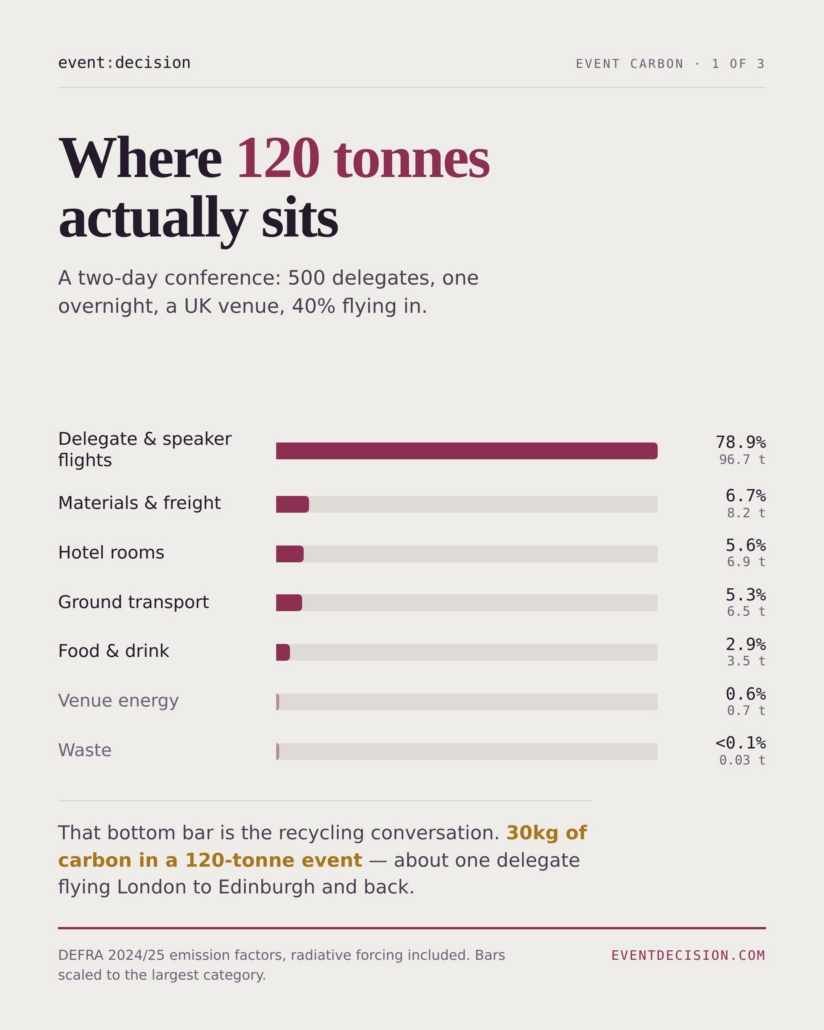
Calculated on DEFRA 2024/25 emission factors. Bars are scaled to the largest category; waste is shown at a minimum width so it remains visible at all.


The useful question isn’t “what’s big”

Knowing that flights dominate is the easy half. The harder and more useful question, if you are the person actually gathering data for a footprint, is: how much detail do I need before the number stops changing?

Because that is where the real cost sits. Chasing a delegate-by-delegate breakdown of who drank which coffee is days of work for an answer that does not move. Meanwhile a single unasked question about flight bookings can shift the total by 40%.

The rule is simpler than it sounds. Detail pays off where the range inside a category is wide — not where the category is large. A category can be enormous and still need only rough data, if everything inside it emits at roughly the same rate. And a small category can demand precision if the options inside it differ by a factor of twenty.

Three questions clear that bar comfortably.
1. Who flew, from where, and in which cabin

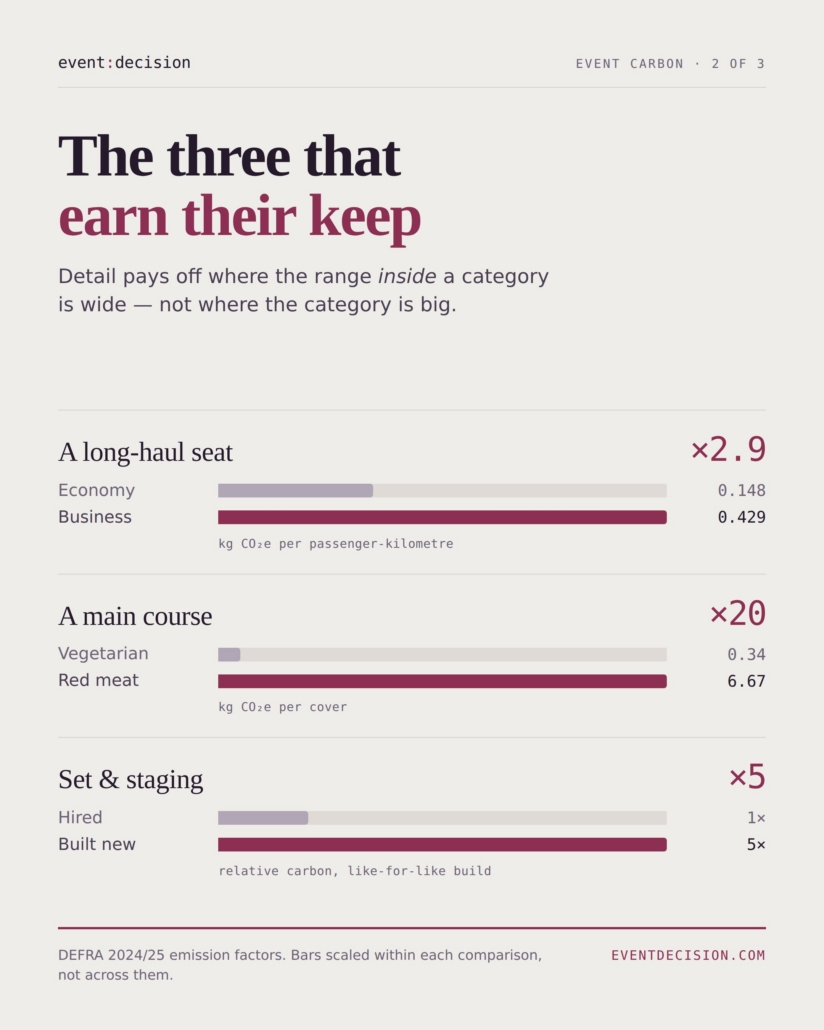
A business-class seat takes up roughly three times the aircraft’s fuel per passenger that an economy seat does, because it takes up roughly three times the floor. In our modelled conference, twenty long-haul delegates turning left instead of right adds 73 tonnes – more than half the footprint of the entire event, from a booking decision nobody thinks of as environmental.

So flight data needs to be person-level, or at least route-and-cabin level. What it does not need is precision about airports. Getting the exact terminal pairing rather than a city estimate changes the answer by a percent or two. Getting the cabin wrong changes everything.

2. What was on the plate

Food and drink is under 3% of this event, which surprises people who have been told to feel bad about catering. But the range inside it is the widest of any category on the list: a red-meat main course carries roughly twenty times the carbon of a vegetarian one. Swing the menu from beef-led to a standard 80/20 chicken-and-vegetarian split and the category drops from 8.8 tonnes to 1.9.

Which means all you need from catering is the protein split – how many meat, how many fish, how many vegetarian, per service.

Ingredient-level menus, provenance, food miles, organic certification: interesting, occasionally worth doing for other reasons, but essentially invisible in the number.

3. Whether it was built or hired

Set, staging, exhibition stands and branding are the second-largest category here, and the single biggest variable is not what they are made of but whether they already existed.

Hiring a stand and re-skinning it, versus fabricating one from scratch, is around a five-fold difference. Air-freighting it rather than sending it by road is another six-fold difference on the transport leg.

Both are decisions made early, by procurement, usually on cost and schedule grounds — which is exactly why they need to be visible before the contracts are signed rather than reported afterwards.

Worth knowing, second tier

Three more that matter more than you’d think

  • Which country the hotel is in. A room-night in France is 7.7 kg; the same room-night in Australia is 41.8 kg. That is a six-fold spread driven entirely by the national electricity grid. The hotel’s star rating, by contrast, moves it by about a third – worth capturing, not worth arguing about.
  • How many rooms were genuinely slept in. Assuming every delegate stays every night, when in fact 60% did, overstates accommodation by more than a third. Ask for the rooming list.
  • Whether the venue is on a renewable tariff. This is a yes/no question that can zero out an entire category. It takes one email.

And what you can genuinely stop chasing

This is the liberating part. In a footprint of this shape, the following are all rounding errors, and collecting them to three decimal places is time you will never get back:

  • Coffee, pastries and bottled water counts – about 1.6 tonnes across two days, roughly 1%. This can all be included empirically.
  • Item-by-item AV power draw. A full 60kW rig over a two-day conference comes to 0.3 tonnes. event:decision will calculate this for you.
  • Waste tonnage by stream. 0.03 tonnes. More on this below.
  • Square metreage of every breakout room, and the exact courier distance for every individual delivery.

To be clear: waste still matters.

It is the most visible thing you do, it is what delegates and clients actually see, and it changes behaviour in ways that carry well beyond the event.

Just be honest in the reporting that it is a cultural win rather than a carbon one – otherwise clients spend their sustainability budget where it feels best rather than where it works, and nobody ever tells them.

One important caveat

Everything above describes one event shape: a conference with a meaningful fly-in audience. Change that and the order changes with it. A city conference drawing 90% of its audience from within city limits inverts the whole table – ground transport and materials become the swing factors, and flight precision stops mattering almost entirely. A gala dinner has a fraction of the accommodation and twice the catering intensity. An exhibition stand is mostly materials and freight from the start.

The method survives the change even when the ranking doesn’t. Work out where the wide ranges are for the event in front of you, spend your data-gathering effort there, and use documented defaults for everything else.

Three questions, asked early

  1. Which cabin are we booking, and for whom? The single largest lever on the largest category.
  2. Are we building this, or hiring it? Ask before the design is signed off, not after.
  3. What’s the protein split at each service? The catering team knows. It takes one line on the BEO.
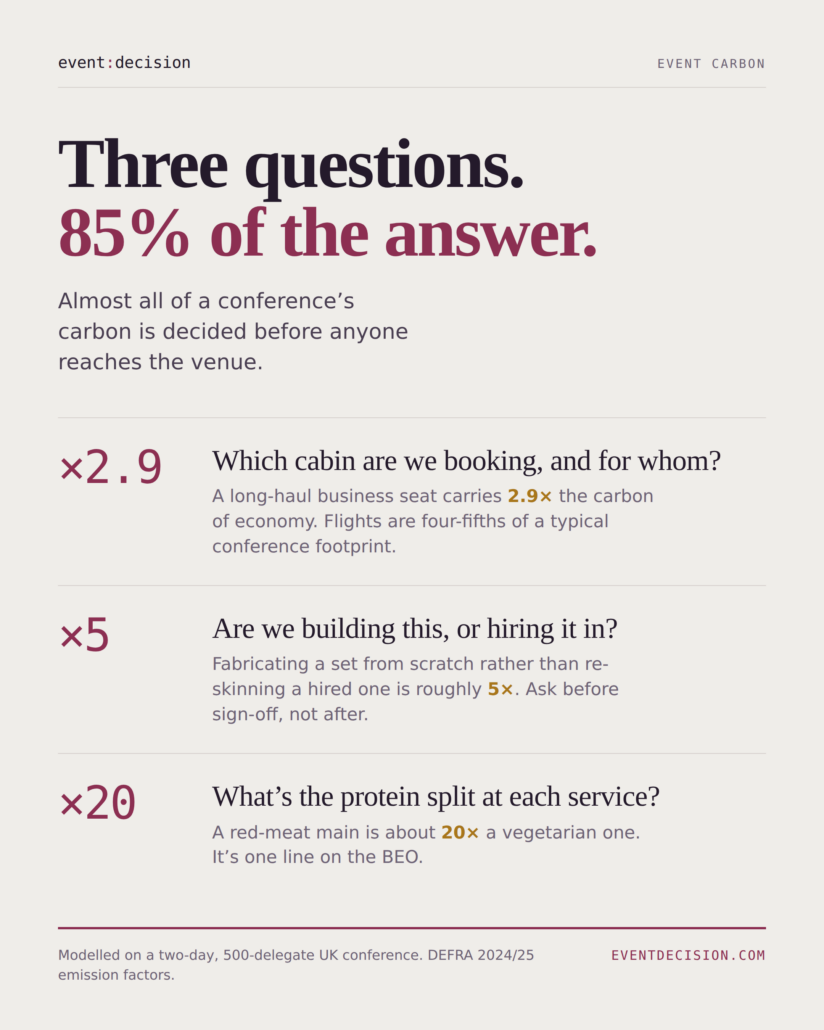
 

Get those three right, and you have roughly 85% of the answer – and, more to the point, you have it at the stage where you can still do something about it.


Figures throughout are modelled on a reference two-day, 500-delegate UK conference using DEFRA 2024/25 emission factors, including radiative forcing on aviation. They are illustrative of proportion and sensitivity, not a benchmark for any specific event.

https://eventdecision.com/wp-content/uploads/2026/08/itallmatters.png 600 1080 Matt Grey https://eventdecision.com/wp-content/uploads/2026/04/mainlogo-ed.png Matt Grey2026-08-26 09:19:002026-08-26 09:19:00It all matters, but some matters more.

What can Uber, Airbnb and Checkatrade teach us about event performance?

August 26, 2026/in event:decision, Event:Decision Content, Impact

event:decision  |  Matt Grey | How event agencies, suppliers, venues and hotels can deliver more sustainable events and be seen to be doing so.


When we explain Impact to a new brand, agency or venue, there’s usually a moment about ten minutes in where someone says “so it’s like a rating.” And they’re closer than they realise – because the rating economy has already trained everyone in the room to understand exactly what event:decision’s Impact will do for you.

The trouble is that it’s also trained you to expect far less than we deliver. So it’s worth walking the analogies…

The record belongs to the driver

Every Uber trip belongs to the passenger. They booked it, they paid for it, they went where they wanted to go. When they get out, the trip is theirs, and it’s over.

But the rating accrues to the driver. It follows them from trip to trip, builds into a rolling average across recent journeys, and becomes the thing that determines whether they keep working. No single passenger owns it. It’s the driver’s asset, assembled from thousands of jobs that were never theirs.

That is precisely the structural problem Impact solves for event agencies and production partners. Your client owns the event. They own the brief, the budget, the outcome and the carbon inventory it feeds into. When the last case goes on the truck, the event is theirs and it’s over. Without something to catch it, your performance goes with it.

Impact is the rolling average. It’s the record that accrues to you across every event you touch, regardless of who owned each one.

Airbnb: the score has structure

Airbnb went further than a single number. Guests rate a stay across separate categories – cleanliness, accuracy, communication, check-in, location, value – so the host doesn’t just learn that a stay went badly. They learn which part went badly.

That’s a scorecard, and it changes behaviour in a way an overall star average never does. A host who sees a weak cleanliness category knows what to fix on Monday. Sustained performance across those categories earns Superhost status, which is a badge a guest recognises without needing to understand the methodology behind it.

Impact Reviews work on the same principle, at considerably greater resolution: performance assessed across 30+ factors, delivered as an Event Scorecard, UN SGD alignment and a unique Social Value Yield (SaVY) for each and every event. Same logic, more levers.

Checkatrade: vetting is what makes a score mean anything

Here’s the one most people skip. Checkatrade’s value isn’t the score. It’s that the trade was vetted before they were allowed to be scored at all.

Strip out the vetting and you have a review site – which is to say, a collection of opinions of unknown provenance, and worth roughly what opinions are worth. The vetting is what converts sentiment into evidence, and evidence is what a homeowner is actually buying when they use the platform.

Every procurement team asking for your sustainability credentials is making the same distinction, whether they articulate it or not. They can tell the difference between a claim and a verified assessment, and they have stopped paying for the former.

Where the analogy breaks

All three of those systems share a limitation: they measure how people felt about the job. Averaged opinion.

Impact doesn’t ask anyone how they felt. It assesses the event against the most comprehensive checklist of sustainability factors available in this sector, the same way every time. That’s the difference between a review and a review body.

And once you have consistent assessment rather than sentiment, four things become possible that no star rating can do:

A score with context, not just a number. A 4.8 tells you nothing about whether 4.8 is good.

Impact benchmarks you against sector peers, by region and by event type – so you know how you performed against the people you’re bidding against, not against an abstract ideal.

It tells you what to do next. Ratings are a verdict. The Intelligence Hub shows you which sustainability factors your organisation actions most often and which you consistently miss, across your whole portfolio. That’s a gap analysis, and it’s a workplan rather than a judgement.

It puts a number in currency. SaVY Social Value Yield – expresses the portion of your event budget that could generate social value if the event performed perfectly against every social indicator. It’s headroom, not a retrospective claim: the value sitting unclaimed in money you’ve already committed. Carbon tools taught the industry to convert activity into tCO₂e. This does the same job for social performance, in a currency your finance director thinks in.

The framework alignment comes free. Every review question maps to one or more UN Sustainable Development Goals, and the aligned SDGs appear on the Scorecard. We’re deliberate about this: alignment is the byproduct, intelligence is the product. It’s the receipt that makes the findings credible to a procurement team – not the reason to do the work.

The version to remember

Uber taught us that a record can accrue to the provider even when every job belongs to someone else. Airbnb taught us that a score with structure changes behaviour. Checkatrade taught us that vetting is what turns a score into evidence.

Impact takes all three, adds a peer benchmark, a gap analysis, a figure in pounds and a framework mapping — and hands the whole thing to you rather than your client.

Your client keeps the event. You get to keep the record.

https://eventdecision.com/wp-content/uploads/2026/08/uber.png 600 1080 Matt Grey https://eventdecision.com/wp-content/uploads/2026/04/mainlogo-ed.png Matt Grey2026-08-26 07:34:172026-09-11 06:49:48What can Uber, Airbnb and Checkatrade teach us about event performance?

At last! A simple channel for food rescue…

August 18, 2026/in Third-party Content

We spend a lot of our time telling event organisers that food is one of the biggest sustainability levers they have. In most of the footprints we measure, catering sits behind only travel and accommodation – and unlike a delegate’s flight, it’s a line item that the organiser controls almost completely. 

But it’s the surplus food left after the event that’s always proved to be the awkward bit.

Organisers who have done everything right – accurate numbers, sensible menus, plant-forward choices – still end up staring at trays of perfectly good food with no plan for it. The honest answer, most of the time, has been a shrug and a bin. Perhaps a composter, should the venue provide one.

So we’re supporting Olio – the leading surplus food sharing platform for events, trusted by organisers, venues and caterers across the UK – to give event planners something better than a shrug.

What’s Olio – and how does it actually work? 

Olio has spent the last decade on a mission to create a world where food waste doesn’t exist – and they’ve built partnerships with the UK’s biggest retailers, caterers, hotels, venues and more to make sure that (perfectly edible) surplus food always gets eaten, rather than binned.

For events, their redistribution process has four simple steps:

  1. You press a button on Olio’s app for event organisers to confirm there’s food to collect. That’s the only action required from anyone on site.
  2. A trained volunteer collects your food. One of Olio’s Food Waste Heroes (there are 100,000 of them nationally, all food safety-trained) comes to the venue and picks the food up directly.
  3. It’s redistributed locally. Volunteers share the surplus with people in the surrounding community via the Olio app.
  4. You get an impact report. Olio reports back on what was collected and where it went, along with testimonials from the people who received it. That’s the bit that goes in your post-event report and your sustainability reporting.

We know what you’re thinking – what about food safety?

It’s the first thing every event team asks, and it’s the right question. Three things worth knowing:

  1. Olio takes on legal liability from the moment its volunteers collect the food. From the point of collection onwards, food safety responsibility is theirs.
  2. Their redistribution process was built with their primary authority and food safety specialists (their in-house team includes the former President of the Institute of Food Science and Technology).
  3. Every volunteer completes thorough food safety training before they can claim a collection. 

Their track record says it all: Olio volunteers have safely shared 160 million meals since 2019 – with zero food safety incidents. 


What about the local charity route?

Plenty of organisers have tried donating to a nearby charity, and it can work beautifully. It’s also fragile. Charities can’t always find a volunteer at short notice, often can’t take every food type because of transport or cold storage constraints, and coordinating it eats staff time on the night. There’s rarely any formal record of what happened afterwards.

Olio isn’t a replacement for that relationship where it already works – but events move, and given their national scale, it’s a more widely available option. 

With Olio, event organisers get:

  • On-demand volunteer availability (including last-minute)
  • Volunteers can take all food types
  • Your team just needs to click a button on their user-friendly software (no missed calls)
  • A detailed impact report of where your food’s ended up – every single time.

The side effects nobody expects

The reason we like this partnership isn’t only the diverted waste. It’s the secondary benefits we keep hearing about:

Costs come down. Less overcatering and less waste disposal both show up in the budget.

Teams feel better. Kitchen staff, waiting staff and organisers no longer have to watch good food go in the bin.

Katie McNeill, Event Manager at BeaconHouse Events, described it to Olio as “a really nice way to solve two problems at once.” 

Guests eat more sensibly. Buffet signage explaining that surplus is being donated changes behaviour – people take what they’ll actually eat, which means less overproduction is needed in the first place.

Why food waste is worth your attention

The hospitality sector throws away around 1.1 million tonnes of food a year, and roughly 75% of that could have been eaten. The cost of that waste runs to about £3.2 billion annually. Meanwhile, 1 in 6 UK households experienced food insecurity in 2025.

Where to start

If you’re already working with us on measurement, food waste diversion is a natural next step – you’ll see it land in your footprint and in your reporting. If you’re not…

This is a good place to begin, because it’s a sustainability intervention that costs little, changes behaviour on site, and produces a hugely positive story worth telling afterwards.

Talk to us about adding Olio to your next event. Read more

https://eventdecision.com/wp-content/uploads/2026/08/Actual-Newsletter-Thumbnail-scaled.png 1440 2560 Matt Grey https://eventdecision.com/wp-content/uploads/2026/04/mainlogo-ed.png Matt Grey2026-08-18 17:19:042026-08-18 17:19:04At last! A simple channel for food rescue…

What event planners can learn from Life Cycle Analyses

August 18, 2026/in event:decision, Third-party Content

Break an event into carbon and social value by lifecycle phase, you ask?

Here you go. Plus advice that falls out, split cleanly into what to decide once – and what to fix every time.

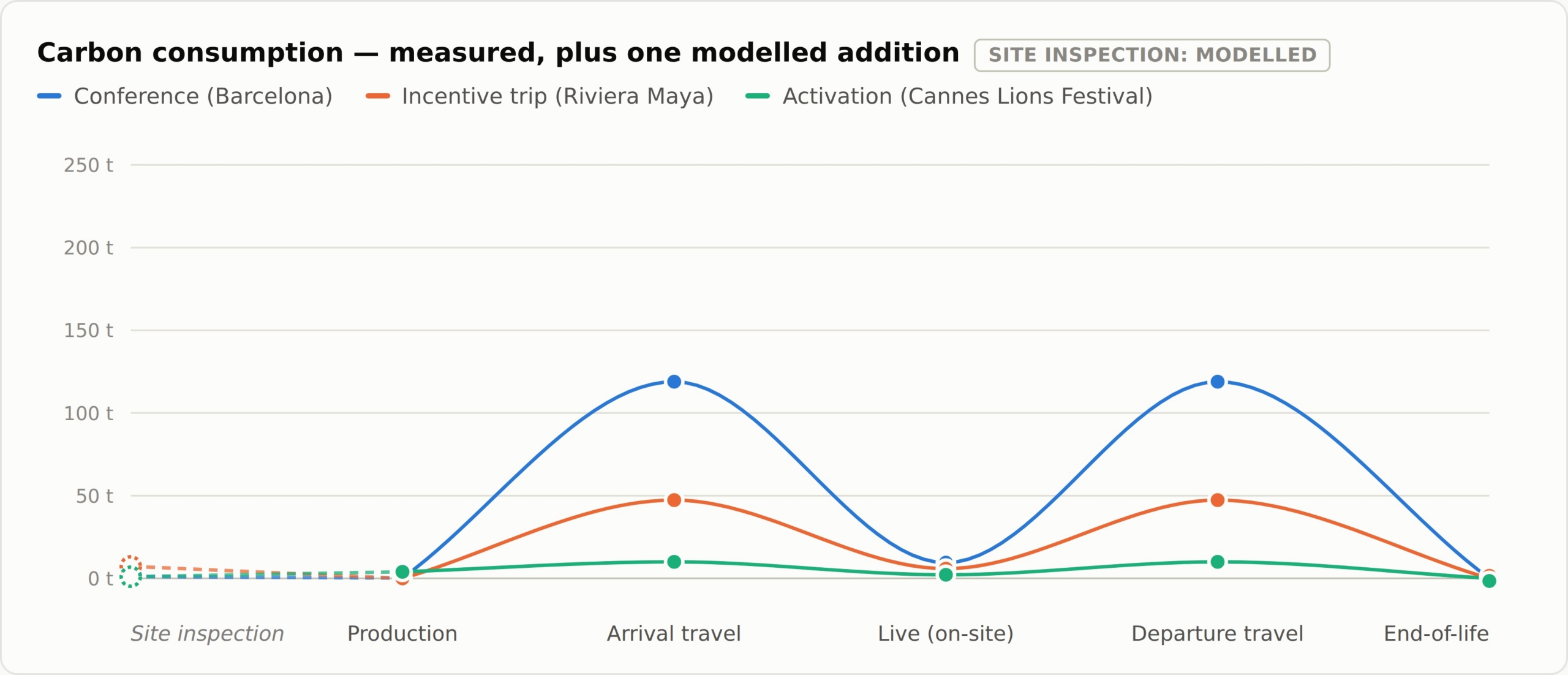
We recently re-cut three real events – a multi-day conference, a long-haul incentive trip, and a festival brand activation – by lifecycle phase rather than by expense line: the build, the day people travel in, the days they are actually there, the day they travel out, the close-down. Client and agency names have been removed throughout; only the format and the numbers are real. The point wasn’t the chart. It was what the chart is useful for, which is telling the difference between two types of decision that are usually discussed as if they were one.

Some choices set the ceiling on what an event can achieve before a single supplier is briefed – destination, format, whether to build or hire. Others are made inside whatever ceiling has already been set – which coach company, which catering default, where is the welcome dinner and so on. Call the first kind strategic and the second tactical. Both matter, but they need different owners, different timing, and different conversations with a client. Here is what the lifecycle view actually recommends for each, on both carbon and social value — with the underlying charts and numbers alongside it.

Carbon


Strategic – decide this once, before the brief is written

The clearest finding across all three formats is that travel to and from the event dwarfs everything that happens once people arrive. One conference’s own numbers: 118.9 tCO2e on arrival day, a plateau of just 9.5 tCO2e across the entire three-day live programme, then another 118.9 tCO2e on departure day. That shape holds, in miniature, across the incentive trip and the activation too. Which means the single biggest lever on any event’s footprint is set at the concept stage – destination and distance – and almost nothing done well during delivery can claw it back.

The live programme is a rounding error next to the two flight days bracketing it. Almost nothing you do well during delivery claws that back.

The second strategic decision is one most agencies aren’t currently making at all, because it isn’t currently being measured: site inspection travel. We modelled a realistic scouting trip – three travellers, London origin, economy, a two-day visit – against all three formats. For the conference it was a rounding error. For the long-haul incentive trip, it added more carbon on its own than the entire five-day on-site programme it existed to plan.

If a format involves long-haul travel, the decision to fly a person out to scout it, versus a virtual walkthrough or piggybacking the visit onto other travel, belongs in the same conversation as destination choice – not left as an invisible add-on nobody owns.

The third is a procurement policy rather than a project-by-project call: build or hire. The one format in our sample with its own physical structure carried a real pre-event materials footprint that the other two – both of which occupied a room rather than built one – simply didn’t have. Whether a brand experience gets built from scratch or dressed with hired and returned stock is a decision made in the contract, not on site.

Tactical – fix this every time, inside whatever’s already been chosen

Once destination and format are locked in, the remaining levers are operational discipline on the days already under your control. None of them reshapes the curve, but they compound across a season of events, and none of them cost the reward proposition anything. Consolidate ground transport: one shared vehicle for a crew rather than three separate cars is a real, repeatable saving, and it is already the pattern in the best-run categories we looked at. Hold cabin class to economy or consolidated group fares by default, including for crew, and treat any upgrade as the exception that needs a reason rather than the default that needs defending.

Favour a plant-forward main at group dinners – the single heaviest catering choice in every capture we’ve seen is a red-meat main, and swapping the default rather than banning the option costs nothing in guest experience. And keep materials on a hire-and-return model wherever a physical build is involved, which is already what separates the best-performing production lines from the rest.

Social Value Yield (SaVY)


If carbon spikes hardest on the two days people are in transit and barely registers while they’re actually there, the plausible shape for social value is close to the mirror image: built almost entirely during delivery, and – unlike carbon – still accruing after everyone has gone home.


Strategic – design the delivery phase for it, don’t audit it afterwards

If social value concentrates in the live phase, it has to be designed into that phase at the brief stage, not measured after the fact and hoped for. That means choosing a venue and a destination with a genuine, specific local-engagement opportunity – not just a nice backdrop – and building a community / local touchpoint into the live programme as a scheduled part of the day, the way one of the incentive programmes we looked at ran a local community visit alongside its excursion schedule. It also means treating “legacy” as a deliverable with an owner, not a hope: what happens to the supplier relationships, the skills the crew picked up, the local partnerships, six months after the event closes down is a question worth answering in the original brief, because nobody answers it afterwards if no one was asked to.


If carbon and social value peak in different phases, most of the good decisions for one don’t cost you the other.

Tactical – the choices that raise it inside a live programme you’ve already set

Inside whatever format and venue have already been chosen, the day-to-day decisions that move social value are mostly about where the spend actually lands. Sourcing catering, décor, production and crew locally – rather than flying in a team – puts spend into the local economy the event is already visiting, on top of whatever it does for the travel line. Local hire over flown-in freelance, where the skill exists on the ground, does the same thing twice over. And the smallest, easiest-to-skip tactical fix is capture: circulating the debrief, the case study, the story of what actually happened, so the legacy that was designed in at the strategic stage is something people can point to rather than something that quietly evaporates once the invoice is settled.

Putting it together

The useful discipline here isn’t really carbon versus social value. It’s separating what gets decided once from what gets fixed every time, and being honest about which conversation you’re actually having with a client at any given moment. A destination choice dressed up as an operational tweak never gets challenged properly. An operational tweak treated as a strategic trade-off wastes a client meeting on something a checklist could have handled.

The genuinely useful pattern, though, is that carbon’s peak and social value’s likely peak sit in different phases of the same event. That’s rare in sustainability work, where the two sides of ESG usually pull against each other. Here, most of the good decisions on one axis don’t cost you anything on the other — which means there is very little excuse left for not doing both.

For your event?

To create this data for your own event could not be more simple.

Track, produces the carbon footprint of your event with no data entry for you

Impact, provides you with (a) the performance of your event across ESG (b) alignment with UNSDGs and (c) the Social Value Yield of your event

*How this was built

Both charts split each event into five real lifecycle phases plus one modelled addition. Production is materials and freight – what goes into a physical build before anyone arrives. Arrival travel and Departure travel are each event’s own reported flights total, split evenly in two: a stated 50/50 allocation. Live (on-site) is ground transport, hotels, catering and venue or AV energy – the days people are actually there. End-of-life is waste and de-rig. These five are drawn directly from each event’s own signed carbon capture.

Site inspection is different: none of the three included one in event data, so we modelled a realistic scouting trip rather than leaving it blank – three travellers, UK origin, economy class, a two-day, one-night visit, using DEFRA 2024/25 flight and ground-transport factors, each event’s own reported hotel or apartment rate where available, and standard meal factors for two days. It is shown throughout with a hollow marker and a dashed connector, distinct from the solid line that carries the five measured phases, and it is not included in any of the reported totals above.


https://eventdecision.com/wp-content/uploads/2026/08/LCA-event.png 600 1080 Matt Grey https://eventdecision.com/wp-content/uploads/2026/04/mainlogo-ed.png Matt Grey2026-08-18 12:01:422026-08-18 12:04:43What event planners can learn from Life Cycle Analyses

Your performance data walks out the door

August 17, 2026/in event:decision, Impact

Measuring event carbon footprints has inherent value.

It gives your client something to keep. As an agency or supplier, it demonstrates your expertise.

Here is something that rarely gets said out loud in an agency, because it sounds ungrateful.

You measure the carbon footprint of an event. You chase the flight manifests, the hotel nights, the freight, the venue energy. You build the number, you check it, you write the report (or rather, event:decision does) It is good work, and it takes real effort.

Then you hand it over – and it’s gone.

The figure belongs to the event, and the event belongs to the client. It goes into their Scope 3 inventory, their annual report, their procurement pack, their investor deck. Wherever. That is exactly as it should be; it is their event and their emissions. But when the file closes, nothing has accrued on your side of the door. You have made your client measurably better informed and left yourself precisely where you started.

Do that forty times and you have forty clients who know more about their events than they did – and an agency that knows no more about itself than it did before the first one.

The thing an agency / supplier actually owns

You do not own your clients’ emissions. You never will, and should not try to.

What you own is the pattern of decisions you make across every event you touch. Where you site things. How you brief production teams. Which venues it goes back to. Whether the social value in its work is designed or accidental. That pattern is the only real asset in this industry that a competitor cannot copy, because it is made of your judgement rather than your rate card.

And almost nobody is capturing it. Not because agencies & supply partners do not care – most now care a great deal – but because every measurement exercise has been framed around the client’s deliverable rather than your record. When the reporting is built one event at a time, for one client at a time, in whatever format that client asked for, there is nothing left over that can be compared, added up, or learned from.

Impact. The benchmark that keeps value on your side

Impact scores an event on environmental, social and governance performance in one consistent methodology – which means, for the first time, your events become comparable to each other.

That gives an you something it has never had: a portfolio view. Every event you deliver, scored the same way, sitting in one place. Across formats, across clients, across venues and supply partners, and across years.

How does your ESG performance compare with industry, in region, by client sector or event-type?

How many UNSDGs the event aligns with.

What is the Social Value Yield of the event?

The client keeps their number, as they should. You keep the record.

Three things follow from that, and they are the three things agencies actually spend money trying to do.

1.  Understand

Before you can sell anything, you have to be able to see it.

Most agencies & suppliers are guessing at questions they could be answering. Are we consistently stronger on conferences than on incentives? Is our governance weak because our processes are weak, or because our documentation is? Did the sustainability push last year actually move anything, or did it just cost us a fortnight of everyone’s time?

A portfolio of comparable scores answers those in a nano-second. It also does something less comfortable and more useful: it shows you the events you would rather not look at. That is where the improvement is, and it’s invisible in a world of one-off client reports.

2.  Win new

Every agency & supplier in a pitch says it is committed to sustainability. Everybody nods, and nobody in the room believes any of it, because a commitment is cheap. 

Now imagine answering that slide with a distribution.

“This is our portfolio average across ESG. This is our spread – here is our best, here is our worst, and we are showing you both. This is what we improved over three years and by how much. This is the score we would expect to deliver on an event like yours, because we have the base rate for events like yours.”

In a procurement process that scores ESG – and there are more of those every year – that is a supremely better answer than your competitor’s.

It is a different category of answer. One side is making a promise. The other is showing its record.

3.  Develop existing

The greatest value is in the accounts you already have.

When last year’s event has been scored the same way as this year’s, the annual conversation changes shape. You are not presenting a report on what happened; you are presenting a direction of travel, with the two or three things that moved it and the two or three that did not. That is a planning meeting rather than a debrief, and planning meetings are where scope grows.

It also gives you a legitimate reason to widen. If one event scores well and three others in the same client’s programme have never been looked at, that is a conversation about consistency, not an upsell. If the drag is coming from venues or production partners rather than from your own decisions, Impact VenueLens and AdVantage take the same methodology out into the supply chain – and you are now the agency helping your client fix their whole programme, rather than the one defending a single number.

None of that is available to an agency whose sustainability work leaves the building every time the invoice is raised.

Two honest conditions

It only works if you measure the ordinary ones. 

A portfolio made of your best three events is marketing, not data.

The value is in the base rate, and base rates need the awkward events in them – the ones with the long-haul flights and the venue you had no say over. An agency that only scores its flagship work will produce a beautiful average it cannot use for anything.

And agree the data question up front.  Your client owns their event data. What you need is the right to retain your own performance record in anonymised, aggregated form – your scores, not their commercial detail. That is one line in a contract, and it is far easier to include at the start of a relationship than to request at the end of one. Almost no client objects; most have never even  been asked.

The point

Carbon measurement is not the problem here. It is necessary, it is increasingly non-negotiable, and the number genuinely does belong to the client.

The problem is that it has been the only thing on the table – so the entire industry has spent years building assets for other people. Measure a footprint and you have given your client something. Score an event on Impact, and every event after it, and you have finally built something of your own: a record of how well you do this work, which is the one thing you can take into a pitch, into a renewal, and into next year.

Your client keeps the number. You should get to keep the proof.

Try event:decision’s Impact. You’ll be surprised at the value you receive.

https://eventdecision.com/wp-content/uploads/2026/08/outthedoor2.png 600 1080 Matt Grey https://eventdecision.com/wp-content/uploads/2026/04/mainlogo-ed.png Matt Grey2026-08-17 17:06:302026-08-31 15:13:47Your performance data walks out the door

Social Value is moving upstairs

August 3, 2026/in event:decision, Impact

By Matt Grey, event:decision

On 20 July, Andy Burnham was sworn in as prime minister. Days earlier, setting out his priorities at a policy speech in Manchester, he had pledged to overhaul public procurement in favour of social value and hinted at a national rollout of the Preston-style community wealth building model he has championed for a decade as mayor of Greater Manchester. Guy Battle, chief executive of the Social Value Portal, called it potentially “the biggest opportunity for the Social Value movement since the Social Value Act 2012.”

For the events industry, that should be a bigger story than it currently is. Social value is not a new idea, but it is about to be enforced, weighted and quantified in ways it never has been before – and events, whether organisers realise it or not, sit squarely inside that system.

A decade of law, and now a lever

The Public Services (Social Value) Act 2012 already requires English and Welsh public authorities to consider how a contract might improve the economic, social and environmental wellbeing of the area it serves. The Procurement Act 2023 hardened that into a duty: contracting authorities must “have regard to the importance of maximising public benefit” when awarding public contracts. And since February 2025, Procurement Policy Note 002 has made it mandatory: central government procurements must give social value a minimum 10% weighting in award criteria, rising further wherever a supply market is judged mature enough to bear it.

Burnham’s stated ambition goes further still. In his own account, he wants a definition of social value that moves beyond jobs alone to cover local supply chains, support for the third sector and broader place-based benefit – applied with the same rigour nationally that he built into Greater Manchester’s own Good Growth Fund. The direction of travel is unambiguous: social value is moving from a soft scoring criterion to a hard, auditable line item in how public money gets spent.

Why this reaches events

Two things make this relevant to brands, agencies and the venues and cities that host them.

The first is direct exposure. A growing share of conferences, exhibitions, awards ceremonies and public-facing events are commissioned through frameworks and contracts – NHS trusts, local authorities, combined authorities, universities, arm’s-length bodies – where a social value score already sits alongside price. An agency that cannot state, in a live and defensible way, what it contributes in supply chain spend or community engagement will simply score worse before cost is even compared. In some procurements, it may not get to the table at all.

The second is indirect, and arguably more interesting:

events are themselves potent generators of exactly the outcomes social value policy is designed to reward. 

Local spend, footfall, skills, temporary and permanent jobs, apprenticeships, civic pride in a host city – conferences and exhibitions produce all of it. The Social Value Portal’s own benchmarking across the public contracts it supports finds an average uplift of roughly 37p of social value for every £1 spent. Greater Manchester Combined Authority weighted social value at 15% on its major waste contract with SUEZ; STAR Procurement, working across several Greater Manchester and North West councils, has generated more than £183 million in validated social value since 2014. Once that same logic is extended to public-sector-linked events, the agencies that can produce a number will win business that the agencies offering only a narrative will not.

The measurement gap nobody has filled

Here is the problem: no dedicated social value framework yet exists for events. The National TOMs Framework and the Social Value Portal’s TOM System – the closest thing the UK has to a standard – were built for long-duration contracts: construction, facilities management, waste, care. They assume years of headcounts, apprenticeship starts and spend data, not the compressed timeline of a three-day conference or a single awards dinner. Search as we might, there is no equivalent framework built for the way events work. So, we built one.

That gap will feel familiar to anyone who has worked in event carbon measurement over the past five years. Carbon started as a nice-to-have in RFPs, became a default question, and is now often a contractual requirement. Social value is on an identical curve, a few years behind, and it now has a prime minister who has spent a decade putting it into practice pushing it forward.

The opportunity, if the industry moves now

Brands and agencies that build the capability to quantify social value per event will not just be ticking a compliance box. They will walk into pitches, public and private, with a story AND a number, at precisely the moment the market starts asking for one.

No need to calculate that social number from scratch. It’s what our own Impact suite at event:decision was built to produce.

Impact: Event gives corporate event owners and their agencies a Scorecard benchmarked across environmental, social and governance performance, event by event, against sector peers – and, alongside it, a quantified Social Value Yield (SaVY): the answer to the “how much is this actually worth” question, expressed as a £ figure or a percentage of budget, in the same way a carbon tool converts activity into tCO2e.

For agencies, this means walking into a pitch with real delivery data and peer benchmarks already in hand, before a client’s procurement team has even asked the question – and keeping that intelligence to sharpen the next bid, and the one after that.

The same logic runs the other way for the hotels and venues that host and supply events, not just those that commission them. Buyers are increasingly shortlisting venues on performance, not just capacity and day rate, which is why Impact: VenueLens lets a hotel or venue turn what it actually delivers into benchmarked, evidenced intelligence it can drop straight into a bid – proof of performance rather than a page of credentials – that buyers struggle to align with their own event.

AV and production partners sit in the same supply chain: Impact: AdVantage does the equivalent job for power, freight, crew travel, skills transfer and kit utilisation, surfacing the credible wins hiding in a supply chain before a client asks about them.

And associations and destinations choosing between venues, or building the case for a bid city, are exactly the audience this was built for – a comparable, evidenced number wins a social-value-weighted procurement process in a way a glossy digital brochure never quite does.

The industry doesn’t need to build this from nothing

event:decision’s Impact suite already benchmarks event performance against sector peers, evidences it against the UN Sustainable Development Goals, and quantifies social value in a language a client, a budget-owner or a procurement officer can use to compare one events proposal against another – the same discipline we’ve applied to carbon for years: measure it properly, report it credibly, and use it to win business rather than merely survive an audit.

The organisations that start measuring now – whether they’re the in-house team commissioning the event, the agency delivering it, the venue hosting it, or the AV partner powering it – will help set the standard. Everyone else will spend the next few years catching up, exactly as many did with carbon.

https://eventdecision.com/wp-content/uploads/2026/08/upstairs.png 600 1080 Matt Grey https://eventdecision.com/wp-content/uploads/2026/04/mainlogo-ed.png Matt Grey2026-08-03 14:56:162026-08-03 14:56:16Social Value is moving upstairs

Client gets the proof. You keep the intelligence.

August 3, 2026/in event:decision, Impact, SaVY


Every Impact: review ends the same way. A Scorecard is generated, a client opens it, a box on an RFP gets ticked or a board paper gets its evidence slide. That part is real, and it’s the part everyone remembers, because it’s the part with someone else’s name on it.

It’s also the smaller half of what just happened.

What the client actually gets

One event. One moment in time. A benchmark against your sector, a gap analysis, a Social Value £$ amount, an SDG map – all of it true, all of it useful, all of it scoped to the programme that client just paid for. The day you send it, its job is done. It answered a question, closed a loop, won or defended a piece of business.

That’s the transaction. It was never supposed to be the whole story.

What you actually get to keep

Every one of those reviews is also a data point. Not in your client’s system – in yours.

It lands in the event:decision Intelligence Hub, sits alongside every other event you’ve ever run through Impact, and starts doing something a single Scorecard never can: it compounds.

The review answers a question for one client. The Hub builds an asset for one organisation – yours.

That’s the part built to be kept, not handed over: organisational data across the full set of Impact factors, not just per event but rolled up as your pattern – the factors you action most, the ones you consistently miss, benchmarked against your sector as a whole. A Social Value Yield by event, and your organisational total. An SDG position that’s yours across your whole portfolio, not just the one event someone happened to ask about.

None of that appears in the report you send to the client. It isn’t supposed to. It’s the layer underneath – and it’s the layer that’s actually yours to build.

Three seats at the table, the same asset

Agencies and corporate teams — Impact: Event. Every review sharpens your position against every other agency in the sector, whether or not that particular client ever asks for a comparison. The client you’re pitching next month has never seen the ten events you measured for someone else – but you have, and that’s exactly the evidence you walk in holding. The intelligence doesn’t belong to whoever commissioned the review. It belongs to whoever ran the portfolio.

AV and production partners – Impact: AdVantage. This is the seat that normally has no data of its own at all. The agency owns the client relationship; the power, freight, crew travel and kit choices you actually make usually disappear into someone else’s report, credited to someone else’s name. AdVantage gives you your own aggregate record – where the credible wins are hiding in your own supply chain, across every job you’ve run, not just the one you’re currently invoicing for. That’s an asset you can put in front of the next agency that hires you, independent of whichever client happened to be in the room last time.

Venues and hotels – Impact: VenueLens. Most venues get judged the same way every time: a brochure, a certificate, a site visit. VenueLens replaces that with a benchmarked hosting record built from every event you’ve ever hosted – not the one the last RFP asked about. When the next bid lands, you’re not describing your credentials from scratch. You’re presenting a track record the buyer never had to request, because you’d already built it before they asked.

Three different seats, three different relationships with a client – and in every one of them, the report goes out the door and the data stays home.

SaVY: a number for them, a running total for you

Handed to a client, Social Value Yield is one figure attached to one event – real, defensible, worth putting in the report. Held by you, across every event you’ve measured, it’s your organisational total: the compounding, evidenced answer to “how much social value has this business actually created” – a number most competitors can’t produce for a single event, let alone a whole portfolio.

That gap is the whole point. Anyone can eventually match a single client’s request for a single number. Almost nobody else is building the total.

The part worth remembering

Sustainability measurement in events has mostly been sold – and bought – as a client deliverable. It is one. But treat it only as that, and you’ve built a very expensive photocopier: every review perfectly serves the client in front of you, and nothing you produce gets any smarter, any more comparable, or any more valuable the next time around.

Build it as an organisational asset instead, and the same reviews do a second job nobody’s paying for directly: they make your next pitch, your next RFP, your next board paper stronger than your last one – regardless of which client is reading it.

The report leaves the building. The data doesn’t. That’s not a limitation of the Impact suite – it’s the reason to use it.

Want to see what your own portfolio’s aggregate would already show? Talk to us about Impact: Event, AdVantage and VenueLens at hello@eventdecision.com

https://eventdecision.com/wp-content/uploads/2026/08/intelligence.png 600 1080 Matt Grey https://eventdecision.com/wp-content/uploads/2026/04/mainlogo-ed.png Matt Grey2026-08-03 07:31:592026-08-03 07:32:28Client gets the proof. You keep the intelligence.

More News

  • Sustainability ranks last. That’s your opening.October 21, 2026 - 7:57 pm
  • How far does your stuff travel?October 20, 2026 - 2:21 pm
  • Sustainability is business as usual?October 14, 2026 - 4:32 pm
  • What Event Professionals Actually Want From the Next DecadeSeptember 25, 2026 - 3:01 pm
  • Events create value. Now make it visible.September 24, 2026 - 2:01 pm
  • Why responsible agencies will win more work, whatever the politics.September 23, 2026 - 10:36 am
  • Venues: stop describing your credentials, prove your performanceSeptember 16, 2026 - 8:01 am
  • We’re FIVE!! What’s been going on?September 10, 2026 - 3:04 pm
  • It all matters, but some matters more.August 26, 2026 - 9:19 am
  • What can Uber, Airbnb and Checkatrade teach us about event performance?August 26, 2026 - 7:34 am
  • At last! A simple channel for food rescue…August 18, 2026 - 5:19 pm
  • What event planners can learn from Life Cycle AnalysesAugust 18, 2026 - 12:01 pm
  • About Us
  • Partners
  • Resources
  • Client Login
  • Create An Account
  • Track
  • Impact
  • Navigator
  • Evolve
  • Tel: +44 (0)333 202 6985
  • Email: hello@eventdecision.com
© Copyright 2024 Event Decision | Privacy Policy | Website Design by Lemongrass Media
  • LinkedIn
  • Instagram
Scroll to top