event:decision
  • Home
  • Our Products
    • Track
    • Impact
    • Navigator
    • Evolve
  • About Us
    • Our Company
    • Clients
  • Resources
    • Responsible Futures
    • Blog
    • Responsible Agency Index
  • Contact Us
  • Client Login
  • Search
  • Menu Menu
  • LinkedIn
  • Instagram
better event measurement

The Future is Measured

April 3, 2024/in event:decision, Track

Why Better Event Measurement Means Better Event Planning

In the world of the event professional, the call for sustainability is no longer a whisper but a shout through the corridors of conference halls, the fields of festivals, and the digital spaces of virtual events.

Your attendees are not looking for you to solve the world’s problems via your event. But they are looking for you to publicly keep your promises to deliver sustainably.

Sustainability begins with an understanding of the impact of events – and to understand impact you need measurement. To plan sustainably, event planners must delve into the world of carbon footprints then extend their gaze beyond, and embrace an intricate web of analytics and data insights.

The crucial first step: carbon footprint calculation

Carbon footprint calculation is the cornerstone of sustainable event planning. It offers a quantifiable measure of the environmental impact that an event has through the emissions of greenhouse gases (GHG). By meticulously tracking everything from energy consumption of the venue to the transportation used by attendees, event planners can grasp the carbon costs of their events. Our own product Track is designed to make this simple for event planners with no need for data input or training on the part of the event planner.

But, calculating a carbon footprint isn’t just about tallying up numbers. It’s an exercise in environmental awareness, spotlighting the areas where an event’s environmental impact is most significant. Whether it’s through destination & venue selection, energy-efficient lighting, electronic ticketing, or sourcing local food to reduce transport emissions, each decision is a step towards a smaller carbon footprint.

Beyond carbon: the spectrum of sustainability metrics

Sustainability doesn’t begin and end with carbon. It covers a much broader spectrum that includes water usage, waste generation, and even the socioeconomic impacts on the local community. Effective sustainability measures requires a 360 degree view that captures not just the environmental, but also the social and economic aspects of an event.

For instance, water usage at events, often overlooked, can be substantial. Measuring this usage not only helps in reducing consumption but also in setting benchmarks for future events. Similarly, waste management – quantifying it, adopting ways to minimise it, and finding pathways for recycling and composting – plays a crucial role in sustainable event planning.

Complex decisions require in-depth measurement

Event planning is a series of complex decisions, each with its own sustainability implications. To make informed choices, event planners should use robust measurement tools that provide in-depth insights into every aspect of the event. event:decision has a suite of interlocking tools designed just for this purpose.

Insights call for detailed life cycle assessments of products and services used, evaluation of the supply chain for sustainability credentials, and analysis of attendee behaviour for insights into sustainable practices. The objective is to establish a holistic sustainability framework that can guide every decision, from the most mundane to the most significant.

The role of data insights and analysis

Don’t be frightened! Data insights and analysis are the compass by which event planners can navigate the rough seas of sustainability. Through careful data collection and analysis, planners can identify trends, predict outcomes, and assess the effectiveness of their sustainability initiatives. This can be a really simple process.

For example, by analysing the travel patterns of attendees, planners can offer more sustainable transport options or even adjust the event location. By gathering data on resource consumption, planners can identify opportunities for using renewable resources or cutting down on unnecessary usage.

Implementing sustainable event technology

Technology plays a crucial role in facilitating better measurement and analysis. Event technology can track real-time data on resource consumption, manage waste more efficiently, and even measure attendee engagement with sustainability initiatives.

From apps that help attendees travel more sustainably to platforms that facilitate virtual attendance – thus reducing the event’s carbon footprint – technology should be an enabler of sustainability, as well as the means to measure it. It also serves as a medium for transparency, allowing event planners to share sustainability metrics with stakeholders, thereby fostering an ethos of accountability.

This allows you to make your attendees feel good about attending, surely a must-have for all planners.

Challenges and opportunities

Measuring sustainability is not without its challenges. It requires a concerted effort from all stakeholders involved in an event, and it necessitates investment in the right tools and expertise. However, the opportunities it presents are significant. By adopting rigorous measurement practices, event planners can not only reduce the environmental impact of their events but also position themselves as leaders in the domain of sustainable event planning.

Will you get all the credit for delivering sustainably? Probably not.

But as someone once said:

It’s amazing what you can achieve when you don’t care who gets the credit.

To find out more about how we could work with you to achieve all your event sustainability and event measurement goals in 2024, get in touch.


https://eventdecision.com/wp-content/uploads/2024/04/the-future-is-measured.png 1344 1792 eventdec https://eventdecision.com/wp-content/uploads/2026/04/mainlogo-ed.png eventdec2024-04-03 06:19:032024-05-13 12:27:03The Future is Measured
the three 'why?'s of event sustainability

The Three ‘Why’s? in Event Sustainability

March 19, 2024/in event:decision, Track

Although sustainability in events encompasses many different motivating factors there are three ‘why?s’ most fall under: moral, legal and commercial.

Here’s event:decision’s summary of how to use these key drivers to get C-Suite attention and buy-in. And why you should.

The ‘Moral’ why: building trust, reputation, and ethical standards

The moral case for sustainability in the events industry is driven by a commitment to leave a positive impact on society and the environment. It stems from the belief that businesses hold a responsibility that extends beyond financial gains to include social and environmental stewardship.

Your audience doesn’t expect your business to solve all the planet’s problems. They do expect your event to deliver on the promises your business has committed to.

You can make money and do good; you can pursue something that has a purpose but also make it good for your brand.

Trust as a foundation for sustainable relationships

Trust is the cornerstone of any successful event. It encompasses the confidence that stakeholders, including attendees, sponsors, and the local community, place in an event organiser’s ability to deliver not only a remarkable experience but also to act responsibly towards people and the planet. Building trust requires transparency in operations, honest communication regarding sustainability efforts, and consistent delivery on sustainability promises.

Reputation: the intangible asset

An event’s reputation is a valuable but intangible asset. It is shaped over time through public perception and direct experience with the event’s brand. A visible commitment to sustainability will enhance your reputation, as it reflects a conscientious approach to business that resonates with public sentiment. Events that are perceived as ethical and responsible can often command a premium, attract better talent, and achieve higher levels of attendee satisfaction and loyalty.

Business ethics: the blueprint for behaviour

Business ethics are the principles that guide an event’s decisions and actions. They encompass a wide range of issues, from environmental stewardship and fair labour practices to anti-corruption measures and economic justice. By integrating these ethical considerations into the planning and execution of events, organisers can demonstrate moral leadership that not only sets industry standards but also contributes to a more equitable and sustainable future.

Operationalising moral values

Operationalising these moral values means embedding them into every facet of event planning and management. It entails conducting thorough ethical assessments of suppliers, choosing venues that are committed to sustainable practices, and designing events that minimise environmental impact while maximising social benefit.

By focusing on building trust, safeguarding reputation and adhering to rigorous business ethics, the moral driver of sustainability becomes a powerful force that not only shapes the operational approach of the events industry but also its broader impact on society and the environment.

This moral compass is crucial for guiding the industry towards a future where the success of an event is judged not only by its financial outcomes but by the positive legacy it leaves behind.

The ‘Legal’ why: navigating the framework of sustainability

The legal driver of sustainability in the events industry is becoming increasingly significant as both governments and NGOs worldwide introduce regulations aimed at reducing environmental impacts. In the UK, the legislative landscape is rapidly evolving, with a clear trajectory towards greater accountability and transparency in sustainability practices.

Climate Change Act: a benchmark for progress

The 2019 Amendment to the UK’s Climate Change Act has set an ambitious target for the country to achieve net-zero greenhouse gas (GHG) emissions by 2050, with an interim goal of a 50% reduction by 2030. This mandate acts as a benchmark for progress, compelling event organisers to rigorously assess and improve their carbon footprint.

For the events industry, this means rethinking every aspect of event planning and management, from your choice of venues and suppliers to transportation and waste management. Our sector must innovate to find new ways to reduce emissions, including consideration of digital solutions or hybrid events that can reduce the need for physical travel.

Streamlined energy and carbon reporting (SECR)

SECR is another critical piece of legislation that requires companies to report their energy use and carbon emissions. For event organisers, this means they must now have in place robust mechanisms for tracking and reporting energy consumption, whether it’s venue lighting, heating, or the power used by audio-visual equipment.

Corporate Sustainability Reporting Directive (CSRD)

The introduction of the Corporate Sustainability Reporting Directive (CSRD) in the European Union marks a significant step towards enhancing corporate transparency and accountability regarding environmental, social, and governance (ESG) matters.

As you would expect, it’s a complex piece, but essentially widens the reporting of carbon emissions from circa 9,000 to around 50,000 companies. Whilst few of these companies are event planners at heart, they are all event-industry customers.

The CSRD applies to three primary groups of companies: (1) all large companies in the EU, (2) small & medium enterprises listed on EU-regulated markets, and (3) non-EU companies with substantial business in the EU.

Will you be prepared when they ask you for data on the event you are planning for them?

Beyond compliance: leveraging legal drivers for innovation

While meeting legal requirements is a necessary aspect of sustainability, forward-thinking event organisers can leverage these drivers as opportunities for innovation.

By anticipating and exceeding legislative demands, events can achieve competitive advantage, build stronger stakeholder relationships, and enhance their reputation as industry leaders in sustainability.

Integrating legal drivers into strategic planning

Effective integration of legal drivers into event planning requires a proactive approach. Event organisers should stay abreast of legislative developments, engage with sustainability experts to understand the implications for their operations, and embed compliance into the core of their strategic planning processes.

The legal driver of sustainability is a dynamic and rapidly evolving force shaping the future of the events industry. By understanding and responding to the complexities of legislation such as the UK’s Climate Change Act, SECR, IFRS, and CSRD, event organisers can not only avoid the risks associated with non-compliance but also pave the way for a more sustainable and resilient industry. The need for compliance stimulates innovation, elevates ethical standards, and, ultimately, catalyses the transition towards a greener economy.

The ‘Commercial’ why: the economic incentive

Commercial drivers highlight the financial advantages of integrating sustainability into event planning and execution.

Contrary to outdated beliefs that sustainability comes at the expense of profitability, current evidence suggests that sustainable practices can enhance economic performance. Sustainability is now a core component of brand building in the events industry. Events with robust sustainability credentials can generate considerable goodwill and customer loyalty, as seen with brands like IKEA and Patagonia in consumer markets.

If you think that the event industry sits outside the models of our larger customers, think again. McKinsey have demonstrated the effectiveness of sustainability and profitability and also detail the (much more advanced than events) transition of another whole industry .

Innovating business models

The shift towards sustainability is leading to new business models. For instance, events focusing on sustainability will attract sponsors keen to associate with green initiatives, potentially creating new streams of revenue. event:decision is already seeing specific ESG-focussed sponsorship packages at major exhibitions.

Managing assets and costs

Events have to manage their physical and financial assets carefully. In a world where natural resources are becoming scarcer, and environmental risks are increasing, sustainable practices help manage costs and protect investments. For example, using renewable energy sources for events can buffer against the volatility in fossil fuel markets.

The value of efficiency and resilience

Sustainability can enhance operational efficiency and resilience. Events that minimise resource use or adopt circular economy principles can realise cost savings and avoid disruptions from supply chain issues. Moreover, sustainable practices can improve the reliability and predictability of event-related logistics.

Enhancing productivity and engagement

A sustainable event planning company is an appealing workplace. It will an attract employees who are motivated by environmental and social causes, which will lead to enhanced productivity and lower turnover rates. It can also foster greater engagement from all stakeholders, including suppliers, attendees, and the local community, leading to a more successful and impactful event.

Each of these three ‘why?s’ on their own make a compelling argument for a focus on sustainability in events, taken together they are impossible to ignore. If you would like to find out more about how we could work with you to achieve all your event sustainability and event measurement goals in 2024, get in touch.


https://eventdecision.com/wp-content/uploads/2024/03/Copy-of-Copy-of-Copy-of-sustainability-hero-event-decision-web-sized-.png 768 1024 eventdec https://eventdecision.com/wp-content/uploads/2026/04/mainlogo-ed.png eventdec2024-03-19 06:15:412024-04-01 17:20:17The Three ‘Why’s? in Event Sustainability

Why is event greenwashing so easy?

March 5, 2024/in event:decision, Track

In events, the distinction between genuinely sustainable practices and greenwashing is critical.

Why is the events industry awash with dubious gestures which don’t achieve meaningful sustainability but make everyone feel better? Here are some of the examples of greenwashing we’ve spotted, and what to do instead.

Token gestures

Token gestures, such as planting a tree for every sale or small donations to local charities, can be thought of as easy ways to claim ‘sustainability’. However, they’re superficial. They may create a feel-good factor but they simply don’t address the deeper environmental impact of events. For example, while planting trees is undoubtedly a good thing for many reasons, it likely won’t compensate directly for the extensive carbon emissions or waste generated by many large events.

The offsetting con

Carbon offsetting is a strategy frequently employed by event organisers, investing in environmental projects to ‘balance out’ their carbon footprint. However, this can be misleading or even harmful. Continuation of harmful practices, like excessive energy use or extensive travel, followed by simply offsetting these emissions, just doesn’t equate to genuine sustainability. It’s akin to a diet where you eat junk food all week and eat a salad on Sunday, hoping it balances out. There’s also evidence of environmentally detrimental projects in the carbon offsetting industry, meaning you may not actually be achieving what you think you’re paying for.

Selective reporting and misleading metrics

Selective reporting, such as boasting about banning single-use plastics but remaining silent on other environmental impacts, is a red flag. An event claiming sustainability while facilitating a thousand business-class long-haul flights is an example of a very skewed portrayal. Selective disclosure creates a distorted image of an event’s true environmental impact.

Incongruous sponsorships

Partnering with sponsors whose values contradict the event’s sustainability goals is another form of greenwashing. On a larger scale, World Rugby’s partnership with Total Energy or British Cycling’s with Shell both raise questions. Alliances like these can undermine the host, and the event’s, credibility, suggesting financial goals have been prioritised over environmental values (but the two don’t have to be mutually exclusive, as we have argued before).

The transparency gap

A lack of transparency is a significant issue in the event industry. Organisers often fail to provide clear information about how they are mitigating environmental impacts or how participants can contribute to their efforts. This opacity hinders attendees’ ability to make informed decisions and participate in sustainability efforts.

How to move to true sustainability

To move beyond greenwashing, event organisers must embrace a holistic approach to sustainability. This starts with measurement. As an event organiser, if you don’t know where your starting point is, how can you move forward to a move sustainable event? Anything else is just guesswork.

A UK industry report by venue Manchester Central claims that “78% thought they had become more sustainable over the last 12 months”. Commendable in itself, but can you imagine any other industry where the metrics are not backed with any proof?

Genuine sustainability shouldn’t involve any of these superficial measures but rethinking the entire event lifecycle — from planning to execution and through to post-event activities. Genuine sustainability includes reducing travel emissions, minimising waste, using sustainable materials, and ensuring that every aspect of the event aligns with your environmental values. Transparency and honest communication with attendees is crucial in this process. By adopting these practices, events can become powerful platforms for promoting and achieving real sustainability, shunning greenwashing and creating a positive impact that extends far beyond the event itself.

If you would like to find out more about how we could work with you to achieve all your event measurement goals in 2024, get in touch.


https://eventdecision.com/wp-content/uploads/2024/02/greenwashing-v2.png 768 1024 eventdec https://eventdecision.com/wp-content/uploads/2026/04/mainlogo-ed.png eventdec2024-03-05 06:42:452024-04-01 17:20:27Why is event greenwashing so easy?
event sustainability

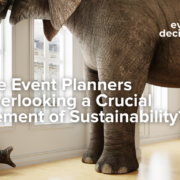
Are Event Planners Overlooking a Crucial Element of Sustainability?

February 19, 2024/in event:decision, Track

There’s an elephant in the event sustainability room

In event planning, ‘sustainability’ is often a buzzword. But are we, as event planners, really embracing its full scope? A recent report, “Shaping a Sustainable Future – One Year On,” should prompt us to reconsider our approach, especially in areas we might be overlooking.

Delegate travel

One glaring omission in many sustainability discussions is delegate travel. Surprisingly, this aspect, which significantly impacts the overall carbon footprint of an event, often escapes the event planner’s sustainability checklist. The report suggests that while we focus on local elements like catering and venue operations, the journey of guests / attendees / delegates to and from the event can be the largest contributor to carbon emissions. This raises a critical question: Shouldn’t travel be a central focus for sustainable event design?

As event planners, we have the unique opportunity to influence and reduce the environmental impact of our events. The location and format of the event, which often fall completely under our remit, play a pivotal role in determining the travel requirements of delegates. By choosing locations that are easily accessible by sustainable transport options, or by organising events in regions with a high concentration of attendees, we can significantly reduce the carbon footprint.

It’s not just corporates that should be considering this – associations and sporting events need to understand the issue & mitigate as best we can. See this pieces on the impact of the recent Super Bowl, for example.

Engaging with delegates for sustainable choices

The report suggests a more proactive approach in integrating sustainability into event planning. This involves not just making greener choices in event execution but designing events with sustainability as a core consideration. This means thinking about sustainability from the inception of the event planning process, not as an afterthought.

A key strategy in enhancing the sustainability of events must be to engage with delegates. Understanding how attendees prefer to consume event content – whether live, hybrid, or virtual – can guide us in designing more sustainable events. For instance, a preference for hybrid or virtual formats could significantly reduce the need for travel, thereby lowering the event’s environmental impact. Hybrid and virtual events not only offer flexibility and inclusivity but also present a sustainable alternative by reducing the need for travel. These formats, when used effectively, can maintain, if not enhance, the engagement and value of the event while significantly reducing its environmental impact.

Incorporating measurement tools for event sustainability

Another key highlighted in the report is the lack of use of robust measurement tools, with 78% of event organisers saying they ‘thought‘ they had become more sustainable in the last twelve months. Without using accurate tools to measure the impact of various components of an event, including delegate travel, it becomes challenging to assess and improve sustainability practices. Adopting comprehensive measurement tools allows us to make data-driven decisions, ensuring that our sustainability efforts are not just symbolic but have a real impact. These tools exist now and it is perfectly possible to quantify sustainability, rather than just thinking or hoping that it is improving, with or without delegate travel

The insights from the report are a wake-up call for the event planning industry. It’s time to broaden our understanding and implementation of sustainability. This involves taking a holistic view, considering all aspects of an event, including delegate travel and the use of measurement tools, and actively engaging with attendees to understand their preferences. Our tool Impact, has been designed after requests from corporate event planners to be able to assess events across all the broader ESG (Environmental, Social and Governance) factors.

As event planners, we have a responsibility to lead the way in sustainability. By incorporating comprehensive sustainability measures, including a focus on delegate travel and measurement tools, and designing events with sustainability as a core principle, we can significantly reduce the environmental impact of our events. It’s time to embrace this challenge and set a new standard for the industry.

If you would like to find out more about how we could work with you to achieve all your event measurement goals in 2024, get in touch.


https://eventdecision.com/wp-content/uploads/2024/02/elephant1.png 768 1024 eventdec https://eventdecision.com/wp-content/uploads/2026/04/mainlogo-ed.png eventdec2024-02-19 06:48:252024-04-01 17:20:35Are Event Planners Overlooking a Crucial Element of Sustainability?
event sustainability

How is Event Sustainability Progressing?

November 28, 2023/in Impact, Track

It’s been an busy month for the team at event:decision in the world of event sustainability. Here’s our round-up of just two of the events we’re taken part in, so far, in November. More to come!

Event Sustainability Live

The inaugural two day event at London Excel where we exhibited our Track and Impact solutions and also took part in no less than three panels:

Stakeholder engagement : why does it matter? – alongside Carina Jandt (Event Cycle), Jennie Mossman (Amplify) and Meg Strahle (The Bulb). We spoke about how to tailor your conversation with stakeholders, to emphasise that there is no excuse to ignore sustainability and to demonstrate how events people are leading this internally, not sustainability teams. Above all we agreed that the sustainable event community and environment is changing and is growing and highlighted that legislation is coming for larger organisations.

“Don’t just do the wrong thing a little bit better, do the right thing”.

Matt Grey, event:decision

The next frontier in event food sustainability – with Jenner Carter and Jo Austin (Lime Venues Portfolio), where we discussed how chefs’ roles have changed to include sustainability, not just producing delicious good looking food. Yes, we acknowledged, food makes up a small proportion of an event’s overall carbon footprint, but it is one of most commented on and visible elements. Huge advances have been made in identifying and working with local and seasonal products but more education is needed.

“If you want to work in sustainability, you can.

If you want to make the world and the society a better place, you can.

Where better to do this, than both at the same time. In events”.

Matt Grey, event:decision


Where to start in ESG – this was a session where we broke apart each element of the E, S and G illustrating the importance of each and showing how to measure it.

You can explore the deck here. The audience wanted to know “How do we engage senior stakeholders who may not be interested?” Thoughts: leaders should be aware of the changing role of business in relation to a. environment and b. society. This is a fundamental change in the role of business. Business is the key driver in transformation, all businesses have innovation, more resources and a LOT more to gain than individuals or government.

Reimagine ‘Events as a Force for Good’

Hosted by the forward-thinking team at emc3, this event was a real highlight for us. It brought together a community of change-makers to talk about how we can harness the power of events, experiences, and campaigns to create strategic, sustainable change. We were invited to join a panel with Josh King, Lisa Sweeting (Green Sense Events) and Danielle Ward (reWARD Events) to discuss using events to create a wider positive impact.

We looked at not just the carbon emissions associated with events, but the societal benefits you can bring to your event with your value chain. Everything we discussed aligned perfectly with evet:decision’s tool Impact  – the ONLY ESG tool for event planners.


“What you can’t measure tends to get overlooked.”

Matt Grey, event:decision

It was a brilliant day. The energy was tremendous, the varied and engaging panel sessions and breakouts were inspiring. The day even ended with a customised song.…

🎶 It’s about improvement, not perfection, embracing flaws and real connection, experiences we can enjoy together, and creating a sustainable future forever. 🎶

Sam McNeill, SongDivision

Thanks, as always, Sam!

If you’d like to find out more about how we could measure and advise on your event ESG goals, including its carbon footprint and its social impact get in touch.


https://eventdecision.com/wp-content/uploads/2023/11/event-sustainability.png 480 640 eventdec https://eventdecision.com/wp-content/uploads/2026/04/mainlogo-ed.png eventdec2023-11-28 06:14:002023-11-29 13:55:43How is Event Sustainability Progressing?
event carbon footprint

The Anatomy of an Event Carbon Report

September 9, 2023/in event:decision, Track

There’s a lot of talk about carbon reports.

But what does an event:decision Track report actually show you?


Events have many moving parts, all inter-dependent; there’s no beating heart without all other parts working in harmony. Delivering that is the skill of an event manager. As you know, each element will have a carbon impact and you can influence nearly all of these, to one extent or another.

You assess the impact by measuring. You can measure before your event or after your event. Or both, to demonstrate your ability in planning more sustainably.

But is understanding a carbon footprint report easy? We’ll show you just how easy it is…

Your impact

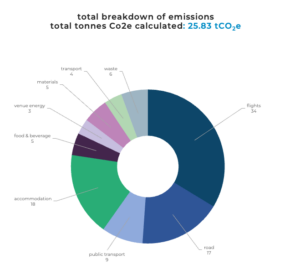
In language you understand. Travel, accommodation, energy, materials and so on.

Not shown in Greenhouse Gas Protocol’s Scopes 1-3, but measured in tonnes of CO2e so that you can align your event’s footprint with that of your organisation (SBTi tracking, for example) and against other events.

Travel – whether by plane, train or automobile and whether you can control it or not, likely the most significant element of the event carbon footprint – and the one on which you can nudge your visitors and delegates to reduce their impact. Ask us about available tools that can help.

Accommodation – again, often in the hands of visitors – but where you can, choose those with sustainable credentials (GreenKey, GreenGlobe, Greengage) and book within walking distance of your meeting space.

F&B – probably entirely within your control as an event manager. Generally accepted in the sustainability world that you should try to move from red meat into white meat, fish and then vegetarian options where you can. Local is mostly better, as is seasonal. Challenge your chefs.

Energy – can be a major factor in venue emissions. Opt for venues with renewable if you have a choice, each and every time. Ask your venue contact at show-round time. The more we ask, the more likely they will change.

Transport / Freight – another chance for you to make a difference. Source local kit and people, wherever you can. Certainly within the country of the event for kit.

Materials – the most visible element on your event/show floor. Your guests will be able to see and touch this (and likely comment), so make them reusable or recyclable and label them as such if you can.

Waste – the invisible factor, which includes food and beverage waste. Source a partner who can distribute unwanted food. Make it easy for the waste contractor to stream your waste, request your suppliers to minimise plastic in packing and shipping. This can be done – several global events have banned plastic in freight.

Virtual – the easiest way to distribute content without a significant impact. And highly recommended, in certain instances.

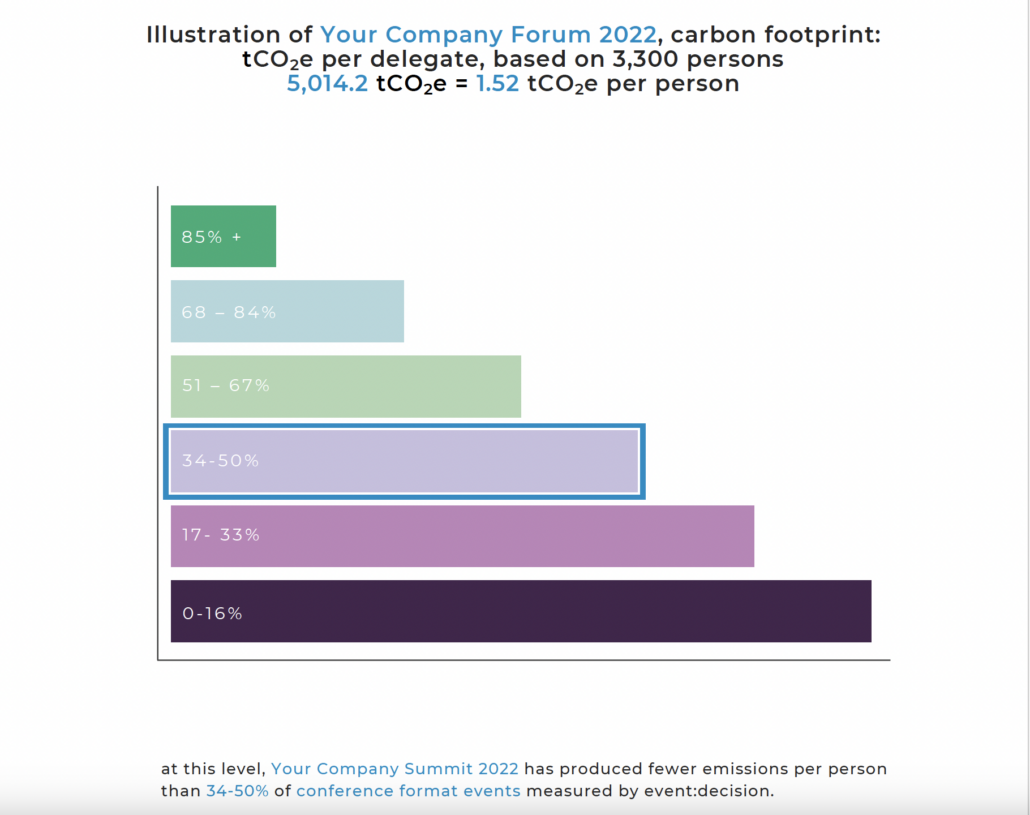
Benchmark

Unique to event:decision Track reports. See how your event compares to other similar events. Aim for better next time. We’ll help you!

benchmarking


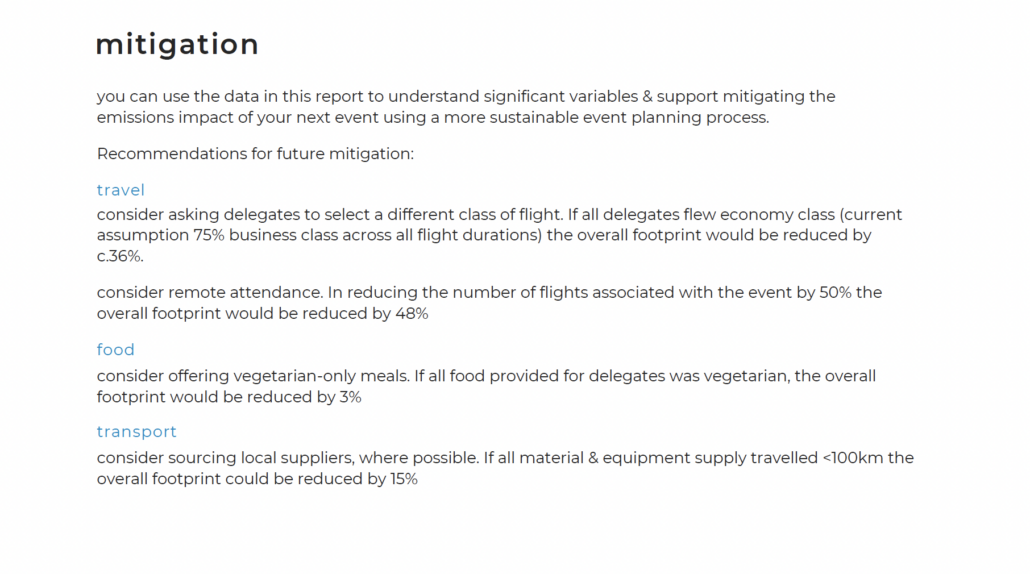
Mitigation

Top tips to mitigate the biggest hotspots in your event footprint – specific to your event and without ripping the legs off it. You may have little control over the size of format of your event, if you’re an agency, but you can always mitigate the impact to some extent.

mitigation


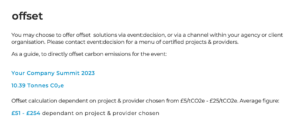
Offset value range

We’ll give you a range of prices for projects from reputable and certified offset providers, if this is a route you’d like to go down. Great for advance budgeting.


There’s a lot in a Track report – but it’s all simple to understand and take to your stakeholders. Chances are much of it will be news to them. We’re #EventProfs’ favourite partners in sustainability and there’s a reason for that. So if you’d like to find out more about how we could measure and advise on your event carbon footprint, get in touch.


https://eventdecision.com/wp-content/uploads/2023/09/carbon_footprint.png 480 640 eventdec https://eventdecision.com/wp-content/uploads/2026/04/mainlogo-ed.png eventdec2023-09-09 14:44:052023-10-24 09:51:59The Anatomy of an Event Carbon Report
sustainability

Get on board the sustainability train (or get left behind)

August 30, 2023/in event:decision, Track

Sustainability isn’t a bandwagon, it’s a train that’s leaving the station #eventprofs need to get on board, or get left behind!

Remember how things were shifting in late 2021?

As in-person gatherings began to return, it became critical for event organisers, digital platforms, and venues to move from merely talking about sustainability as their top focus to actually implementing sustainable practices. Many have started this transition to some degree.

To recap;

Why ‘sustainability’?

Sustainability is not ‘just’ an ethical choice; it’s a business imperative. Clients and attendees are increasingly discerning in their selection of events, looking for those that demonstrate a commitment to environmental and social responsibility. Taking sustainability seriously can be a USP, setting your event apart from the many others that have yet to adopt practices.

New advances in tech are helping to make events more sustainable much more easily. From virtual and hybrid event options that reduce travel-related emissions to smart waste solutions, embracing the latest tech solutions can significantly mitigate an event’s environmental footprint. Ignoring tech advancements is not only a missed opportunity for innovation but also risks rendering your events obsolete. The market is rapidly-shifting and sustainability is now seen as a key indicator of quality and responsibility.

Finally, cross-sector collaboration can’t be underestimated in driving the agenda forward. Industry associations, government bodies, and even competitors can offer valuable insights and resources for enhancing practices and solutions. Attending or organising events and forums (below) that focus on sharing best practices in sustainability can amplify collective impact, creating a more substantial change than any single entity could achieve on its own.

Room for improvement

There’s significant room for improvement in our industry. Notably, key players in the event sustainability landscape likely only engage with a fraction—perhaps less than 1%—of the entire event market. This implies that a large percentage of events are neither assessed for their environmental impact nor reported on.

Legislation is fortunately evolving.

Kudos to Prestige Events for spearheading the focus on sustainability with their first Sustainable Event Show at the Barbican in November 2021. event:decision contributed by measuring and reporting on the event; and by collating topics and panelists supporting the event’s subject matter and diverse range of speakers.

A variety of sustainable events and shows have been launched since then, and the current season is just kicking off.

Recent data from EY reveals that “36% of companies are well-progressed in their ESG commitments,” indicating an impending uptick in transparent reporting against ESG goals, stimulating business innovation, and bolstering supply chain sustainability.

For actionable insights, stay tuned with Event:decision in the upcoming months and consider attending:

– The CN Sustainability Summit

– Event Sustainability Live

– The Sustainable Event Show

There’s likely room for you at any of these events; make it a point to attend at least one.

The saying holds true: if you don’t make sustainability a priority, your competitors will.

So, it’s time to get on board; this movement is headed in only one direction—forward!

https://eventdecision.com/wp-content/uploads/2023/08/1.png 768 1024 eventdec https://eventdecision.com/wp-content/uploads/2026/04/mainlogo-ed.png eventdec2023-08-30 07:15:382023-08-30 07:29:45Get on board the sustainability train (or get left behind)

New UK Sustainability Disclosure Standards: Why Do They Matter?

August 15, 2023/in Track

An Insight into the New Reporting Mandate and its Impact on the Events Industry

The UK government recently unveiled plans to create Sustainability Disclosure Standards, that mirror the EU’s Corporate Sustainability Reporting Directive (CSRD) legislation. This means that companies will be obliged to report on their Scope 3 (supply chain) emissions.

What is the EU’s CSRD and why does it matter?

Before understanding the UK’s decision, it’s essential to know the context. The EU’s CSRD is a legislation aiming to ensure that companies operating within the EU provide accurate, reliable, and consistent information about their sustainability practices. One key aspect of the CSRD is the focus on Scope 3 emissions.

Scope 3 emissions are indirect emissions resulting from a company’s operations, but which aren’t directly owned or controlled by them. In simpler terms, it includes emissions from a company’s supply chain – such as those produced by the emissions from the manufacture of any products they purchase or any emissions related to employee work-related travel.

UK’s Step towards Sustainability Disclosure Standards:

Post-Brexit, the UK is building its own set of standards which mirror the EU CSRD. This move aims at ensuring that businesses in the UK align with global sustainability reporting standards. In a nutshell, just like their EU counterparts, many UK-based companies will soon be obliged to report on their Scope 3 emissions.

Navigating the Jargon – A Quick Guide to Sustainability Acronyms

AcronymStands forDescription
IFRSInternational Financial Reporting StandardsThese are international accounting standards set by the IFRS Foundation and the International Accounting Standards Board (IASB). They guide how specific types of transactions and other events should be reported in financial statements.
ISSBInternational Sustainability Standards BoardAn offshoot of the IFRS Foundation, the ISSB focuses on creating a global set of sustainability reporting standards, filling the need for clear, consistent, and comparable information on sustainability performance.
PICPublic Interest CommitmentThis term emphasises an organisation's commitment to prioritise the general public's welfare over the interests of its stakeholders. In a sustainability context, it can mean efforts undertaken by companies that benefit the environment and society, even if they don't directly boost profits.
SDSSustainability Disclosure StandardsStandards relating to the reporting of a company's sustainability practices. They often pertain to environmental, social, and governance (ESG) issues, ensuring transparency and uniformity in sustainability reporting.
TACTotal Actual CostWhile not exclusive to sustainability, TAC is a comprehensive assessment of all costs associated with a project or an investment. For event professionals, this can involve calculating the total cost of making an event sustainable, including costs related to sustainable materials, technologies, and practices.
TCFDask Force on Climate-related Financial DisclosuresA market-driven initiative, aiming to increase and standardise companies' disclosure of climate-related financial risks and opportunities. The information allows investors, lenders, and insurance underwriters to make informed decisions.

Implications for the Events Industry:

If you’re an event prof or planner, you might be wondering, “What does this mean for me?” Let’s break down the implications:

  • Vendor and supplier selection: Eventprofs rely on a vast network of suppliers – from caterers to logistics and equipment rentals. With the new standards, event planners will need to consider the carbon footprint of their entire supply chain. This means that suppliers with transparent and better environmental practices will have a competitive edge.
  • Venue selection: Venues could be a significant part of the Scope 3 emissions for an event. Venues that are sustainable, eco-friendly, or have green certifications may become more attractive options for events.
  • Comprehensive reporting: For larger events, especially those by global corporations, the carbon footprint of the event may need to be reported. This includes everything – from the energy used to power the stage lights to the emissions from the vehicles transporting attendees to and from the event.
  • Client expectations: Given that companies will be more accountable for their Scope 3 emissions, it is likely they will exert pressure on event planners to ensure that events are as sustainable as possible. This will lead to a rise in client expectations regarding sustainable practices in event planning.
  • Opportunity for ‘Green’ marketing: Events that can shout about their low carbon footprint or sustainability measures can use it as a USP (unique selling proposition). This could be a differentiating factor in a competitive market.

Preparing for the shift:

For event professionals, the introduction of these standards doesn’t just represent a challenge but also an opportunity. Here are some steps to consider:

Measure: Consider employing tools or services that help in measuring the carbon footprint of your events. Regular reporting can provide insights into areas of improvement and help in making informed decisions.

Educate: Stay updated on the latest regulations and understand how they directly impact the events industry. This knowledge will ensure you remain compliant, but also ahead of the curve.

Collaborate: Start building relationships with suppliers who prioritise sustainability. They can provide insight, innovations, and best practices that can enhance the green credentials of your event.

Communicate: Engage with your clients and communicate the importance of sustainable practices, reinforcing trust and demonstrating your commitment to responsible event planning.

Sustainability is not a buzzword; it’s rapidly becoming an integral part of business operations across all industries. For event planners and professionals in the UK, understanding and adapting to the Sustainability Disclosure Standards is not just about compliance, but also about being relevant, competitive and profitable. The legislation may introduce new complexities but it also offers a chance for the events industry to be at the forefront of sustainable change, setting the bar high for corporate responsibility and green initiatives.

If you’re interested in finding out more about how our event carbon footprint calculator – track – could help measure and report on your event’s carbon footprint for SDS compliance and reporting requirements, get in touch. We’re the market-leading experts in sustainable reporting for events.

https://eventdecision.com/wp-content/uploads/2023/08/Copy-of-Event-Decision-blog-.png 768 1024 eventdec https://eventdecision.com/wp-content/uploads/2026/04/mainlogo-ed.png eventdec2023-08-15 05:52:182023-08-29 17:37:12New UK Sustainability Disclosure Standards: Why Do They Matter?

Event Sustainability: Smoke And Mirrors?

August 1, 2023/in Track

Sometimes, word on the show-floor contradicts published policy.

The events industry has made some great strides in terms of sustainability over the last few years alone. But, we must keep working hard to transform our industry, alongside all those we work with. There’s no finish line in this journey, and the key lies in finding the best trade-offs to reduce our carbon footprint while delivering memorable experiences. How can we focus on really meaningful actions that go beyond superficial gestures, avoiding smoke and mirrors or so-called greenwashing in events?

1. Celebrate Progress and Keep Pushing Forward:

We need to start by recognising and celebrating the real progress the events industry has already made towards sustainability. The reduction of average hotel greenhouse gas emissions by 30.42% between 2019 and 2021, as reported in the 2023 Cornell Index, shows that collective efforts can yield positive results on the venue side. Nevertheless, we must continue pushing boundaries and striving for even greater achievements. As Martin Fuller says;

“There’s no finish line here”

Martin Fuller, Davis Tanner

2. Uncover the True Impact of Events:

We’ve said this many time before on this blog but it’s worth repeating that truly sustainable events require a holistic approach. While incorporating reusable cups or badges made from seeded-paper isn’t nothing, we can’t throw around the world ‘sustainable’ when that’s all that we’ve done, or forget the really significant hidden impacts behind the scenes. Delegate travel, accommodation, and waste management often remains unseen, yet they can contribute considerably to an event’s footprint. Travel and accommodation isn’t visible on the show floor, yet they’re almost always the largest factors (by up to four times) in an event’s carbon footprint. Similarly, you don’t always see the waste left behind in the show-floor skips once the visitors and brands have departed, despite assurances of a ‘sustainable supply chain’. Addressing all these factors is essential to achieving genuine sustainability.

3. Think Strategically and Act Tactically:

Event and agency savings can be substantial through strategic event design and more tactical measures. When selecting destinations and venues, prioritise locations that are accessible via public transport and then those that promote eco-friendly practices. Encourage local transport usage and sustainable menu choices for catering. Opt for build materials that are reusable, recyclable, or have low environmental impact. Additionally, consider digital alternatives to minimise printed materials – there’s no greenwashing in events about any of these choices.

4. Set Sustainable Standards with Expo Stand Design:

Expo stand designers and builders can play a vital role in promoting sustainability. Encourage the use of more reusable or recyclable materials, but also using local crew and management. Build firms have made massive steps in providing more re-usable or recyclable materials. Event:decision works with one build firm that consistently demonstrates 20-40% year-on-year reductions in materials, crew and transport-related emissions, with no impact, through careful thought and deliberate decision making.

5. Embrace Trade-Offs:

A wise man once said;

“There are no solutions, only trade-offs. Striving for complete sustainability may be unrealistic, but making the best trade-offs we can is achievable”.

Thomas Sowell

So, aim for continuous improvement, looking for ways to minimise environmental impact without compromising the event’s success.

6. Lead by Example and Hold Others Accountable:

As event planners, we must exemplify sustainable practices ourselves and hold our partners and suppliers to the same high standards. Collaboration is key – by working together, we can influence positive change across the industry. Praise and support firms that consistently prioritise sustainability while also raising concerns and encouraging improvements where necessary.

Sustainability in event planning is an ongoing journey with no definitive endpoint. It requires dedication, innovation, and collaboration to make meaningful strides. By looking beyond the surface and addressing the less visible aspects of events, we can create experiences that are both memorable and environmentally responsible and minimise greenwashing in events. Let’s maintain our commitment to sustainability, ensuring that the good work of the majority isn’t tarnished by the few who fail to do the right thing when no one is watching.

https://eventdecision.com/wp-content/uploads/2023/08/Copy-of-Event-Decision-blog-2.png 768 1024 eventdec https://eventdecision.com/wp-content/uploads/2026/04/mainlogo-ed.png eventdec2023-08-01 05:41:212023-08-01 09:16:21Event Sustainability: Smoke And Mirrors?
sustainability heroes

Nine Sustainability Heroes

July 25, 2023/in event:decision, Track

Who are the people the team at event:decision find the most inspiring in the sustainability space?

We’re constantly inspired by the pioneers and inventors in the sustainability space in the work that we do here at event:decision, but we’re aware that only some of them are as widely known as we think they deserve to be. So we thought we’d share with you nine sustainability innovators who have made significant contributions to the cause:

Sir David Attenborough World-renowned naturalist and broadcaster and widely regarded as a global voice for the natural world. With a career spanning decades, he has produced numerous documentaries highlighting the wonders of nature and the urgent need to protect it. Through his powerful storytelling and environmental advocacy, Attenborough has raised awareness about the impacts of climate change, plastic pollution, and habitat destruction and inspired millions to appreciate and safeguard the planet’s biodiversity. No-one tops David Attenborough in our list of sustainability heroes.
Wangari Maathai The late Wangari Maathai was a Kenyan environmental activist and the first African woman to be awarded the Nobel Peace Prize. She founded the Green Belt Movement, which focuses on reforestation, conservation, and women’s empowerment. Through tree-planting initiatives, she contributed significantly to restoring Kenya’s biodiversity and fighting against deforestation.
Mike Berners-Lee Expert in carbon foot-printing and sustainability and a professor and researcher at Lancaster University, he has focused on understanding the environmental impact of everyday activities. Through his book “How Bad Are Bananas?: The Carbon Footprint of Everything,” Berners-Lee has made complex climate issues accessible to the general public. His work has helped individuals and businesses make informed choices to reduce their carbon footprints and contribute to a more sustainable world.
Greta Thunberg The Swedish environmental activist gained international recognition for her dedication to addressing the urgent issue of climate change. At just 15 she initiated the “Fridays for Future” movement (also known as the School Strike for Climate), inspiring millions of students worldwide to strike for climate action. Her speeches and advocacy have brought global attention to the need for urgent environmental policies and actions.
Kevin Kumala Indonesian entrepreneur and biologist is the co-founder of Avani Eco, a company that focuses on producing eco-friendly alternatives to single-use plastics. He invented a sustainable bioplastic made from seaweed that is fully biodegradable and compostable. This innovative material has the potential to replace conventional plastic packaging, reducing plastic pollution and its harmful impact on the environment.
Dr. Jane Goodall Renowned for her work with chimpanzees, Dr. Jane Goodall is also a passionate advocate for environmental conservation and sustainability. Through her Jane Goodall Institute, she promotes community-centred conservation and empowers individuals to take positive action for the protection of wildlife and their habitats.
Boyan Slat Dutch inventor and entrepreneur, is the founder of The Ocean Cleanup, an organisation dedicated to developing advanced technologies to remove plastic pollution from the oceans. He designed a passive floating system that utilises ocean currents to capture and concentrate plastic debris, making cleanup operations more efficient. Slat’s invention has brought attention to the critical issue of ocean plastic pollution and inspired efforts to tackle this global challenge.
Hindou Oumarou Ibrahim The environmental activist from Chad who advocates for the rights of indigenous peoples and sustainable land management. An expert in indigenous knowledge and its connection to climate change adaptation. Ibrahim has been actively involved in global climate negotiations, ensuring that indigenous voices are heard and incorporated into climate policies. Her work has highlighted the importance of including indigenous perspectives in sustainable development and environmental conservation efforts. In 2016, Ibrahim was selected to represent civil society at the signing of the historic Paris Climate Agreement on April 22, 2016
Dr. Shuji Nakamura Japanese engineer and winner of the Nobel Prize for Physics and known for his pioneering work in developing blue light-emitting diodes (LEDs) and the blue laser diode. His breakthrough in the 1990s revolutionised lighting and display technologies, significantly improving energy efficiency compared to traditional incandescent bulbs. The widespread adoption of Nakamura’s LED technology has led to substantial energy savings globally and reduced greenhouse gas emissions.

Each of these sustainability heroes has demonstrated extraordinary dedication and commitment to the preservation of our planet, inspiring people from all walks of life to take action and contribute to a more sustainable future. We find them all incredibly inspiring and they remind us every day that individual actions can drive significant positive change for the environment.

To find out more about our own work, especially our carbon footprint measurement tool track and how it can help event planners measure the carbon impact of their events – get in touch.

https://eventdecision.com/wp-content/uploads/2023/07/sustainability-heroes.png 1080 1920 eventdec https://eventdecision.com/wp-content/uploads/2026/04/mainlogo-ed.png eventdec2023-07-25 06:10:572023-07-25 10:28:13Nine Sustainability Heroes
Page 3 of 6‹12345›»

More News

  • Why responsible agencies will win more work, whatever the politics.September 23, 2026 - 10:36 am
  • Venues: stop describing your credentials, prove your performanceSeptember 16, 2026 - 8:01 am
  • We’re FIVE!! What’s been going on?September 10, 2026 - 3:04 pm
  • It all matters, but some matters more.August 26, 2026 - 9:19 am
  • What can Uber, Airbnb and Checkatrade teach us about event performance?August 26, 2026 - 7:34 am
  • At last! A simple channel for food rescue…August 18, 2026 - 5:19 pm
  • What event planners can learn from Life Cycle AnalysesAugust 18, 2026 - 12:01 pm
  • Your performance data walks out the doorAugust 17, 2026 - 5:06 pm
  • Social Value is moving upstairsAugust 3, 2026 - 2:56 pm
  • Client gets the proof. You keep the intelligence.August 3, 2026 - 7:31 am
  • The Value You’re Already Creating (And Can’t See)July 29, 2026 - 9:14 am
  • We’re already doing these things…July 20, 2026 - 1:10 pm
  • About Us
  • Partners
  • Resources
  • Client Login
  • Create An Account
  • Track
  • Impact
  • Navigator
  • Evolve
  • Tel: +44 (0)333 202 6985
  • Email: hello@eventdecision.com
© Copyright 2024 Event Decision | Privacy Policy | Website Design by Lemongrass Media
  • LinkedIn
  • Instagram
Scroll to top