event:decision
  • Home
  • Our Products
    • Track
    • Impact
    • Navigator
    • Evolve
  • About Us
    • Our Company
    • Clients
  • Resources
    • Quiz
    • Blog
    • Most Sustainable Agencies
  • Contact Us
  • Client Login
  • Search
  • Menu Menu
  • LinkedIn
  • Instagram

Go Sustainable: Big Impact, Small Footprint

April 15, 2025/in event:decision, Impact, Track

event:decision reflects on a recent sustainability-focused trip through Switzerland

Earlier this month, our Head of Sustainable Event Operations, Laura Robinson, joined a group of industry leaders on a journey through Switzerland for Go Sustainable, this exclusive study trip offered the chance to get to know two of Switzerland’s premium MICE destinations; Lucerne & Zurich, in an inspiringly sustainable way. The focus was on first-class sustainability practices, circular economy at events and making valuable contacts. The event began with an early start on 3 April at London St. Pancras International.

Go Sustainable set an example, by taking all three dimensions of sustainability – ecological, social, and economic – when planning and realising the event. Participation, including round-trip travel between London and Switzerland, was generously covered by Eurostar and TGV Lyria, and various suppliers.

The experience brought together destinations, venues, suppliers, and buyers in a unique showcase of what happens when sustainability is embedded at every stage of an event, starting with the journey itself.  The four day trip ended back at St. Pancras in London in the evening of 6 April, and Laura shares her experience of the event below.

Rethinking the Commute: Trains Over Planes

From the outset, the trip demonstrated how travel can become part of the experience, not just a means to an end. Taking the train from London to Lucerne via Paris, the group avoided air travel complications, with no long queues, no liquid restrictions, and no tight baggage allowances, the group embraced a relaxed, comfortable, and lower-carbon alternative.

“The journey showcased just how effortless train travel can be,” Laura noted. “We were able to check in smoothly and begin networking with peers from the very start of the day.”

With breakfast onboard, a glass of champagne in hand, and glorious weather, whilst sitting back in pure comfort, soaking up the stunning European countryside, the group enjoyed a sustainability-themed quiz to break the ice. The journey doubled as a networking opportunity which was an ideal start to the days ahead.

A seamless connection through Paris included a coach transfer powered by sustainable rapeseed oil, hosted by a local DMC who added insight with a brief city tour between stations.

Sustainable Venues and Purposeful Choices

That evening’s dinner took place at Neubad Lucerne, a standout venue that beautifully embodies the harmony of environmental consciousness and social impact. A striking example of adaptive reuse and social enterprise. Formerly a public swimming pool, it has been reimagined into a creative venue that supports community-led initiatives and artistic programming which perfectly aligned with the Go Sustainable mission.

The following day continued with a guided walking tour of Lucerne’s historic centre, before boarding the MS Cirrus, an energy-efficient boat designed with reduced fuel consumption in mind. A delicious vegetarian lunch was served onboard, offering guests a taste of thoughtful, sustainable dining, with valuable networking time as the group travelled across Lake Lucerne taking in the breathtaking panoramic views.

The journey then climbed Mount Rigi, in Vitznau, via the iconic cogwheel train, Europe’s first mountain railway, adding a historic layer to the sustainable travel story.

Dinner was hosted at Restaurant Elmira, a Michelin-starred venue focused entirely on plant-based fine dining. “Vegetarian ingredients were transformed into an innovative, high-end culinary experience that artfully blended creativity with flavour,” said Laura. “Sustainability was present not just in the sourcing, but in the ethos behind each dish.”

Workshops, Waste, and the 5 Rs

Saturday introduced a series of hands-on, purpose-driven workshops. Though Laura was assisting in workshop planning and missed the morning run through Zurich, one of the standout sessions of the day was Taste the Waste. Here, participants created a full lunch using surplus ingredients that would otherwise have gone to waste, such a creative and delicious exercise in circular thinking. What began as a creative test turned into a fun and rewarding experience, embraced wholeheartedly by everyone involved.

event:decision then partnered with the Zurich Convention Bureau to deliver a workshop focused on sustainable event delivery. Grounded in our 5 Rs framework – Refuse, Reduce, Reuse, Repurpose, Recycle – we explored some of the common barriers event planners face today and dove into practical strategies for reducing impact and how partnering with social enterprises can help maintain quality without taking anything away from the guest experience.

A key theme was the use of our Impact tool which offers planners and suppliers a transparent, data-backed way to assess and improve the sustainability of their events.

“The Impact Certificate is proving especially popular with both planners and DMCs,” Laura shared. “It gives them a clear and credible way to demonstrate progress and value to their clients.”

The session also encouraged collaboration with social enterprises, showing how event delivery can support local communities, not just minimise harm.

Culture, Connection, and Closing the Loop

The day closed with a guided walk through Zurich’s charming old town before sitting down to a traditional Swiss dinner, accompanied by a live music performance from a local folk band. It made for a memorable, authentic evening with true cultural immersion.

The group returned home on Sunday by train, once again benefitting from the ease, comfort, and low-carbon efficiency of rail travel. “Zurich–Paris–London was just as seamless and relaxed as the outbound leg,” Laura reflected.

Measuring What Matters

Beyond inspiration, the trip delivered measurable outcomes. Our Impact Certificate provided a clear view of the event’s sustainability performance, capturing emissions savings and highlighting areas of excellence.

The forthcoming TRACK report (to be published soon) will take this a step further, offering deeper insights into the environmental and social metrics of the journey. From travel to venue use and food choices, each element was assessed with precision – translating sustainable intentions into actionable data.

Final Thoughts

A big thank you to the Swiss team, Tiffany, Melanie, Reto, Gregory, Anna & Inge and all the many partners involved. Go Sustainable wasn’t just a showcase of good ideas, it was a working example of what sustainability in events can look like when it’s built into the DNA of every decision. From carbon-efficient travel and ethical dining to authentic local engagement, the experience provided a model for how our industry can lead by example.

At event:decision, we believe in delivering more than just green checkboxes. We believe in evidence-based impact, smart partnerships, and intentional design – values clearly reflected throughout the Go Sustainablejourney.

Want to Learn More?

  • Explore our Impact Tool and how it can be applied to your events
  • Discover Track—our measurement system for emissions, engagement, and more
  • Read about our services or contact our team directly for a tailored sustainability plan

Questions? Reach out via hello@eventdecision.com

View the event image gallery from Go Sustainable here!

https://eventdecision.com/wp-content/uploads/2025/04/Blog-post-image-EIN-Question-time-1.png 768 1024 Laura Robinson https://eventdecision.com/wp-content/uploads/2022/07/mainlogo-ed.png Laura Robinson2025-04-15 21:43:362025-04-16 09:45:08Go Sustainable: Big Impact, Small Footprint

Question Time continued… (EIN-style)

April 1, 2025/in event:decision, Impact, Track

Event Industry News Sustainable Events Guide Launch

This week we are covering the last four of the eight topics from questions put to the panel at the Event Industry News annual Event Sustainability Breakfast Briefing.

  • Measuring impact and proving sustainability efforts
  • Selecting sustainable suppliers and venues
  • Executing sustainable events in practice
  • Addressing policy, regulation, and accountability

Here are the final selection of questions we didn’t manage to discuss – and event:decision’s (short!) associated thoughts:

5. Measuring impact and proving sustainability efforts

Tracking & Reporting Sustainability Metrics

  • How can we efficiently measure the impact of events?   The first is to look at the carbon footprint of your event (& you really should include delegate travel in this piece). Either subscribe to a platform and input the data or push the job to event:decision’s Track, the #1 service globally.  Second way is to undertake an Impact: Responsible Event Review – the ONLY tool that allows you a checklist across the whole of ESG, with embedded sustainable suppliers, event scorecards and event team performance.
  • What are the most effective and accessible methods for tracking and reporting sustainability?   See above for that…
  • What key metrics and reporting frameworks should event organisers prioritise to measure real impact?   In carbon terms, targets are longer-term than event-by-event & include various net-zero frameworks such as Science-based Target Initiatives (SBTi). In wider sustainability, Impact: Responsible Event Reviews benchmark your event and team performance against industry sector mean performance.
  • How can we improve carbon tracking and ensure accurate offsetting in the exhibition industry?   In short, measure. If you are a stand/booth owner it’s simple enough to report the carbon footprint yourself, with an online tool or a service such as event:decision’s Track Reporting.  If you’re a show or portfolio-owner, ask event:decision, we have tried & trusted methods to report the impact of your whole show, from space-only to visitor travel. Don’t forget the SOCIAL value of holding a show as well!

6. Sustainable Venue & Supplier Selection

Choosing the Right Suppliers & Venues

  • Are sustainability accreditations important to clients, and if so, which ones?   Take a look at the data in the event:decision & micebook’s Most Sustainable Agencies recognition programme. Plenty of data on accreditations.
  • What is your definition of green venues?   Venues can usually demonstrate environmental sustainability in a number of ways, accreditations such as Green Key & many others. Issue is, you can host a pretty low-carbon event at most venues and a pretty high-carbon event at the same venues, it all depends on the travel factor. Suggestion is that agencies – you concentrate on the elements you can control & try to select venues accessible to the audience – Venues, work hard on the factors you can control. Don’t forget, venues, you can make a REAL DIFFERENCE in social value with links to local sustainable supply and communities.
  • How can historic venues balance sustainability with the constraints of listed building status?   Pretty hard to get around listed status, just ask BMA House, but you can work on innovations in service, such as the weekly menus BMA House offer as part of the meeting proposition.
  • What key criteria should event planners look for when selecting a green venue?   Above all, search for and select a suitable venue that is accessible to your audience geographically. Then filter by proposition, see above for accreditations.

7. Sustainable Event Execution: Practical Steps

Reducing Waste & Circular Economy

  • How do you avoid unnecessary waste after an event such as an exhibition?   Three ways:
    1. Design out unnecessary waste in terms of re-usability, material and supply-chain. Ask your builder(s) how & what they will do with materials post event. We’re living in a dreamland if we think all materials can be infinitely re-used, brands require more flexibility in terms of visual approach and messaging.
    2. Put the end-of-life channel for the stand/booth/materials you commission into your contract. If you want to audit your supplier post-event, please do. Yes, this will take time, but if they’re a trusted and regular supplier you’ll have good reason to visit with them regardless.
    3. Measure both the carbon footprint of the stand & the social impact. You will see incremental improvements YOY if you action (1) & (2) above.
  • How can we promote a circular approach in events?   If you can’t reuse materials created for specific events, look to Event Cycle and Used Creative.
  • What are your top tips to enhance sustainability and circularity for a global exhibition client?   See above
  • What are some quick wins for a production company to maintain an eco-friendly service?   Think cleverly about materials. It is possible to reduce the carbon impact of the same programme by 50% between Yr 1 and Yr 2. We have clients who have demonstrated this. After that it can become harder.  Use local crew. The largest carbon factor in nearly ALL expo stands is the travel associated with both brand staff and build crew. At least you can try to source the general crew locally.

Food, Travel & Merchandise Impact

  • How do you support event clients in measuring travel and transport impacts?   With the #1 global event carbon footprint service, Track, which has an automated link within to the market-leading platform to capture and produce low carbon travel plans from You.Smart.Thing.
  • What is the best way to represent carbon savings per meal type at events?   We often advise clients to put plant-based options at the top of the menu – proven to increase uptake. We also encourage chefs to indicate low-carbon options in the same way as chilli-heat & or calories on many menus.
  • What are the best ways to promote sustainable travel to events?   Select a venue that is accessible via public transport. Consider subsidising or enhancing public travel options. Use a Travel Tool such as within Track.

8. Policy, Regulation & Industry Accountability

Regulatory Challenges & Avoiding Greenwashing

  • Will governments set targets for organisations to improve their sustainability impact?   Not in the short term, no. The EU is re-looking at company carbon emissions reporting as we speak in early 2025, update due May-25. In the US, it’s a different story, for now. Main pressure to deliver responsibly and sustainably comes from within companies, brand values and customer demand.
  • How do we ensure sustainability remains a priority despite regulatory rollbacks?   Keep pushing for sustainable events, if you’re a corporate, a brand, an agency or a venue. For now, it’s still a commercial advantage. The main driver for sustainable behaviour is customer demand. This really is up to us all as consumers, vote with your wallet.
  • How can we differentiate truly sustainable brands from greenwashing competitors?   In the event world there is little external comparison of clients’ events due to commercial sensitivities. There are many brands espousing sustainability accreditations at Board level, whilst delivering clearly unsustainable event programmes, all with agency and supplier support. If you’re brave, call them out. At present the best indicator is within ‘agency-land’ is this.  Check for accreditations, they hopefully have stringent compliance criteria.
  • How can businesses balance profitability with sustainable practices?  Without sustainability (Environmental, Social and Governance) there is little point in profit, an unsustainable business is by definition, a fairly short term endeavour. If one means purely environmental sustainability, this is a vital issue that the event sector needs to address. One cannot produce live events with no impact. The larger the event, the larger the impact.
  • Is sustainability a threat to the event sector?   Absolutely not. It’s the largest opportunity we’ve had in a generation.

Sustainability in the events industry isn’t just a challenge, it’s an opportunity. By prioritising impact measurement, responsible supplier choices, waste reduction, and proactive policy engagement, we can build a more sustainable future for events. The insights shared at the Event Industry News Breakfast Briefing highlight that while there’s still work to do, practical solutions are already within reach. The real question is: how will you take action?

https://eventdecision.com/wp-content/uploads/2025/04/Blog-post-image-EIN-Question-time.png 768 1024 Laura Robinson https://eventdecision.com/wp-content/uploads/2022/07/mainlogo-ed.png Laura Robinson2025-04-01 10:12:492025-04-02 09:31:03Question Time continued… (EIN-style)

Question Time… (EIN-style)

March 26, 2025/in event:decision, Impact, Track

Event Industry News Sustainable Events Guide Launch

Last week Event Industry News published their sixth Sustainable Events Guide, launched with the annual Event Sustainability Breakfast Briefing.

event:decision took to the stage alongside Chrissie Beck Worlds Better, Anna Abdelnoor Isla, Nick Grimaldi Shelton Fleming and Hannah Robinson from BMA House.

A record number of guests were invited to submit questions during registration – so many questions in fact, that as a panel we were unable to answer many due to time constraints.

So we thought we’d have a go. This week we’ll cover the first four of eight topics:

  • Identifying & Prioritising Sustainability in Events
  • Stakeholder Engagement & Changing Behaviours
  • Cost vs. Sustainability: Making It Affordable & Accessible
  • Innovation, Technology & Future Trends

Here is a selection of the questions we didn’t manage to discuss – and event:decision’s (short!) associated thoughts:

1. Identifying & Prioritising Sustainability in Events

Assessing & Improving Sustainability

  • How do you identify areas in need of improvement/stay updated with new developments to become more sustainable?   Undertake an Impact: Responsible Event Review which provides you with a checklist of possible sustainable actions, with actionable insights and a benchmark to show how you compare with other events.
  • What is one small change you could make in your event briefs to start delivering incremental change?   Ask your supply-chain to list or benchmark specific actions they are taking to align with your event sustainability goals.
  • What is the most effective way to influence sustainable travel to events?   Provide each & every delegate with a personalised low-carbon Travel Plan, accessible via Track

Biggest Sustainability Challenges in the Events Industry

  • What would you say is the most pressing sustainability issue in the events industry?   Be brave, you won’t be called out if you’re honest, open and transparent. If you’re still saying “we’re at the beginning of our journey” you are falling behind your peers.
  • Where is the revolution in sustainability happening in the events sector?   It’s happening right now. What we’re not seeing is wholesale changes in delegate behaviours. By delegate behaviours we mean, of course, you and us. This issue is larger than the events industry, but should not allow us to side-step it.
  • What are the biggest barriers to engagement that you face from clients?   Fear of getting it wrong. “We’re too busy to engage with sustainability” or “We’re not in the right place” are both comments ecent:decision has heard first hand. If you’re still saying this, your model not sustainable. The support and tools are there for you & they are simple to use.
  • One of our problems is breaking client habits—how can we move away from throwaway practices while maintaining good margins?   If you’re brave enough, remind your client of their own values. These will not be “use the cheapest and least sustainable method of delivery possible”. Suggest viable, more sustainable, alternatives. Agencies tell us they get good reactions to doing this.

2. Stakeholder Engagement & Changing Behaviours

Convincing Clients & Stakeholders

  • How do we convince a client that opting for sustainability is a better choice, even if the cost is higher?   Advise your client that they are not following best-practice and that the event model is considered unsustainable. Reference (1) above, be brave.
  • Are there any tips on gathering support and behaviour change from regular suppliers who may be slower in adopting sustainable practices?   First, speak frankly with your supply partner. If still no action, vote with your feet. Use a different supplier.
  • How do we ensure sustainability actions are put into place by the industry?   No one organisation is responsible or speaks for for the entire event industry. End-user client briefs are already almost all asking for sustainability credentials and competition between event delivery organisations & planners is driving sustainable practice.

Industry-Wide Collaboration & Standardisation

  • How can we come together as an industry to be more sustainable?   Show your peers what good looks like. Trade with sustainable supply-chain, those who demonstrate clear, unambiguous objectives in sustainability. Maybe don’t trade with those who do not.
  • How can event planners foster stronger collaborations with venues to improve sustainability?   Support, by booking, venues who demonstrate sustainable credentials (ISO, BCorp, EcoSmart and others)
  • What fundamental sustainability standards should suppliers, and planners follow?   The Power 30 Most Sustainable Agencies 2025 showed that there are a number of standards that agencies and venues can achieve. Each is nuanced, but make sure that you achieve and hold at least one accreditation.
  • How can event managers navigate the challenge of verifying sustainability claims in complex supply chains?   Audit your suppliers. Doesn’t need to be a time-consuming desk audit necessarily. On site, take a look – have they wrapped in plastic where they said they would not? Where have the crew travelled from? A London venue claiming to use only local labour and public transport employs an AV Tech who drives 50 miles across London every day, in direct contravention of policy. Why would we believe anything else they claim?

3. Cost vs. Sustainability: Making It Affordable & Accessible

Financial Considerations & Return on Investment

  • How can sustainability be accessible/affordable for all venues?   Venues can choose whether to accredit and which practices to put in place. The level of affordability will no doubt be a major factor in the decision, balanced against potential additional revenues associated with more sustainable practices.
  • What are the financial costs of implementing sustainability practices?   Sometimes very little, sometimes none. Depends on the nature of the event. Many materials associated with Paris 2024 are in storage for the next Winter Olympics, for example. Yes, there is a cost for this – but weighed against binning/burning them – seems like a good choice.  Can event profs do the same for smaller events?   We think so.
  • What financial incentives are available for businesses to improve their footprint?   It has been demonstrated by McKinsey, Bain, Harvard Business Review and almost every worthwhile media title & consultancy that by definition, sustainable businesses deliver better returns. In the short-termist event delivery business, competitive advantage is still an incentive as practices vary widely.
  • When cost realities hit, what are the most compelling justifications to keep pushing for sustainability?   If you’re brave enough, remind your client of their own values. These will not be “use the cheapest and least sustainable method of delivery possible”. Suggest viable, more sustainable, alternatives. Agencies tell us they get good reactions to this.

4. Innovation, Technology & Future Trends

New Solutions for Sustainable Events

  • What event technology is available to make events more sustainable?   Check out Impact: Responsible Event Reviews. A checklist, supplier partners, event scorecard and sustainability benchmark all rolled into one simple tool.
  • What is the best way to measure an events’s sustainability levels?   Carbon footprints like event:decision’s Track are great, in a way. But many struggle to understand what tons of carbon relate to. For a wider view on real sustainability, Check out Impact: Responsible Event Reviews.
  • AI tools can assist in event planning but come with a carbon impact—how should we address this?   Concentrate on what you can control – event planning factors such as travel, accommodation, F&B, materials and transport. The event sector won’t solve the global energy conundrum.
  • What role could AI play in sustainability?   Quite early to be clear on this. AI tools lack real-world event planning capability and (so far) the nuance of supply chain. Hopefully, this will evolve.
  • Are there best practices for reducing the environmental footprint associated with temporary staffing?   Source locally, encourage public transport use. Provide each staffer with a personalised low-carbon travel plan, such as one available via event:decision’s Track.

Exciting Sustainability Innovations

  • Is there any innovation or change in the industry in the last year that you’re particularly excited about?   Check out Impact: Responsible Event Reviews.
  • What has surprised you most about sustainability in the last six months?   The excitement with which event planners are engaging on the Social element of ESG. It’s not ALL about carbon – we are uniquely placed to push social values and benefits within the event sector. Get to it!
  • What role should governments and emerging technologies play in driving sustainability?   This is a very wide question & somewhat beyond the scope of event:decision – but leadership in sustainable practice and support for sustainable innovation would be good starting points. Sometimes, some of this is evident in events – sometimes not.
https://eventdecision.com/wp-content/uploads/2025/03/Blog-post-image-EIN-Question-time.png 768 1024 eventdec https://eventdecision.com/wp-content/uploads/2022/07/mainlogo-ed.png eventdec2025-03-26 09:38:352025-03-26 11:12:49Question Time… (EIN-style)

Showtime! It’s sustainability show season…

October 8, 2024/in event:decision, Track

It’s that time of year, autumn leaves bring sustainability show season to London

As the event industry leans further into a more sustainable future, the final quarter of the year brings with it a series of unmissable exhibitions and conferences focused on event sustainability. This time of year, which we’re dubbing ‘sustainability show season’, is the time for everyone across the industry to come together and exchange ideas and innovations that will lead to more responsible events.

Two upcoming events stand out for us, and we’re pleased to be playing a significant role at both. Here’s our look at what’s coming up.

The Sustainable Events Show

The Sustainable Events Show, on 31st October 2024 at Chicago Booth Conference Centre London, is a must-attend for anyone working in the events industry. With a focus on reducing the environmental impact of events and enhancing social responsibility, the show provides a space for industry leaders to connect, collaborate, and explore new strategies for making events more sustainable.

event:decision will not only be exhibiting at the show but also showcasing our work as part of The Power 50 UK’s Most Sustainable Agencies, the definitive campaign recognising UK agencies at the forefront of sustainability.

Supported primarily by Encore EMEA and also by Wyboston Lakes Resort, The Power 50 highlights those agencies setting benchmarks in sustainability within the events sector. The Sustainable Events Show will offer a unique face-to-face optimisation clinic for all Power50 MSA entrants. Don’t miss the chance to meet with the P50 MSA team at the show to go over your proposals. Please register for the show independently.

As curators of all content sessions, we are also proud to support the Sustainable Events Show by helping to shape the agenda with a wide range of seminars and workshops all focused event sustainability. CEO Matt Grey will be speaking on “How to deliver a responsible event – Carbon is just the start…”, alongside industry experts in a wide variety of fields.

For anyone looking to improve the sustainability credentials of their agency or event, this show will offer an excellent opportunity to meet with sustainability experts, see cutting-edge solutions, and learn how to incorporate more eco-friendly practices into your operations.

More information on how to enter The Power 50 UK’s Most Sustainable Agencies: Power50

Event Sustainability Live

Event Sustainability Live (ESL), taking place 20th & 21st November at ExCeL, London, another key date in the event sustainability calendar. This event focuses on driving real change within the events industry by showcasing sustainable products, services, and innovations, while offering a full programme of educational sessions and networking opportunities for industry professionals.

event:decision is thrilled to be both exhibiting and speaking at ESL. At 12:40 on Wednesday 20th Matt Grey will be speaking on his “Top ten learnings from three years in event sustainability”. After event:decision’s first three years working for 200+ event brands, Matt will be sharing what the team has learned about event sustainability that everyone can benefit from. From the sudden surge of ‘we’re sustainable’ through to ‘how do we really do this?’ ‘what should we be doing?’ and ‘how can we prove it?’. The event industry has been through a lot in the last few years – this talk from Matt is the perfect chance to learn from it all.

Join us at the shows

London’s event sustainability show season offers a fantastic opportunity for professionals across the events industry to deepen their understanding of sustainability, discover new products and services, and network with event profs on the same journey. At both the Sustainable Events Show and Event Sustainability Live, we’ll be showcasing our products and services and are excited, as always, to be contributing to shaping the conversation around sustainability in the events industry. Our involvement at both shows underscores our commitment to helping event professionals move beyond just talking about sustainability and start taking measurable, impactful action.

Take some time out of your busy work schedule and come and see us at The Sustainable Events Show or Event Sustainability Live – or even both. We look forward to seeing you during sustainability show season!

For more information about how event:decision can support all your sustainability goals, please get in touch.

https://eventdecision.com/wp-content/uploads/2024/10/edshowsblog.png 768 1024 eventdec https://eventdecision.com/wp-content/uploads/2022/07/mainlogo-ed.png eventdec2024-10-08 07:38:352024-10-08 13:01:53Showtime! It’s sustainability show season…
sustainability in corporate events

Progress on sustainability in events: a corporate perspective

July 9, 2024/in event:decision, Track

Recent industry reports reveal a shift in priorities, with sustainability slipping off the immediate corporate agenda.

This change is largely down to budget pressures and the complex decision-making landscape that corporations face. As we reflect on the progress of sustainability in corporate events, it becomes clear that while there are efforts to integrate sustainable practices, significant challenges remain.

Sustainability slipping off the immediate agenda?

Despite the growing awareness and commitment to sustainability, the urgency to implement sustainable practices in corporate events has somewhat waned. The primary reason for this shift is the overarching budget constraints that many corporations are grappling with. As companies navigate the economic uncertainties and tighter budgets, the allocation of resources towards sustainability initiatives often takes a backseat. This is not to say that corporations have completely abandoned their sustainability goals, but that their immediate focus has shifted towards cost-saving measures and financial caution.

The role of corporate decision-making

The responsibility of making sustainable choices in corporate events predominantly falls on the shoulders of the corporations themselves, despite the guidance and recommendations provided by their event agencies. Event agencies play a crucial role in suggesting sustainable practices and highlighting potential benefits, but ultimately, the decision to implement these recommendations rests with their client. This places significant pressure on corporations to balance sustainability with their other business priorities, sometimes leading to compromises.

Benchmarking and policy development phase

Currently, most corporations are in what we see as a phase of sustainability benchmarking and policy development rather than making substantial leaps in sustainability. They are assessing their current practices, identifying areas for improvement, and developing the comprehensive sustainability policies that can be implemented in the future. Benchmarking provides a valuable framework for corporations to measure their sustainability efforts against industry standards and best practices. It also facilitates the identification of gaps and opportunities for improvement, paving the way for more strategic and impactful sustainability initiatives as the economic climate improves.

Challenges in implementing sustainability

The path to achieving sustainability in corporate events requires a reframing of event scope and format, not a re-jig of existing deliverables. Can corporates achieve the same or better ROI with a different mix of in-person & virtual? Should they run more regional events in place of larger prominent global events? There are some great examples of brands achieving both of these. We should support our corporate Eventprof friends in framing this discussion with their stakeholders. After all, many of these discussions are outside the area of expertise of many budget holders. The easy option of on-site and external agency cost-cutting just doesn’t cut the mustard in large-scale sustainability gains.

One challenge is the lack of resources and expertise within corporations to drive sustainable initiatives. While event agencies can provide valuable insights and support, the onus is on corporations to allocate resources and build internal capabilities to manage sustainability. This requires investment in training, hiring sustainability experts, and establishing dedicated teams to oversee their sustainability efforts.

Additionally, there is a notable gap in knowledge and awareness about sustainable practices within the corporate sector. Many corporations are still in the early stages of understanding the full scope of sustainability and its implications for their events. This knowledge gap can hinder the adoption of sustainable practices and slow down progress.

Corporate perspectives on sustainability

Corporates acknowledge the importance of sustainability and express a strong commitment to integrating sustainable practices in their events. However, they also recognise the practical challenges and constraints that they face. For many, the focus is currently on building a strong foundation for future sustainability drives. Corporations are increasingly leveraging benchmarking data to identify best practices and set realistic targets for their sustainability initiatives. This structured approach ensures that when they do implement sustainable practices, they are well-informed and strategically aligned with their overall business objectives.

Strategic initiatives for sustainability

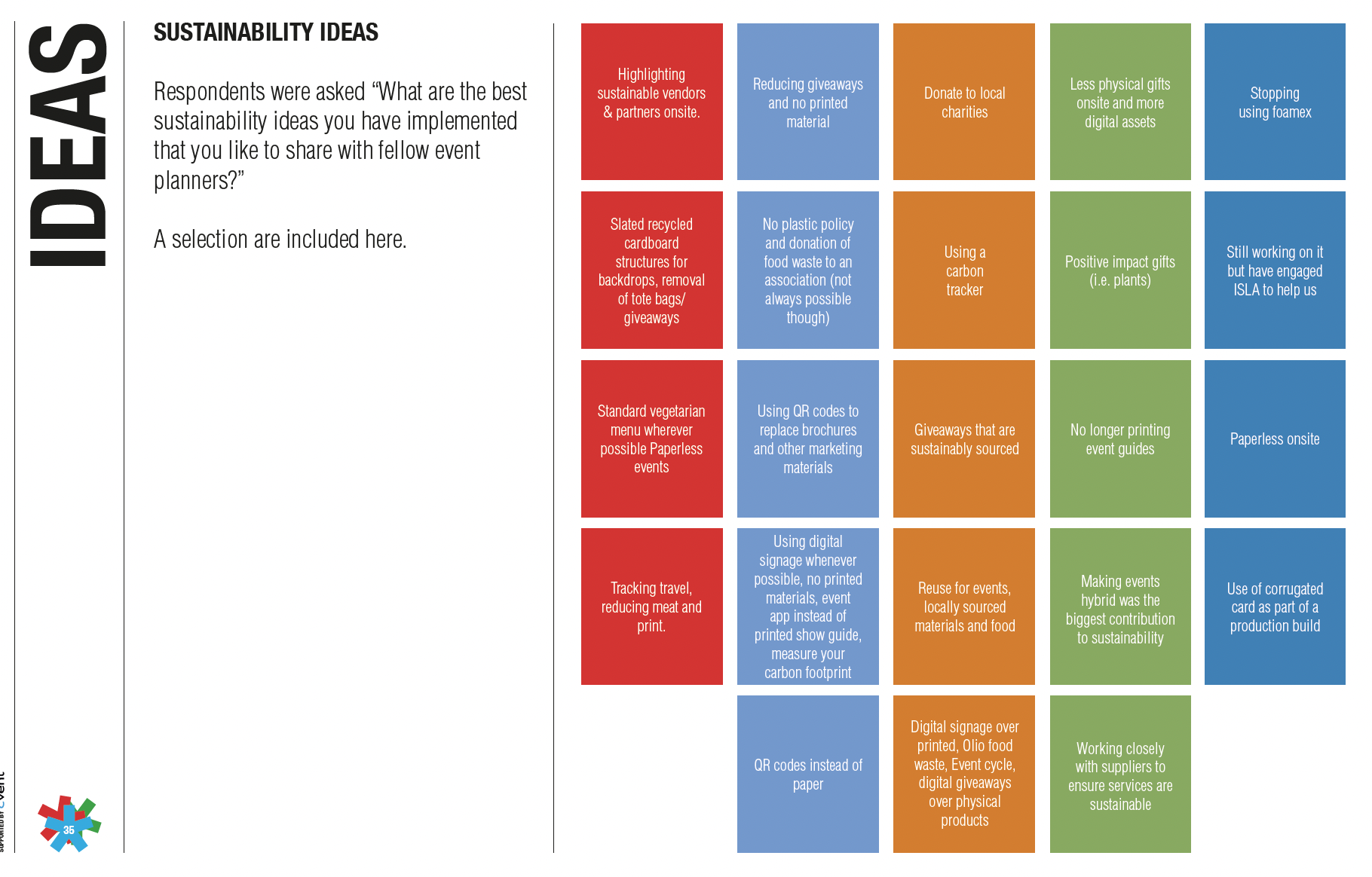
Despite the challenges, there is evidence that corporations are being creative about enhancing sustainability in their events and are open to cost-effective and creative ideas. This graphic shows some recent sustainability ideas which corporates have found effective:

sustainability in corporate events

ICE Corporate Event Planner Research 2024 supported by Cvent

The journey towards sustainability in corporate events is complex. While there has been a shift in immediate priorities due to budget pressures, it is nevertheless the case that corporates remain committed to integrating sustainable practices in the long term. This current phase of benchmarking and policy development is an important step towards achieving this goal. By leveraging data, setting clear goals, and adopting strategic initiatives, companies can navigate the challenges and make meaningful progress in their sustainability journey. As they continue to build a strong foundation for sustainability, the events industry can look forward to a future where sustainable practices are not just an option but a standard.

For more details on how event:decision can help meet your sustainability goals, get in touch.

https://eventdecision.com/wp-content/uploads/2024/07/Corporate-sustainable-events.png 768 1024 eventdec https://eventdecision.com/wp-content/uploads/2022/07/mainlogo-ed.png eventdec2024-07-09 06:53:452024-09-15 11:36:29Progress on sustainability in events: a corporate perspective

event:decision at Reset Connect

June 26, 2024/in event:decision, Track

event:decision presented at Reset Connect, part of London Climate Action Week.

The AEV (Association of Event Venues), AEO (Association of Event Organisers) and ESSA (Event Suppliers and Services Association) invited event:decision to update members on the State of Sustainability. As part of the Reset Connect show at London ExCel this was an excellent opportunity for Association members to understand and benchmark their organisations in wider event sustainability.

Members also had the opportunity in working groups to define areas of sustainability that the industry performs well, alongside elements that we can work together on to improve. Collated content will be made available to members shortly.

As requested, the deck delivered is here.

For more details on how event:decision can help meet your sustainability goals, get in touch.

https://eventdecision.com/wp-content/uploads/2024/06/event-image-for-blog.png 1152 1536 eventdec https://eventdecision.com/wp-content/uploads/2022/07/mainlogo-ed.png eventdec2024-06-26 06:42:072024-09-15 11:36:40event:decision at Reset Connect

Groundbreaking partnership in event sustainability announced

June 25, 2024/in event:decision, Track

Groundbreaking partnership between event:decision and the travel demand management platform You.Smart.Thing.

The collaboration will provide event organisers with the tools to facilitate personalised low-carbon journeys for event delegates, nudging them towards net-zero travel, and integrating comprehensive planning, delivery, and tracking of event environmental impacts.

Addressing the sustainability challenge of event travel

One of the most challenging aspects of event sustainability has traditionally been the accurate reporting and mitigation of travel impacts associated with delegate and visitor journeys. The sustainable event travel partnership between event:decision and You.Smart.Thing specifically addresses this issue within the Meetings, Incentives, Conferences, and Exhibitions (MICE) sector. Our new solution allows both B2B and B2C event planners to seamlessly include their audience’s travel patterns and the corresponding environmental impact in their sustainability reports, achieving an unprecedented level of accuracy through event:decisions’s Track reporting tool.

Innovative integration for sustainable travel

The integration of You.Smart.Thing’s platform into Track represents a significant advancement in the measurement and management of event travel impacts. Every Track report can now incorporate sustainable door-to-door travel planning powered by You.Smart.Thing. This global system recommends personalised low-carbon journey options, records mode choices, accounts for multimodal routes, and curates a visitor experience that encourages sustainable travel behaviours. With over 200 event brands already utilising event:decision’s  Track reporting service, this enhancement will enable event organisers to better understand and mitigate their events’ travel impacts.

Our commitment to sustainable event planning

Both partners are dedicated to providing formalised processes for planning, delivering, and tracking the environmental impacts of events. Matt Grey, Director at event:decision said:

“Whilst we’re delighted to be recognised as market leaders in event impact measurement and mitigation, automatically adding the capabilities of ‘You.Smart.Thing.’ into Track reporting takes our service to a completely new level. Now organisers of events, conferences, congresses, and exhibitions can both measure visitor travel impact and start to nudge visitors onto more sustainable modes of transport.”

Chris Thompson, CEO at You.Smart.Thing, added

“Partnering with event:decision is an important way for us to extend our commitment and reach into the corporate and agency-led market. We know that our large event and public sector clients already benefit hugely from our sustainable travel planning platform. We’re delighted to be able to bring this unique new product to the MICE market alongside event:decision.”

Case Study: The Commonwealth Games in Birmingham

An excellent example of the effectiveness of You.Smart.Thing’s platform was seen in the Commonwealth Games held in Birmingham. The platform played a crucial role in managing the travel demand and ensuring that the event’s transportation logistics were as sustainable as possible.

During the Games, You.Smart.Thing provided tailored travel advice to attendees, offering multimodal journey options that prioritised low-carbon transport methods. This included public transport, walking, cycling, and shared mobility services. The platform’s ability to provide real-time updates and personalised recommendations helped reduce the overall carbon footprint of the event.

Moreover, the data collected during the event enabled organisers to gain deep insights into travel behaviours and the effectiveness of various interventions. This data was invaluable in planning for future events, ensuring that sustainable travel options could be optimised and more widely adopted.

Enhancing the MICE sector

We expect the integration of You.Smart.Thing’s platform into our services to have a substantial impact on the MICE sector. By automating the measurement of audience travel patterns and their environmental impacts, event organisers can make more informed decisions that align with sustainability goals. This integration not only simplifies the process of collecting and analysing travel data but also provides actionable insights that can lead to tangible reductions in carbon emissions.

This sustainable event travel partnership sets a new standard for sustainability in events. As more event organisers adopt these advanced tools, the collective impact on reducing carbon emissions could be significant. The collaboration highlights the importance of innovation and cooperation in addressing global sustainability challenges.

For more details on how event:decision can help meet your sustainability goals, get in touch.

https://eventdecision.com/wp-content/uploads/2024/06/webimage.png 768 1024 eventdec https://eventdecision.com/wp-content/uploads/2022/07/mainlogo-ed.png eventdec2024-06-25 07:15:362024-09-15 11:36:49Groundbreaking partnership in event sustainability announced

Train or Plane? Encouraging Sustainable Event Travel

May 14, 2024/in event:decision, Track

Encouraging sustainable event travel is a decision that will significantly impact the event’s overall environmental footprint.

For event planners and professionals, the choice between train and plane travel involves weighing up not only carbon emissions but also the broader implications of each travel choice on sustainability. With increasing attention on reducing greenhouse gas emissions, making informed and conscientious travel choices is more under the spotlight than ever before. Here’s our comparison of the sustainability of trains versus planes plus some advice on how event planners can encourage more eco-friendly travel decisions to events.

Comparing the carbon footprint: train vs. plane

Statistics from the International Transport Forum and other research groups highlight that trains emit significantly less CO2 per passenger kilometre compared to planes. In regions where the electricity grid is largely powered by renewables, such as in key parts of mainland Europe, train travel becomes even more environmentally friendly, with emissions dropping to under 10 grams per passenger kilometre. The stark contrast in emissions is primarily due to the high energy efficiency of rail transport and the intensive fuel use involved in aviation, especially during takeoff and landing. Considering the entire lifecycle emissions, including manufacturing and maintenance, trains still maintain a significant advantage over planes.

But few pressed-for-time delegates seem to actively choose to travel by train because they feel guilty about the environment or because they are browbeaten into it. So how can event professionals sell the wider benefits of sustainable event travel of taking the train over the plane?

Benefits of train travel beyond pure emissions

More relaxed travel

Train travel offers a scenic route option that planes seldom match plus the comfort of larger legroom. The ability to move around just in itself can transform travel from just a transfer to an enjoyable part of the event experience.

Connectivity and accessibility

Trains often connect directly to city centres, reducing the need for additional transfers and the associated costs and emissions. This connectivity can really enhance the accessibility of events, particularly in urban areas where train stations are hubs of local and regional transport networks.

Economic benefits

For local economies, trains can bring more consistent foot traffic than planes, which is particularly beneficial for events aiming to boost local tourism alongside their primary activities.

Addressing the ‘inconvenience and time’ push-back of train travel

While trains may take longer than planes over long distances, the time spent travelling can be turned into a productive or restful period, rather than just transit. Modern trains offer much more comfortable seating than planes, Wi-Fi, and dining options, allowing delegates to work, relax, or socialise. For event planners, positioning train travel as a time to unwind before the start of the event or a chance to catch up on work, even schedule informal meetings with fellow travellers, can reshape perceptions about lengthy travel time.

And, the hassle of early airport check-ins, security checks, and time spent commuting to and from airports often actually negates the perception of the time saved by flying when you compare hour-by-hour. Trains typically require less stringent security procedures, allowing passengers to arrive closer to departure without the stress associated with airports.

How venue & event planners can promote sustainable travel choices

Incentivising train travel

Event planners can negotiate discounts with railway companies or include train travel as part of the event registration packages. Offering exclusive benefits for train travellers, such as upgrades, vouchers, or exclusive event carriages to travel to the event with fellow delegates, can also incentivise attendees to choose the greener option.

Iconic Luxury Hotels in the UK offers event planners a percentage of the contracted value back a as hotel credit, if 50% of the delegates arrive via public transport (terms apply) Now there’s thinking out of the box!

Providing detailed information

Providing attendees with comprehensive information about their travel options, including comparative carbon footprints and time considerations, can help everyone make more informed choices. Interactive tools that allow attendees to calculate their own travel emissions can also help the decision-making process.

Encouraging slower travel

Promoting the ‘slow travel’ concept, where the journey is part of the experience, can also make train travel more appealing. Organising pre- or post-event activities that can be enjoyed along the train route, or suggesting stopovers at points of interest, can turn sustainable event travel into a whole experience in itself.

Making sustainability part of the event identity

Embedding sustainability into the event’s brand – from the choice of venue to the activities included – sets a precedent for making sustainable choices, including travel. Highlighting the environmental commitment of the event can also inspire attendees to align their travel choices with the event’s values.

For event professionals, advocating for train over plane travel is not just about promoting sustainability but also enhancing the overall event experience. By focusing on the benefits and addressing the potential drawbacks of train travel creatively, event planners can encourage attendees to make choices that align with global sustainability goals without feeling coerced. In doing so, everyone in the events industry can take a leading role in advocating for and achieving significant reductions in travel-related carbon emissions.

For more details about Track (carbon reporting for events) get in touch and see how we can help you meet your sustainability goals.


https://eventdecision.com/wp-content/uploads/2024/05/plane_or_train.png 960 1280 eventdec https://eventdecision.com/wp-content/uploads/2022/07/mainlogo-ed.png eventdec2024-05-14 05:27:092024-05-20 08:52:14Train or Plane? Encouraging Sustainable Event Travel
better event measurement

The Future is Measured

April 3, 2024/in event:decision, Track

Why Better Event Measurement Means Better Event Planning

In the world of the event professional, the call for sustainability is no longer a whisper but a shout through the corridors of conference halls, the fields of festivals, and the digital spaces of virtual events.

Your attendees are not looking for you to solve the world’s problems via your event. But they are looking for you to publicly keep your promises to deliver sustainably.

Sustainability begins with an understanding of the impact of events – and to understand impact you need measurement. To plan sustainably, event planners must delve into the world of carbon footprints then extend their gaze beyond, and embrace an intricate web of analytics and data insights.

The crucial first step: carbon footprint calculation

Carbon footprint calculation is the cornerstone of sustainable event planning. It offers a quantifiable measure of the environmental impact that an event has through the emissions of greenhouse gases (GHG). By meticulously tracking everything from energy consumption of the venue to the transportation used by attendees, event planners can grasp the carbon costs of their events. Our own product Track is designed to make this simple for event planners with no need for data input or training on the part of the event planner.

But, calculating a carbon footprint isn’t just about tallying up numbers. It’s an exercise in environmental awareness, spotlighting the areas where an event’s environmental impact is most significant. Whether it’s through destination & venue selection, energy-efficient lighting, electronic ticketing, or sourcing local food to reduce transport emissions, each decision is a step towards a smaller carbon footprint.

Beyond carbon: the spectrum of sustainability metrics

Sustainability doesn’t begin and end with carbon. It covers a much broader spectrum that includes water usage, waste generation, and even the socioeconomic impacts on the local community. Effective sustainability measures requires a 360 degree view that captures not just the environmental, but also the social and economic aspects of an event.

For instance, water usage at events, often overlooked, can be substantial. Measuring this usage not only helps in reducing consumption but also in setting benchmarks for future events. Similarly, waste management – quantifying it, adopting ways to minimise it, and finding pathways for recycling and composting – plays a crucial role in sustainable event planning.

Complex decisions require in-depth measurement

Event planning is a series of complex decisions, each with its own sustainability implications. To make informed choices, event planners should use robust measurement tools that provide in-depth insights into every aspect of the event. event:decision has a suite of interlocking tools designed just for this purpose.

Insights call for detailed life cycle assessments of products and services used, evaluation of the supply chain for sustainability credentials, and analysis of attendee behaviour for insights into sustainable practices. The objective is to establish a holistic sustainability framework that can guide every decision, from the most mundane to the most significant.

The role of data insights and analysis

Don’t be frightened! Data insights and analysis are the compass by which event planners can navigate the rough seas of sustainability. Through careful data collection and analysis, planners can identify trends, predict outcomes, and assess the effectiveness of their sustainability initiatives. This can be a really simple process.

For example, by analysing the travel patterns of attendees, planners can offer more sustainable transport options or even adjust the event location. By gathering data on resource consumption, planners can identify opportunities for using renewable resources or cutting down on unnecessary usage.

Implementing sustainable event technology

Technology plays a crucial role in facilitating better measurement and analysis. Event technology can track real-time data on resource consumption, manage waste more efficiently, and even measure attendee engagement with sustainability initiatives.

From apps that help attendees travel more sustainably to platforms that facilitate virtual attendance – thus reducing the event’s carbon footprint – technology should be an enabler of sustainability, as well as the means to measure it. It also serves as a medium for transparency, allowing event planners to share sustainability metrics with stakeholders, thereby fostering an ethos of accountability.

This allows you to make your attendees feel good about attending, surely a must-have for all planners.

Challenges and opportunities

Measuring sustainability is not without its challenges. It requires a concerted effort from all stakeholders involved in an event, and it necessitates investment in the right tools and expertise. However, the opportunities it presents are significant. By adopting rigorous measurement practices, event planners can not only reduce the environmental impact of their events but also position themselves as leaders in the domain of sustainable event planning.

Will you get all the credit for delivering sustainably? Probably not.

But as someone once said:

It’s amazing what you can achieve when you don’t care who gets the credit.

To find out more about how we could work with you to achieve all your event sustainability and event measurement goals in 2024, get in touch.


https://eventdecision.com/wp-content/uploads/2024/04/the-future-is-measured.png 1344 1792 eventdec https://eventdecision.com/wp-content/uploads/2022/07/mainlogo-ed.png eventdec2024-04-03 06:19:032024-05-13 12:27:03The Future is Measured
the three 'why?'s of event sustainability

The Three ‘Why’s? in Event Sustainability

March 19, 2024/in event:decision, Track

Although sustainability in events encompasses many different motivating factors there are three ‘why?s’ most fall under: moral, legal and commercial.

Here’s event:decision’s summary of how to use these key drivers to get C-Suite attention and buy-in. And why you should.

The ‘Moral’ why: building trust, reputation, and ethical standards

The moral case for sustainability in the events industry is driven by a commitment to leave a positive impact on society and the environment. It stems from the belief that businesses hold a responsibility that extends beyond financial gains to include social and environmental stewardship.

Your audience doesn’t expect your business to solve all the planet’s problems. They do expect your event to deliver on the promises your business has committed to.

You can make money and do good; you can pursue something that has a purpose but also make it good for your brand.

Trust as a foundation for sustainable relationships

Trust is the cornerstone of any successful event. It encompasses the confidence that stakeholders, including attendees, sponsors, and the local community, place in an event organiser’s ability to deliver not only a remarkable experience but also to act responsibly towards people and the planet. Building trust requires transparency in operations, honest communication regarding sustainability efforts, and consistent delivery on sustainability promises.

Reputation: the intangible asset

An event’s reputation is a valuable but intangible asset. It is shaped over time through public perception and direct experience with the event’s brand. A visible commitment to sustainability will enhance your reputation, as it reflects a conscientious approach to business that resonates with public sentiment. Events that are perceived as ethical and responsible can often command a premium, attract better talent, and achieve higher levels of attendee satisfaction and loyalty.

Business ethics: the blueprint for behaviour

Business ethics are the principles that guide an event’s decisions and actions. They encompass a wide range of issues, from environmental stewardship and fair labour practices to anti-corruption measures and economic justice. By integrating these ethical considerations into the planning and execution of events, organisers can demonstrate moral leadership that not only sets industry standards but also contributes to a more equitable and sustainable future.

Operationalising moral values

Operationalising these moral values means embedding them into every facet of event planning and management. It entails conducting thorough ethical assessments of suppliers, choosing venues that are committed to sustainable practices, and designing events that minimise environmental impact while maximising social benefit.

By focusing on building trust, safeguarding reputation and adhering to rigorous business ethics, the moral driver of sustainability becomes a powerful force that not only shapes the operational approach of the events industry but also its broader impact on society and the environment.

This moral compass is crucial for guiding the industry towards a future where the success of an event is judged not only by its financial outcomes but by the positive legacy it leaves behind.

The ‘Legal’ why: navigating the framework of sustainability

The legal driver of sustainability in the events industry is becoming increasingly significant as both governments and NGOs worldwide introduce regulations aimed at reducing environmental impacts. In the UK, the legislative landscape is rapidly evolving, with a clear trajectory towards greater accountability and transparency in sustainability practices.

Climate Change Act: a benchmark for progress

The 2019 Amendment to the UK’s Climate Change Act has set an ambitious target for the country to achieve net-zero greenhouse gas (GHG) emissions by 2050, with an interim goal of a 50% reduction by 2030. This mandate acts as a benchmark for progress, compelling event organisers to rigorously assess and improve their carbon footprint.

For the events industry, this means rethinking every aspect of event planning and management, from your choice of venues and suppliers to transportation and waste management. Our sector must innovate to find new ways to reduce emissions, including consideration of digital solutions or hybrid events that can reduce the need for physical travel.

Streamlined energy and carbon reporting (SECR)

SECR is another critical piece of legislation that requires companies to report their energy use and carbon emissions. For event organisers, this means they must now have in place robust mechanisms for tracking and reporting energy consumption, whether it’s venue lighting, heating, or the power used by audio-visual equipment.

Corporate Sustainability Reporting Directive (CSRD)

The introduction of the Corporate Sustainability Reporting Directive (CSRD) in the European Union marks a significant step towards enhancing corporate transparency and accountability regarding environmental, social, and governance (ESG) matters.

As you would expect, it’s a complex piece, but essentially widens the reporting of carbon emissions from circa 9,000 to around 50,000 companies. Whilst few of these companies are event planners at heart, they are all event-industry customers.

The CSRD applies to three primary groups of companies: (1) all large companies in the EU, (2) small & medium enterprises listed on EU-regulated markets, and (3) non-EU companies with substantial business in the EU.

Will you be prepared when they ask you for data on the event you are planning for them?

Beyond compliance: leveraging legal drivers for innovation

While meeting legal requirements is a necessary aspect of sustainability, forward-thinking event organisers can leverage these drivers as opportunities for innovation.

By anticipating and exceeding legislative demands, events can achieve competitive advantage, build stronger stakeholder relationships, and enhance their reputation as industry leaders in sustainability.

Integrating legal drivers into strategic planning

Effective integration of legal drivers into event planning requires a proactive approach. Event organisers should stay abreast of legislative developments, engage with sustainability experts to understand the implications for their operations, and embed compliance into the core of their strategic planning processes.

The legal driver of sustainability is a dynamic and rapidly evolving force shaping the future of the events industry. By understanding and responding to the complexities of legislation such as the UK’s Climate Change Act, SECR, IFRS, and CSRD, event organisers can not only avoid the risks associated with non-compliance but also pave the way for a more sustainable and resilient industry. The need for compliance stimulates innovation, elevates ethical standards, and, ultimately, catalyses the transition towards a greener economy.

The ‘Commercial’ why: the economic incentive

Commercial drivers highlight the financial advantages of integrating sustainability into event planning and execution.

Contrary to outdated beliefs that sustainability comes at the expense of profitability, current evidence suggests that sustainable practices can enhance economic performance. Sustainability is now a core component of brand building in the events industry. Events with robust sustainability credentials can generate considerable goodwill and customer loyalty, as seen with brands like IKEA and Patagonia in consumer markets.

If you think that the event industry sits outside the models of our larger customers, think again. McKinsey have demonstrated the effectiveness of sustainability and profitability and also detail the (much more advanced than events) transition of another whole industry .

Innovating business models

The shift towards sustainability is leading to new business models. For instance, events focusing on sustainability will attract sponsors keen to associate with green initiatives, potentially creating new streams of revenue. event:decision is already seeing specific ESG-focussed sponsorship packages at major exhibitions.

Managing assets and costs

Events have to manage their physical and financial assets carefully. In a world where natural resources are becoming scarcer, and environmental risks are increasing, sustainable practices help manage costs and protect investments. For example, using renewable energy sources for events can buffer against the volatility in fossil fuel markets.

The value of efficiency and resilience

Sustainability can enhance operational efficiency and resilience. Events that minimise resource use or adopt circular economy principles can realise cost savings and avoid disruptions from supply chain issues. Moreover, sustainable practices can improve the reliability and predictability of event-related logistics.

Enhancing productivity and engagement

A sustainable event planning company is an appealing workplace. It will an attract employees who are motivated by environmental and social causes, which will lead to enhanced productivity and lower turnover rates. It can also foster greater engagement from all stakeholders, including suppliers, attendees, and the local community, leading to a more successful and impactful event.

Each of these three ‘why?s’ on their own make a compelling argument for a focus on sustainability in events, taken together they are impossible to ignore. If you would like to find out more about how we could work with you to achieve all your event sustainability and event measurement goals in 2024, get in touch.


https://eventdecision.com/wp-content/uploads/2024/03/Copy-of-Copy-of-Copy-of-sustainability-hero-event-decision-web-sized-.png 768 1024 eventdec https://eventdecision.com/wp-content/uploads/2022/07/mainlogo-ed.png eventdec2024-03-19 06:15:412024-04-01 17:20:17The Three ‘Why’s? in Event Sustainability
Page 2 of 512345

More News

  • That box is now on fire…April 8, 2026 - 8:58 am
  • Ten reasons why measurement gives better outcomes than certificationMarch 30, 2026 - 11:11 am
  • Think CSRD is just about carbon?March 23, 2026 - 8:51 am
  • Table Stakes?March 20, 2026 - 11:59 am
  • What’s up in other sectors?March 12, 2026 - 8:13 am
  • So, how did it go?March 5, 2026 - 11:09 am
  • Accreditation or Performance Benchmarking? The Arguments.March 3, 2026 - 9:39 am
  • M&E: Crossing the accreditation / performance borderMarch 3, 2026 - 8:11 am
  • An RFP sustainability narrative generator?February 23, 2026 - 2:03 pm
  • High-Performing ESG Enhances Brand Value and Mitigates RiskFebruary 23, 2026 - 11:07 am
  • event:decision disrupts sector pricingFebruary 11, 2026 - 2:31 pm
  • It’s More Acceptable to Fart in a LiftFebruary 9, 2026 - 10:26 am
  • About Us
  • Partners
  • Resources
  • Client Login
  • Create An Account
  • Track
  • Impact
  • Navigator
  • Evolve
  • Tel: +44 (0)333 202 6985
  • Email: hello@eventdecision.com
© Copyright 2024 Event Decision | Privacy Policy | Bespoke Website Design by Lemongrass Media
  • LinkedIn
  • Instagram
Scroll to top