event:decision
  • Home
  • Our Products
    • Track
    • Impact
    • Navigator
    • Evolve
  • About Us
    • Our Company
    • Clients
  • Resources
    • Responsible Futures
    • Blog
    • Responsible Agency Index
  • Contact Us
  • Client Login
  • Search
  • Menu Menu
  • LinkedIn
  • Instagram

Why Do UK Hotel Venues Lag in Sustainability?

July 11, 2023/in Track

There are challenges in achieving sustainability for UK hotel venues

The publication of the 2023 Cornell Hotel Sustainability Index at the end of last month revealed that the UK doesn’t feature in the top 3 countries where hotels rank highly for sustainability (these are Norway, Sweden and Costa Rica). While many countries have made substantial progress, the UK faces unique challenges in its quest for fully sustainable hotel venues. What are these challenges, and what questions should event profs ask when shortlisting hotel venues for their events?

The UK’s Sustainable Hospitality Landscape

The United Kingdom has been proactive in promoting sustainability initiatives across various sectors, including the hospitality industry. However, several factors contribute to the struggle faced by hotel venues in achieving full sustainability.

1. Aging Infrastructure:

One significant challenge faced by hotel venues in the UK is our aging infrastructure. Many historic and iconic venues possess architectural features that limit the implementation of modern sustainable practices, such as energy-efficient systems, renewable energy generation, and effective waste management.

2. Limited Space for Renewable Energy:

The UK’s smaller land area compared to other countries also presents a constraint when it comes to incorporating renewable energy solutions. Hotel venues often struggle to find sufficient space for installing solar panels or wind turbines, limiting their capacity to generate clean energy.

3. Regulatory Framework and Policy:

The regulatory framework and policies in the UK, while supporting sustainability goals, can also pose obstacles for hotel venues.

i. Complex Planning Permissions:

Obtaining planning permissions for sustainable infrastructure installations can be a complex and time-consuming process in the UK. The bureaucratic hurdle makes it challenging for hotel venues to implement sustainable practices within a reasonable timeframe.

ii. Unclear Incentives:

While the UK government offers incentives and grants for sustainable initiatives, these programs may lack clarity or have limited accessibility. The absence of clear guidelines and consistent support makes it difficult for hotel venues to navigate the sustainability landscape effectively.

4. Supply Chain Challenges:

The pursuit of sustainability requires collaboration throughout the entire supply chain, which can be a challenging task for hotel venues in the UK.

5. Local Sourcing Limitations:

Despite the rising demand for locally sourced products and services, the UK faces limitations in terms of local availability. Hotel venues often struggle to find reliable local suppliers for sustainable materials, food, and beverages, hindering their ability to embrace a fully sustainable approach.

6. Transportation and Logistics:

Logistics and transportation play a crucial role in sustainability efforts. The UK’s dense urban environment, coupled with limited public transport infrastructure, increases reliance on road transportation. This reliance on vehicles can have a significant environmental impact, particularly when it comes to large-scale events hosted by hotel venues.

With all the above in mind, here’s our handy checklist for exploring the suitability of hotel venues for your event.

Key Questions for #EventProfs Investigating Hotels & Venues

1. What sustainable initiatives has the venue implemented? (e.g., energy-efficient systems, waste management practices, water conservation measures)

2. Does the venue have any certifications or accreditations for sustainability? (e.g., LEED certification, Green Key, ISO 14001, EcoSmart)

3. What renewable energy sources are used or planned for the venue?

4. How does the venue manage waste and recycling? Are there any composting or recycling programs in place?

5. Does the venue have a clear sustainability policy and targets?

6. What efforts are made to source local, seasonal, and sustainably produced food and beverages?

7. How does the venue encourage sustainable transportation options for guests and event attendees?

8. Are there any partnerships with local sustainability-focused organisations or suppliers?

9. Does the venue have plans for ongoing sustainability improvements and innovations?

10. What support does the venue provide to event planners in achieving sustainability goals?

While the UK has embraced sustainability and made progress in various sectors, achieving full sustainability in UK hotel venues continues to pose unique challenges. Event planners should be aware of this and ask critical questions when investigating hotel venues for their events. Even within the challenging environment, hotels can still demonstrate that they are making steps to achieve sustainability and help event planners meet their sustainability targets.

If you’re interested in finding out more about sustainable event planning, get in touch to find out how our tool track can calculate your event’s projected carbon footprint and help you evaluate the impact of different venue choices.

https://eventdecision.com/wp-content/uploads/2023/07/top_three_edblog.png 768 1024 eventdec https://eventdecision.com/wp-content/uploads/2026/04/mainlogo-ed.png eventdec2023-07-11 05:00:052023-07-25 10:27:40Why Do UK Hotel Venues Lag in Sustainability?

Hotel Sustainability: How Green is Your Venue?

July 4, 2023/in Track

The Cornell Hotel Sustainability Index: A Valuable Tool for Event Planners

Event planners play an important role in ensuring that gatherings, conferences, and meetings are not only successful but also environmentally responsible. One useful tool that event planners can use to assess and compare the sustainability efforts of hotels is the Cornell Hotel Sustainability Index (CHSI). The (CHSI) is the biggest industry benchmark and provides a standardised framework for evaluating and measuring hotel sustainability, using Hotel Carbon Measurement Initiative (HCMI) and Hotel Water Measurement Initiative (HWMI) metrics from over over 20,000 properties to track energy, greenhouse gas emissions and water usage. The 2023 report just out indexes data from 25,576 hotels from 31 international hotel groups and has some fascinating findings.

But, first a bit of history and an overview of what the CHSI is and what it covers;

History of the Cornell Hotel Sustainability Index

The Cornell Hotel Sustainability Index, also known as the CHSI, was developed by the Center for Hospitality Research at Cornell University’s School of Hotel Administration. The index was introduced in 2011 as an initiative to assist the global hospitality industry in measuring and improving sustainability practices. With the aim of providing a consistent benchmarking tool over time, and across geographical locations, the CHSI enables hotels to assess their sustainability performance and to identify areas for improvement.

Coverage and Components of the CHSI

The CHSI covers a broad range of sustainability-related areas within the hotel industry. It evaluates and measures sustainability efforts in six key categories:

  1. Environmental Management: Focuses on environmental policies, practices, and certifications, such as energy efficiency, water conservation, waste management, and green building certifications like LEED (Leadership in Energy and Environmental Design).
  2. Operational Practices: Examines day-to-day operational activities and procedures, including purchasing practices, supplier relationships, employee training, and guest engagement programs.
  3. Social Impact: Evaluates the hotel’s impact on local communities, including social responsibility initiatives, community involvement, and employee well-being programs.
  4. Human Resources: Assesses human resource practices, such as employee satisfaction, diversity and inclusion, talent development, and labor practices.
  5. Risk Management: Focuses on the hotel’s preparedness and resilience to various risks and emergencies, including crisis management plans, safety procedures, and disaster response.
  6. Innovation: Recognises and rewards hotels for their innovative sustainability practices, encouraging the industry to continually evolve and adopt new environmentally friendly technologies and approaches.

Key Findings 2023 CHSI

The 2023 report provided key findings as follows;

  • Average hotel greenhouse gas (GHG) emissions per square meter have reduced by 30.42% between 2019 and 2021 (the full year on which the 2023 Index is based).
  • The best performers in the Top 25% of hotels are emitting 2.5x less than the hotels in the bottom 25%.
  • Renewable energy is key to reducing hotel carbon emissions.
  • Luxury hotels tend to have the highest carbon intensities compared to other segments.
  • Limited-service hotels are less carbon intensive than full-service hotels.
  • The limited service segment is reducing emissions faster than the full-service segment.
  • Resort properties are slower to reduce GHG emissions than other properties.
  • The top three countries with the lowest hotel GHG intensity were; Norway – 13.5 (kgCO2e/m2), Sweden – 14.9 and Costa Rica – 15.6.
  • The bottom three countries with the highest hotel GHG intensity were; Hong Kong, China – 214.5 (kgCO2e/m2), Barbados – 194.5 and Kuwait – 167.0.

Why use the Cornell Hotel Sustainability Index (CHSI)?

Being aware of the CHSI could provide event planners with several advantages:

  1. Sustainability Alignment: Event planners who prioritise sustainability in their events can use the CHSI as a valuable tool to identify hotels that align with sustainability goals. By selecting hotels with higher CHSI scores, event planners can ensure that their event venue shares their commitment to environmental responsibility.
  2. Benchmarking and Comparison: The CHSI offers a standardised framework for evaluating and measuring hotel sustainability performance. Event planners can use the index to benchmark and compare different hotel venues based on their sustainability practices, empowering them to make informed decisions and choose hotels that demonstrate strong sustainability performance, setting higher standards for the industry.
  3. Transparent Evaluation: The CHSI provides a transparent evaluation of hotels’ sustainability efforts. Event planners can review the index to gain insights into the specific areas where hotels excel or need improvement in terms of sustainability practices, enabling event planners to ask targeted questions, have informed discussions with hotels, and ensure that sustainability considerations are adequately addressed in event planning and execution.
  4. Event Reputation and Stakeholder Expectations: Sustainability has become an essential factor in shaping the reputation and image of events. Event planners who select hotels with higher CHSI scores demonstrate their commitment to hosting sustainable events. This, in turn, enhances their reputation among attendees, sponsors, and other stakeholders who increasingly prioritise environmental responsibility.
  5. Collaboration Opportunities: The CHSI highlights hotels that are leading the way in sustainable practices. Event planners can leverage this information to initiate collaborations and partnerships with hotels that prioritise sustainability. Collaborations can lead to shared knowledge, innovative event solutions, and the creation of more environmentally friendly event experiences.
  6. Positive Impact and Legacy: By choosing hotels that prioritise sustainability, event planners contribute to reducing the environmental impact of events. By promoting sustainable practices through venue selection, waste reduction, energy efficiency, and more, event planners are contributing to fostering a culture of sustainability within the events industry.

If you’re interested in finding out more about sustainable event planning, why not explore our tool track  to calculate your event’s projected carbon footprint. If you get in touch, we can give you a demo to illustrate just what it could do for you.

https://eventdecision.com/wp-content/uploads/2023/07/Copy-of-Event-Decision-blog-.png 768 1024 eventdec https://eventdecision.com/wp-content/uploads/2026/04/mainlogo-ed.png eventdec2023-07-04 06:37:082023-07-10 13:36:19Hotel Sustainability: How Green is Your Venue?
CSRD

Why UK Event Planners Can’t Ignore the EU Corporate Sustainability Reporting Directive (CSRD)

June 20, 2023/in Track

What are the implications for UK event planners of the EU CSRD?

The EU Corporate Sustainability Reporting Directive (CSRD) is a significant development in corporate reporting, and it begins with mandatory reporting in 2025 for the 2024 financial year for large companies. While the United Kingdom has exited the European Union, its impact on companies operating in the EU shouldn’t be underestimated. In this article we aim to provide UK event planners with a comprehensive understanding of the CSRD and the implications it holds for our industry.

Understanding the CSRD

The CSRD, proposed by the European Commission, represents a major step towards creating a more sustainable and transparent business environment within the EU. It is an extension of the existing Non-Financial Reporting Directive (NFRD) and aims to enhance corporate reporting by introducing stricter sustainability disclosure requirements. The directive seeks to introduce more comprehensive reporting standards and ensure that companies disclose information aligned with internationally recognised frameworks, such as the Global Reporting Initiative (GRI) and the Sustainability Accounting Standards Board (SASB).

The CSRD will require companies operating in the EU to:

  • Publicly report their ESG performance as it aligns with the CSRD – and do this annually.
  • Report on their entire value/supply chain, not just their own operations.
  • Ensure due diligence, which will be mandatory.
  • Get ‘limited’ assurance on their sustainability reporting from a trusted third party who will audit their data to ensure it’s accurate and legitimate.
  • Roll out the process in a timeline spreading over several years, starting with larger companies first.

Implications for UK Event Planners

While event planners may not immediately associate themselves with sustainability reporting, the CSRD has far-reaching implications for the industry. Event planners in the UK cannot afford to ignore this directive for the following reasons:

  1. Client expectations and reputation: in an increasingly sustainability-conscious world, businesses are prioritising environmentally-friendly practices and seeking partners who align with their values. Companies that operate within the EU and adhere to the CSRD requirements will be under pressure to work with event planners who can contribute to their sustainability goals, as they have to report on their entire value and supply chain. Ignoring the CSRD may lead to missed opportunities, loss of clients, and damage to the reputation of event planning companies that fail to integrate sustainability practices into their operations.
  2. Regulatory compliance: although the UK is no longer an EU member state, event planning companies operating across borders or organising events within the EU will still need to comply with the CSRD. Non-compliance could result in both reputational damage & legal consequences including fines. By staying ahead of the game and proactively aligning practices with the CSRD, event planners can ensure compliance, minimise risks, and maintain a competitive edge in the EU market.
  3. Event impact and reporting: the CSRD emphasises reporting on environmental, social, and governance (ESG) factors. Event planners can expect increased scrutiny regarding the sustainability impacts of the events they organise, including carbon emissions, waste management, and community engagement. Meeting these reporting requirements will necessitate a greater focus on sustainable event management practices, from sourcing eco-friendly suppliers and reducing waste to promoting social inclusivity and incorporating diversity. By proactively incorporating sustainability into all event planning processes, planners and agencies can demonstrate their commitment to responsible business practices and meet the expectations of clients, attendees, and regulatory bodies.

To navigate the changing landscape effectively, event planners in the UK should consider the CSRD as a huge opportunity – one that will help them effectively integrate sustainability into their business practices. By staying informed about the directive’s developments, understanding the reporting requirements, and actively pursuing sustainable strategies, event planners can position themselves as leaders in the industry, attract a wider client base across the EU and beyond, and contribute to the global sustainability agenda.

The introduction of the EU Corporate Sustainability Reporting Directive may seem unimportant to UK event planners right now, because of Brexit. However, the interconnected nature of business and the global focus on sustainability means it’s vital for event planners to sit up and pay attention. By proactively embracing sustainability reporting and aligning their practices with the CSRD, event planners can gain a competitive advantage, foster client trust, ensure regulatory compliance, and contribute to a more sustainable future. Ignoring the CSRD is not an option; it’s time for event planners in the UK to embrace the opportunities it presents and lead the way towards a more sustainable event industry

If you’re interested in finding out more about how our event carbon footprint calculator – track – can help achieve CSRD compliance and reporting requirements. Please get in touch, we can give you a demo and show you some more sample reports to illustrate what it could do for you.

https://eventdecision.com/wp-content/uploads/2023/06/CSRD.png 768 1024 eventdec https://eventdecision.com/wp-content/uploads/2026/04/mainlogo-ed.png eventdec2023-06-20 06:00:402023-06-24 07:15:35Why UK Event Planners Can’t Ignore the EU Corporate Sustainability Reporting Directive (CSRD)
Let's ban the phrase 'wherever possible'

Let’s Ban ‘Wherever Possible’

May 31, 2023/in Track

It’s time to turn talk into action

There’s one phrase we hear on the lips of event planners all the time that we need to consign to the bin. That phrase is ‘wherever possible’ when discussing implementing sustainable practices. It’s time to stop seeing sustainable choices as an optional extra and start seeing them as the only option.

Despite the growing awareness and urgency surrounding sustainability, event planners still find themselves making excuses to avoid implementing sustainable practices. One reason is the misconception that sustainable choices are costly and time-consuming. While some sustainable alternatives may require initial investments or additional planning, they often prove to be cost-effective and more profitable in the long run. Another reason could be resistance to change within our industry. We talk as a dynamic and nimble industry, but as event profs we may be comfortable with tried and tested methods and resistant to adopting new practices, fearing disruptions or resistance from clients. A lack of knowledge and awareness about sustainable options and their impact could also be contributing to a general reluctance to take sustainability more seriously and to keep trotting out the sentence ‘we’ll implement sustainable practices wherever possible’. Overcoming excuses requires a shift in mindset, a willingness to explore innovative solutions, and proactive education about the benefits and feasibility of sustainable event planning – the latter is where we come in.

“Sustainable event planning is no longer an option but an imperative. It’s time to transform words into actions and take responsibility for the impact our events have on the planet and in society. Sustainable events are efficient events, so we’ll be able increase event ROI at the same time – push back to your clients & stakeholders.”

Matt Grey, Founder, event:decision

As event planners, we hold the power to make a significant impact on the environment and society through our actions. Sustainable event planning is no longer a trend but a necessity. While it’s easy to make excuses for not implementing changes, it’s crucial to recognise that these choices have far-reaching consequences. It’s time to turn our words into action and take responsibility for creating events that leave a positive legacy.
  1. Start with small steps – implementing sustainable practices may seem overwhelming, but the key is to start with small steps. Begin by evaluating your event’s impact on the environment and identify areas where improvements can be made. Consider elements such as waste management, energy consumption, transportation, and sourcing of materials. By making small changes in these areas, you can quickly build a more sustainable event.
  2. Collaborate with sustainable suppliers – event planning is a collaborative effort, and partnering with sustainable suppliers can make a significant difference. Seek out suppliers who prioritise eco-friendly practices, use renewable resources, and minimise waste. From caterers who source sustainable food choices to venues that prioritise energy-efficient systems, there are plenty of options available. By choosing responsible suppliers, you not only support their sustainable initiatives but also set a positive example for the industry.
  3. Educate and engage participants – sustainability is a collective effort, and involving event participants is crucial. Educate attendees about the importance of sustainable practices and inspire them to contribute. Encourage them to carpool or use public transportation to reduce emissions, provide recycling and composting facilities, and avoid single-use plastic items. Engage participants through interactive sessions, workshops, or nudges that encourage sustainable lifestyles and innovations. By creating an inclusive and environmentally conscious event culture, you can inspire long-lasting change.
  4. Embrace technology – technology offers a plethora of opportunities to reduce our ecological footprint. Embrace digital invitations and registration systems to minimise paper waste. Utilise event apps or virtual platforms to provide schedules, maps, and resources, eliminating the need for printed materials. There are tons of vendors in this area. Additionally, leverage technology such as our carbon footprint measurement tool track, to track and measure the environmental impact of your event, allowing you to make data-driven decisions for future improvements.
  5. Leave a positive legacy – every event leaves a lasting impact, and it’s essential to consider the legacy you want to create. Sustainable event planning involves minimising negative effects and maximising positive outcomes. Explore opportunities for social and environmental initiatives within your event. Partner with local charities, organise community clean-ups, or support causes aligned with your event’s theme. By leaving a positive legacy, you inspire others to follow suit and make a difference in their own events.
Sustainable event planning is no longer an option, a ‘wherever possible’, but an imperative. It’s time to transform words into meaningful actions and take responsibility for the impact our events have. And sustainable events are efficient events so prioritising this will result in increasing profits too – a win:win.  By starting with small steps, collaborating with sustainable suppliers, educating participants, embracing technology, and leaving a positive legacy, we can create a ripple effect of change throughout the event planning industry. Let’s make sustainability the standard for events and leave a lasting positive impact on the world, one event at a time.

If you’re interested in finding out more about the practicalities of sustainable event planning, you can use track  to calculate your own event’s projected carbon footprint. Please get in touch, we can give you a demo and show you some more sample reports to illustrate just what it could do for you.

https://eventdecision.com/wp-content/uploads/2023/05/zip.png 768 1024 eventdec https://eventdecision.com/wp-content/uploads/2026/04/mainlogo-ed.png eventdec2023-05-31 05:57:522023-06-12 13:08:18Let’s Ban ‘Wherever Possible’
event sustainability quote

Turning Measurement into Action on Event Sustainability #SOS23

May 23, 2023/in Track

event:decision is helping the events industry deliver on sustainability

Last week we released the findings of our first annual State of Sustainability report, the aggregated data from the hundreds of events and planners that are using our sustainability tool track to deliver more sustainable and efficient events. But simply measuring the carbon footprint of an event, while a crucial first step, isn’t enough. That measurement must then lead to action to reduce emissions impact.

“TRACK isn’t just about measurement – it’s about action too. Our aggregate data shows that in the last year we’ve helped the events industry save emissions equivalent to 1,000 London to New York flights”.

Matt Grey, Founder event:decision

The illusion of progress

Think about a chef who measures ingredients but then fails to use their skills to create a memorable dish. Or, a doctor diagnosing their patient’s illness but then not prescribing any treatment. In both those cases measuring, or assessing, without follow-up action is fairly ineffectual. The same applies to the measurement of a carbon footprint in the events industry. Measuring provides valuable insights into the environmental impact of an event, allowing event planners to identify the major areas of concern. However, without any accompanying action, measuring alone can create a dangerous illusion of progress. To use yet another analogy; a company that tracks customer satisfaction through surveys and questionnaires but doesn’t take the necessary steps to address any dissatisfaction, may feel they are doing enough by listening but will probably rapidly lose their customers.

Pre and post event measurement highlights action

Our sustainability tool track is unique (we believe globally), in that it allows for both pre and post event measurement which highlights exactly what action has been taken and the subsequent reduction in carbon emissions which have resulted. Findings from our State of Sustainability report across all the aggregated data revealed an impressive 8% average reduction in the carbon footprints of events using the tool. That’s between the footprint projected at the planning stage versus the final footprint of the actual event.

Action taken varies from event to event but typically includes:

  • Re-thinking the location of the venue to ensure sustainable travel options are available
  • Considering hybrid real and online options where appropriate
  • Planning accommodation choices carefully to maximise walking and public transport options
  • Offering sustainably-sourced food and a comprehensive waste and recycling plan on-site

Any or all of these choices, together with many other smaller decisions, can make a big impact on sustainability if factored in at the planning stage of any event, as the event planners who use our tool track have been able to demonstrate.

The results of taking action

That 8% average reduction across the hundreds of events that were planned using our tool is equivalent to 1,000 London to New York flights, or a whole two and a half day Europe-wide 450 delegate in-person conference with flights, transfers, accommodation, stage-set, AV and all food and beverage. Or, the same as filling up 3,576 London double deckers! All of which goes to show that when you move from measurement to action you really can make a big difference.

If you’re interested in finding out more about sustainable event planning, you can use track  – the tool used by the event planners in our report – to calculate your own event’s projected carbon footprint. Please get in touch, we can give you a demo and show you some more sample reports to illustrate just what it could do for you.

https://eventdecision.com/wp-content/uploads/2023/05/Event-Decision-quote-1.png 768 1024 eventdec https://eventdecision.com/wp-content/uploads/2026/04/mainlogo-ed.png eventdec2023-05-23 05:19:012023-06-12 13:08:27Turning Measurement into Action on Event Sustainability #SOS23
State of Sustainability

State of Sustainability 2023 #SOS23

May 16, 2023/in Track

event:decision launches an annual report on the state of sustainability in events.

At event:decision we’re now mid-way through our second year in business measuring the carbon impact of the event industry through our sustainability tool track. With unparalleled access to a wealth of hugely useful data from across the industry, the launch of an annual State of Sustainability report releases for the first time findings from the hundreds of events and planners that are using track to deliver more sustainable and efficient events.

SOS ’23 Findings

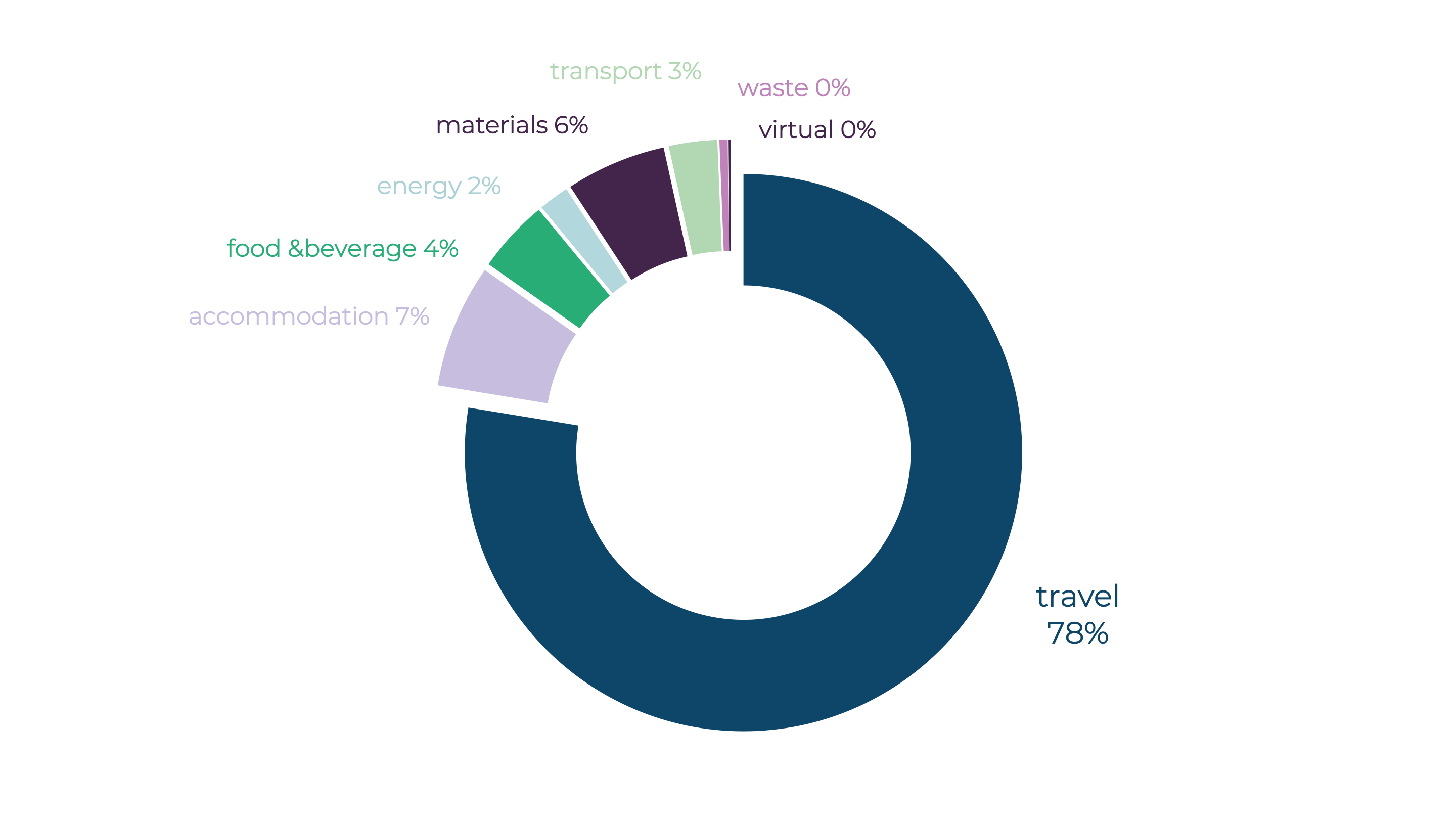
Data runs from April 2022 to May 2023 and shows an average event carbon footprint of 117 tCO2e. This is broken down into the key event components as follows:

State of Sustainability Report 2023

  • 78% of the overall footprint from travel
  • 7% from accommodation
  • 6% from materials
  • 4% from food and beverage

Of events reported on within this time period, 54% are UK events, and 46% elsewhere globally.  89% are in-person events, with 6% hybrid and 5% fully virtual.

NB Removing global events (with high flight emissions profiles) does not typically significantly alter the proportions of flights, accommodation, F&B, energy, materials, freight and waste.

Perhaps the most striking finding from the data however, comes in the comparison between pre and post event carbon footprints. Using track at the planning stage has empowered hundreds of event planners to make decisions which have resulted in a significant reduction in the climate impact of their event. As event:decision founder Matt Grey explains

“Our data shows that reductions in carbon footprints, through pre-event planning, range from 4% to 44% across agency portfolios. And the largest single-event mitigation was an impressive 95%”.

Matt Grey, Founder event:decision

What areas have the greatest impact?

Unsurprisingly, the data shows that there is a significant impact on emissions associated with getting to and from events, with travel accounting for an average of 78% of all events’ carbon footprints (we measure a large number of events with significant flight profiles). There are relatively small proportions associated with materials, freight and waste, however, which may come as a surprise to event planners.

Matt comments that the data highlights that event planners may be focusing their current sustainability efforts in the wrong places;

“It’s very easy to devote a lot of time and effort on factors that are visible at an event (badges, lanyards, menus etc) which, of course, we still need to do. It’s much harder though to devote significant effort to the mitigation of invisible factors, such as travel and accommodation, which affect the meeting format as a whole. But these are the areas which desperately need our industry focus.”

Matt Grey, Founder event:decision

Progress in sustainability is being made

It’s important to emphasise that huge progress is being made in sustainability for events. Only four years ago, just prior to Covid, no event specific carbon footprint measurement tools were available. Sustainability was a small section, if included at all, within brand event briefs, while very few venues were accredited to sustainability standards – in fact, few standards existed. Into this environment event:decision was founded in Mar 2021 with Net Zero Carbon Events following in Aug 2021. Matt comments

“A fundamental shift has started. Whether due to concern for climate change or fear of the brand risk associated with conspicuous consumption – change is happening. The next trick, is how to make it meaningful?”

Matt Grey Founder event:decision

So, armed with the knowledge from this data, what do event planners need to do? We suggest our seven point action plan, which starts and ends with measurement.

A Sustainability Action Plan for event planners

  1. Measure – create a projected carbon footprint.
  2. Select destinations carefully (think ‘access’)  – plan with travel in mind, event:decision can accurately predict travel footprints for specific venues and destinations and compare them.
  3. Select venues carefully (think ‘power’) – using renewable venue power makes a significant difference.
  4. Consider F&B – move away from meat where you can (especially beef), it makes a difference to the F&B element, if not a hugely significant one to the event as a whole.
  5. Use local supply for kit & crew (not just for transport mitigation, but crew accommodation and subsistence also).
  6. Build stands locally – using local materials and labour.
  7. Measure – post event, measure the projected carbon footprint to demonstrate your savings.

This is the first of our State of Sustainability reports and we will be using these annually to track how we are performing as an industry. The timing is significant as just on the horizon is the Corporate Sustainability Reporting Directive (CSRD), an EU directive requiring large and listed companies to publish regular reports on the social and environmental risks they face, and on how their activities impact people and the environment. It is EU legislation but will affect all companies of a significant size operating in the UK. Measurement will become even more important in order to accurately report progress in sustainability.

“There is no way to tell how well you are doing unless you measure!”

Matt Grey, Founder event:decision

If you’re interested in finding out more about sustainable event planning, you can use the carbon footprint calculator track  – used by the event planners in our report – to calculate your own event’s projected and actual carbon footprint. Please get in touch, we can give you a demo and show you some more sample reports to illustrate just what it could do for you.

https://eventdecision.com/wp-content/uploads/2023/05/State-of-Sustainability-.png 768 1024 eventdec https://eventdecision.com/wp-content/uploads/2026/04/mainlogo-ed.png eventdec2023-05-16 11:00:312023-05-16 15:26:43State of Sustainability 2023 #SOS23
sustainability

The Events Industry Can Lead the World in Sustainability

May 10, 2023/in Track

The events industry has lagged but now has the chance to become a world-leading exemplar in sustainability

The events industry has been slow to engage with the issue of sustainability, but there are welcome signs of change. The COVID-19 pandemic provided an opportunity (albeit an unwelcome one) for the industry to take a step back and rethink how events are planned and executed, and to be more flexible and creative as a result. With a global focus on environmental impact, there is suddenly a real opportunity for the industry to transform itself to become a leading sector in sustainability.

Three key areas provide the key to unlocking best practices: reducing waste, reducing carbon emissions, and promoting sustainable actions.

Reducing Waste

One of the biggest challenges facing the events industry is waste reduction. Events generate large amounts of waste, including single-use plastics, food waste, and materials used in event production. To reduce waste, event organisers must focus on reducing, reusing, and recycling.

Reducing waste can be achieved through a range of strategies, such as sourcing local and sustainable materials, reducing the amount of packaging used, and encouraging attendees to bring their own reusable water bottles and coffee cups. Reusing materials, such as event signage and decorations, can also help to reduce waste, as can recycling materials such as paper, cardboard, and plastics.

Some events have already made big progress in reducing waste. The Glastonbury Festival in the UK has implemented a range of sustainability initiatives, including a reusable cup scheme, composting toilets, and a food waste reduction program.

Reducing Carbon Emissions

Another key area where the events industry can make a significant impact on sustainability is by reducing carbon emissions. Events generate large amounts of carbon emissions through travel, energy consumption, and event production. To reduce carbon emissions, event organisers must focus on reducing energy consumption, promoting sustainable transportation, and only then by offsetting emissions.

Reducing energy consumption can be achieved through a range of strategies, such as hosting virtual events where appropriate, either wholly or within a hybrid format. On-site things to consider include; using LED lighting on-site, reducing the use of air conditioning, and encouraging attendees to use public transportation or carpool to the event. Promoting sustainable transportation, such as cycling or walking, is a key part of helping to reduce carbon emissions.

Offsetting carbon emissions is another strategy for reducing the environmental impact of events (although not producing the emissions in the first place is always the preferred strategy). This could be initiatives such as investing in renewable energy, carbon capture (well-known as planting trees)), or supporting community projects that promote sustainability.

Promoting Sustainability

The events industry needs to not just pay lip service but actively promote sustainability, raising awareness of the importance of sustainability among attendees, suppliers, and partners. This can be achieved through a range of strategies, such as providing information on sustainability initiatives, offering sustainability training, and promoting sustainable products and services. Working with suppliers and partners to promote sustainability is also key, through initiatives such as sustainability clauses in contracts, supplier audits, and sustainability scorecards.

Social sustainability is an important aspect to consider – evaluating the impact of events on local communities and working to ensure that events benefit everyone involved.

For example, events can partner with local charities or businesses to provide opportunities for attendees to give back to the community. It’s also important for the events industry to consider the impact of events on the mental and physical well-being of attendees and your event staff – including those who serve your lunch and drinks, take away your rubbish and service your hotel bedrooms.

One major challenge in achieving sustainability in the events industry is the lack of standardised metrics and reporting. There is currently no consistent way to measure the environmental and social impact of events, which makes it difficult for companies and event planners to set goals and track progress. However, the United Nations has developed a set of sustainable development goals (SDGs) that provide a framework for sustainable development across a range of industries. These goals can be used to guide the events industry in developing sustainable practices. For example, SDG 12 focuses on responsible consumption and production, while SDG 13 addresses climate action.

The events industry has a long way to go to become a world-leading sustainability exemplar. However, by implementing sustainable practices in areas such as waste, the reduction of carbon emissions, and promoting sustainability, it can reduce its environmental impact and demonstrate its commitment to sustainability – showing other industries how it can be done.

If you’re interested in finding out more about sustainable event planning, our carbon footprint calculator – track – can calculate your own event’s projected and actual carbon footprint. Please get in touch, we can give you a demo and show you some more sample reports to illustrate just what it could do for you.

https://eventdecision.com/wp-content/uploads/2023/05/new-pic.png 768 1024 eventdec https://eventdecision.com/wp-content/uploads/2026/04/mainlogo-ed.png eventdec2023-05-10 06:00:022023-05-09 18:47:19The Events Industry Can Lead the World in Sustainability
Sustainable Event Food

What you’re getting wrong about sustainable event food

May 3, 2023/in Track

When considering sustainable event food there are plenty of pitfalls. Plan your sustainable food choices carefully.

When planning a sustainable event the menu and catering are amongst the most important elements. Food choices can significantly impact the overall carbon footprint of your event. And even though most of the industry is aware of this, there are still some pretty large pitfalls that event profs can fall into if we don’t educate ourselves about the wider implications of our choices. We’ve come up with four areas that we think every event organiser needs to consider carefully;

1. Eat local?

‘Eat local’ is a mantra often repeated by those looking to enhance sustainability, whether for individual lifestyle choices, or for an event, with ‘buy local’ a frequent recommendation to reduce the carbon footprint of catering.

But, from an emissions perspective, ‘buy local’ can be one of the most misguided pieces of advice. Yes, buying and eating food from local suppliers is great for the local economy but actually the transportation of food tends to account for a relatively small share of its overall greenhouse gas emissions. You may be surprised to know that the food grown in the UK for UK consumers can actually have a larger carbon footprint than the footprint of similar food grown overseas

That’s because agriculture in the UK tends to rely more heavily on energy-intensive inputs, such as fertilisers and machinery, which can significantly increase the carbon footprint of domestically produced food. In addition, many crops can only be grown during certain times of the year in the UK, and out-of-season production requires heated greenhouses or the use of artificial lighting to keep plants growing. All of this increases the energy consumption required to produce domestic food, thereby increasing its carbon footprint.

While importing food from overseas may require transportation which contributes to the carbon footprint, it is often more energy efficient to transport food that isn’t a product of energy intensive agricultural practices over long distances in bulk by ship or rail, than by individual trucks for local or regional distribution. Surprised? It might be time to take a look at exactly where your food is coming from.

2. The menu

Bearing in mind the above and with seasonality and sourcing in mind, you should certainly try and choose your ingredients carefully to try and minimise your event menu’s carbon impact. You probably already know that beef has a high carbon impact, followed by lamb, farmed prawns, pork, poultry, fish (both farmed and wild catch). The debate about whether to go fully vegetarian is alive and well in the European events’ market and it’s a choice that’s very much down to you and your event. But for pure sustainability a vegetarian menu probably can’t be beaten.

Companies like Klimato are working with venues such as Exclusive Collection to add food impacts to event menus to help your guests make more informed decisions and to emphasise the thought that has gone into planning the menu.

3. Cutlery, crockery and glasses

According to estimates, England uses 2.7 billion items of single-use cutlery — most of which are plastic — and 721 million single-use plates per year, with only 10% of these recycled. To give you an idea of the scale, if 2.7 billion pieces of cutlery were lined up they would go round the world over eight and a half times.

The UK Government is banning single-use items completely from October 2023 (that’s a mere five months from now). But what materials should you be thinking about using instead? It isn’t as simple as just not using single-use. Your choice of material actually comes down to how often you think your items will be reused. To minimise your event carbon footprint the following calculations might be useful:

  • Use glass plates and bowls if they will be reused at least 15x
  • Use stainless steel plates and bowls if they will be reused at least 24x
  • Use ceramic plates and bowls if they will be reused at least 118x

4. Food waste

Drinks, snacks and tea and coffee breaks are a central feature of any event as they allow your guests to network and mingle as well as giving event organisers a bit of a breathing space to ensure everything is running smoothly. Unfortunately, because of their ubiquity, it often means events are over-catered. That means a lot of food waste. In the UK it’s estimated there are about 10 million tonnes of food waste generated annually. The average event actually wastes around 15%-20% of all the food, contributing significantly to its carbon footprint. and of course it’s a significant part of the overall event budget – wasted.

How can you minimise food waste, yet ensure your guests get a good choice of food and refreshments? Companies such as Olio can help by using food waste post event. And chefs are becoming far more adept at using ‘all-of-animal’ and vegetable offcuts which previously would have been binned. So, involve your chefs in your sustainability planning and get their input on what’s possible.

If you’re interested in finding out more about sustainable event planning, our carbon footprint calculator – track – can calculate your own event’s projected and actual carbon footprint. Please get in touch, we can give you a demo and show you some more sample reports to illustrate just what it could do for you.

https://eventdecision.com/wp-content/uploads/2023/05/Sustaianable-Event-Food.png 768 1024 eventdec https://eventdecision.com/wp-content/uploads/2026/04/mainlogo-ed.png eventdec2023-05-03 07:50:392023-05-03 07:55:59What you’re getting wrong about sustainable event food
Eurovision's carbon footprint

Eurovision Song Contest: Carbon Headache or a Reason to Jump for Joy?

April 25, 2023/in Track

Eurovision’s carbon footprint has been calculated in advance of the 2023 contest in Liverpool. Is all the fun worth the damage to the planet?

Eurovision – here we go again (as we like to imagine ABBA singing). It’s almost time for the excitement of the 67th Eurovision Song Contest! Hosted in Liverpool for the first time (the ninth time in total in the UK), as last year’s winners Ukraine were prevented from hosting it themselves. Thirty seven countries will take part in this year’s contest with millions settling down at watch parties to watch at home and thousands of singers and visitors preparing to flood the streets of Liverpool from the 9th to 13th of May. Here at event:decision we thought we’d have a look at the carbon footprint of the core event to work out whether all that fun is really worth it (we’re not party poopers, we promise).

The carbon footprint calculated

CEO and Founder Matt Grey talked us through the process of how the team arrived at the calculation of the total carbon footprint for the event (using our carbon footprint calculator track).

“Thirty-seven countries take part in the Eurovision Song Contest and each entry brings up to 25 people with them. When you calculate flights, hotel accommodation, food and drink, audience travel, audience accommodation, and the energy it takes to host such a mammoth television production to 161 million viewers, then you’re talking big numbers.

Now factor in the production and broadcast crew, staffing the ACC Liverpool and associated venues, crew, and stewards, that’s a lot of people. You also need to consider the 11,000 people travelling to Liverpool for three Eurovision events [two semi-finals and one final] and this all has an adverse impact on the event’s carbon footprint.” Matt Grey

When we input all the data into track to calculate the carbon footprint of Eurovision we arrived at a footprint of approximately 65,000 tCO2e.  As Matt explained, that number broke down into the following areas;

  • Flights – 879 tCO2e
  • Energy consumed at the venue – 30 tCO2e
  • Hotels accommodation for participants – 90 tCO2e
  • Food and beverage for participants – 46 tCO2e
  • Audience travel – 4,450 tCO2e
  • Audience hotel accommodation – 356 tCO2e
  • Broadcast/streaming – based on 161 million viewers watching a four-hour performance with four people sharing a screen – 59,000 tCO2e

So, is Eurovision’s carbon footprint a lot?

Eurovision as an event is huge. It’s the longest-running annual international televised music competition in the world. In 2022, it had a TV viewing audience of 161 million people and was streamed live into 500 cinemas in the UK. In the UK alone, more than 8.8 million people watched the Grand Final. So it’s not surprising that its carbon footprint is going to be a big number, but just how a big is it really? Matt explained further;

“It’s the same as parking 250,000 double-decker buses nose-to-tail and filling each one with carbon dioxide and other not-so-great gases”.

OK, so not great then?

“Yes, but at the same time, it’s only about 2.5 per cent of last year’s FIFA World Cup”.

That’s a sobering comparison (for FIFA). How does that work out on a per-person basis?

“It’s approximately the same as one pint of beer or one glass of wine, per viewer.”

The same carbon footprint as a single drink per viewer? When you put it like that it really doesn’t seem as bad as we thought it might be. But how much joy can the equivalent of one drink really bring while we all try to work out whether it’s worth it..?

A price worth paying?

We love measuring things, and we were sure someone must have already calculated how much joy Eurovision brings so we tracked down some research. It was carried out by Imperial College, London and it looked at exactly that question – how much joy does the Eurovision Song Contest bring? Their study found that even if your country simply takes part in ESC,  your life satisfaction can be increased.. In fact, life satisfaction increased by four per cent for every increase of ten places on the final scoreboard. Imperial found that winning the competition doesn’t even matter to the overall impact!

“When you look at it like that, the joy of 161 million people adds up to a lot…”

…concluded Matt, and we have to say we agree.

So here’s to a happy Eurovision for everyone and remember it’s the taking part not the winning that’s important (and the research backs that up).

If you’re interested in finding out more about sustainable event planning, our carbon footprint calculator – track – can calculate your own event’s projected and actual carbon footprint. Please get in touch, we can give you a demo and show you some more sample reports to illustrate just what it could do for you.

https://eventdecision.com/wp-content/uploads/2023/04/Eurovisions-carbon-footprint.png 768 1024 eventdec https://eventdecision.com/wp-content/uploads/2026/04/mainlogo-ed.png eventdec2023-04-25 07:02:582026-01-08 14:55:20Eurovision Song Contest: Carbon Headache or a Reason to Jump for Joy?

5 big issues with Sustainable Event Planning

April 4, 2023/in Track

If sustainable event planning was easy everyone would be doing it. What are the big issues you need to think about?

Event sustainability is the goal of every event planner but there some issues that trip everyone up. We’ve identified five big ones we think event planners need to confront when thinking about their sustainable event planning;

1. Visible vs invisible

Some event planners love to focus on lanyards, badge holders and plastic drinks bottles, all the stuff you and your clients and visitors and guests can see. And you should. But in reality these can add up to less than 1% of an event footprint, often much smaller. Sweat the small stuff but give significant time to the big things that make a much bigger difference.

Instead of designing an event and then thinking “How can I deliver this more sustainably?” The most effective approach is: “How can I design a sustainable event?” Elements such as flights and accommodation, organised far in advance of delegates arriving on site, will have a far higher impact overall than those small tactical elements at the venue. The issue is, we don’t see them during the event, so they can attract less feedback and plaudits.

2. The travel problem

In-person events need travel, yet the sad truth is that travel is generally not yet sustainable. With one airline group (IAG ) predicting air travel rising by a third between now and 2050, it seems that the appetite for travel is not going anywhere but up (pardon the pun). It follows that international travel for events will fit within this trend. With event emissions averaging between 60-90% of the total event carbon footprint, event planners need to be more savvy when it comes to event destination and global vs. regional event models, to help other industries mitigate their impact. The location, destination and venue can be the single most important decision any event planner makes in designing a more sustainable event.

3. Local food is best?

It’s true that buying local is best when it comes to supporting local communities and economies. But, that’s not necessarily for emissions. For example, UK tomatoes grown in heated greenhouses may actually have a higher carbon footprint than tomatoes imported from hotter countries – even including the extra transport. And, whether we like it or not, vegetarian fare is not for everyone, which can lead to increased food waste if you plan a vegetarian menu to enhance event sustainability.

4. Plastic – the enemy?

Plastic has had a really bad rap over the past decade. But many recycling centres are really good at reclaiming plastic from events, be it bottles, cutlery or other. The main issue is sorting at source. Dumping full drinks into recycling bins (it happens, you know it does) can render then entire contents un-recyclable – soggy paper cups and wooden cutlery generally cannot be reclaimed. Clear and polite signage on-site can help the right bits go in the right bins.

5. Carpet

We don’t have a clear-cut answer to this one.

20sqm of carpet can have lifetime emissions of a whole tonne of CO2 associated. But for large exhibitions, omitting carpet completely causes issues of area delineation, ugly convention floors and issues for anyone with a hearing disability. If you do go for carpet, the recycling centres are few and far between, which can add significant truck miles. And yes, manufacturers will claim decomposition rates, but these can be 100 years+, far longer than the product has been in existence. We’re seeing a good number of expos trying out both options, with or without carpet covering, and so far the view is ‘undecided’.

None of the issues make an event planner’s life easier. But you can measure the effect of your decisions, at planning stage and post-event with our sustainable event planning tool – track – which can calculate your event’s projected and actual carbon footprint. Please get in touch, we can give you a demo and show you some more sample reports to illustrate just what it could do for you.

https://eventdecision.com/wp-content/uploads/2023/04/2.jpg 768 1024 eventdec https://eventdecision.com/wp-content/uploads/2026/04/mainlogo-ed.png eventdec2023-04-04 06:54:322023-04-14 12:08:035 big issues with Sustainable Event Planning
Page 4 of 6«‹23456›»

More News

  • Sustainability is business as usual?October 14, 2026 - 4:32 pm
  • What Event Professionals Actually Want From the Next DecadeSeptember 25, 2026 - 3:01 pm
  • Events create value. Now make it visible.September 24, 2026 - 2:01 pm
  • Why responsible agencies will win more work, whatever the politics.September 23, 2026 - 10:36 am
  • Venues: stop describing your credentials, prove your performanceSeptember 16, 2026 - 8:01 am
  • We’re FIVE!! What’s been going on?September 10, 2026 - 3:04 pm
  • It all matters, but some matters more.August 26, 2026 - 9:19 am
  • What can Uber, Airbnb and Checkatrade teach us about event performance?August 26, 2026 - 7:34 am
  • At last! A simple channel for food rescue…August 18, 2026 - 5:19 pm
  • What event planners can learn from Life Cycle AnalysesAugust 18, 2026 - 12:01 pm
  • Your performance data walks out the doorAugust 17, 2026 - 5:06 pm
  • Social Value is moving upstairsAugust 3, 2026 - 2:56 pm
  • About Us
  • Partners
  • Resources
  • Client Login
  • Create An Account
  • Track
  • Impact
  • Navigator
  • Evolve
  • Tel: +44 (0)333 202 6985
  • Email: hello@eventdecision.com
© Copyright 2024 Event Decision | Privacy Policy | Website Design by Lemongrass Media
  • LinkedIn
  • Instagram
Scroll to top