event:decision
  • Home
  • Our Products
    • Track
    • Impact
    • Navigator
    • Evolve
  • About Us
    • Our Company
    • Clients
  • Resources
    • Quiz
    • Blog
    • Most Sustainable Agencies
  • Contact Us
  • Client Login
  • Search
  • Menu Menu
  • LinkedIn
  • Instagram
sustainable event materials

Rethinking event materials for a more sustainable future

September 17, 2024/in event:decision, Impact

Being innovative in sustainable event materials means looking far beyond recycled cardboard.

Dezeen (the world leading architecture and design website) have just published the long list for their sustainability awards and there’s some interesting products in the material innovation shortlist that caught our eye. Some of these new materials are very different to the usual recycled wood frames and cardboard based solutions the events industry have been adopting in some areas. For anyone wanting to show innovation and lead the sustainability field they’re definitely worth checking out.

Here’s our top pick of the most exciting new materials we think show the most potential for events:

Slag

One of the most innovative materials on the Dezeen list to consider is About Slag. Slag is a by-product of industrial processes that is now being transformed into high-performance building materials. Traditionally considered waste, slag has evolved into a sustainable, robust, and aesthetically pleasing option. In Dezeen’s shortlist they are highlighting an experimental project integrating the material into various artisanal and industrial contexts through the use of slag-based glass.

Slag’s ability to be repurposed into a high-strength, fire-resistant material makes it particularly suitable for events requiring strong infrastructure, such as outdoor festivals or trade shows. Its sustainability credentials are further boosted by the fact that using slag reduces the need for newly mined raw materials, significantly lowering the environmental footprint of construction.

For event professionals seeking sustainable event materials that align with eco-conscious values but still offer impressive structural capabilities, slag-based materials could provide an unexpected but highly functional option. Its modern industrial aesthetic is also a perfect fit for events aiming to evoke an urban, cutting-edge vibe.

Other Matter Decals

Sustainability is not only about large-scale materials; even the small details like signage and branding can make a big impact. Other Matter Decals offer an eco-friendly alternative to traditional event graphics and decals, which are often made from petrochemicals.

Made using a patent-pending method from a renewable, non-petrochemical polymer, they are fully recyclable and designed to minimise environmental impact. This means that once the event is over, you can dispose of them without guilt, knowing they won’t contribute to landfill waste. Operating within a closed-loop zero-waste system, Other Matter Decals supports low-energy, decentralised recycling, promoting widespread adoption.

For event professionals, this material could offer an excellent way to make a statement about sustainability while enhancing visual appeal. Whether it’s logos, directional signage, or decorative motifs, decals can be integrated into various event formats – and beyond signage, the manufacturer says they also have potential applications in protective packaging, representing a groundbreaking advancement in renewable plastics.

Acoustic Byssus Core Tile

Good acoustics can be a game-changer in event production, especially in large venues or spaces where sound management is crucial. Acoustic Byssus, a sustainable material derived from mussel beards, is making waves in the world of soundproofing. Traditionally, soundproofing solutions have relied heavily on synthetic foams or fabrics, but Acoustic Byssus offers an eco-friendly alternative without compromising on performance.

The mussel byssus, often referred to as the ‘beard,’ is the inedible part of the mussel that is trimmed off and discarded and has been used in this product, making it 100% renewable, recyclable and biodegradable. This natural material has sound absorption properties, making it perfect for use in conference rooms, exhibition spaces, or any environment where controlling noise levels is critical. In addition to its functional benefits, Acoustic Byssus is also lightweight and visually appealing, offering designers a versatile material that can be integrated into walls, ceilings, or even bespoke installations.

For event professionals aiming to create an immersive experience while minimising environmental impact, Acoustic Byssus could present the perfect combination of sustainability and innovation. Its ability to enhance acoustics in a sustainable way is a strong selling point for eco-conscious planners.

Bio-Block Spiral

Although not ideal for short-term events, Bio Block is an innovative material worth considering for semi-permanent event installations. This building block, made from algae, offers an alternative to blocks made of concrete, a product which accounts for 8% of the world’s annual CO2 emissions, and offers strength and versatility while being entirely biodegradable. It could be ideal for installations that require stability, such as large stages, festival grounds, or even interactive displays that are intended to last weeks or months.

Corn Wall

Corn Wall is an innovative, biodegradable material sourced primarily from the cores of regional (Western Europe) corn cobs, designed to be used as a finishing product for walls, partitions, and other surfaces. For event professionals, Corn Wall offers an eco-friendly alternative for interior wall cladding and covering that may contain harmful chemicals or synthetic components.

One of Corn Wall’s most appealing qualities is its natural aesthetic. The material’s textured finish provides a warm, organic look, perfect for creating inviting spaces. From corporate events to more casual outdoor festivals, Corn Wall can add a touch of nature-inspired design while reinforcing an event’s sustainability message.

TômTex Mushroom Leather

Incorporating sustainability into event furniture and décor is just as important as using eco-friendly construction materials. TômTex Series M, a mushroom-based leather alternative, is a vegan, biodegradable option in sustainable event materials that could be used to create seating or decorative elements at an event. TômTex works with mushroom farmers that use sustainable practices to grow their mushroom and it’s crafted from mushroom chitosan. It’s 100% plant-based, devoid of tanning or coating processes and mimics the look and feel of leather without the need for animal products or synthetic chemicals. At the end of its lifecycle the biomaterial can be recycled or biodegraded naturally.

This innovative material looks to be versatile and durable enough to be used for soft furnishings, upholstery, or even event merchandise like branded bags or giveaways. It could be an excellent choice for event professionals looking to replace traditional leather with an innovative sustainable, cruelty-free option.

LiquidPlant

The aesthetics of an event are largely defined by its colour schemes and finishes, which often rely on paint. Traditional paints, however, are notorious for their high levels of toxic chemicals and volatile organic compounds (VOCs), which can be harmful to both the environment and human health. LiquidPlant, the ‘world’s first 100% plant-based, high-performance topcoat’, offers an environmentally friendly alternative that allows event professionals to achieve vibrant finishes without environmental impact.

Made entirely from renewable plant-based ingredients, LiquidPlant paint is biodegradable and free from harmful chemicals. It’s perfect for use in a wide variety of settings, from exhibition stands to large-scale event decor. Its performance is on par with traditional paints, making it a viable choice for event professionals who want to ensure both sustainability and visual impact.

As the events industry continues to evolve its sustainability initiatives, so too must the drive towards more creativity and innovation in the use of sustainable event materials. The new materials highlighted here offer exciting opportunities for event professionals to embrace sustainability in all aspects of event production and go far beyond some of the existing options currently relied on.

For more inspiration on re-thinking sustainability in events, please get in touch.

https://eventdecision.com/wp-content/uploads/2024/09/1.png 768 1024 eventdec https://eventdecision.com/wp-content/uploads/2022/07/mainlogo-ed.png eventdec2024-09-17 06:35:532024-11-05 16:50:29Rethinking event materials for a more sustainable future
sustainability in events event decision

Is collaboration the key to unlocking sustainability in events?

September 4, 2024/in event:decision, Impact

The impact of collaboration in the events industry can be profound, shaping the way we approach sustainability.

As the Power 50 Most Sustainable Agencies 2024-5 launches, we’re unpacking the difference between mere sponsorships and genuine collaborations to uncover why the latter could be the answer for the future of event sustainability.

Collaboration vs. sponsorship: understanding the difference

Collaboration should not be confused with sponsorships, which are often commercially driven partnerships where the exchange of value is transparent and typically financial. Sponsorships, such as Shell’s involvement with British Cycling or Total Energy’s partnership with the Rugby World Cup, while beneficial for brand exposure, can sometimes lead to negative press, especially if there’s a perceived mismatch between the sponsor’s image and the values of the event. They can bring some benefits of course, but can also create risk.

In contrast, true collaborations are built on shared values and goals rather than just financial incentives. They involve a deeper level of commitment and engagement, where the parties involved – agencies, brand, client – work together to achieve a common purpose, often resulting in significant social and environmental benefits. On a macro-scale, a powerful example of this is Vodafone’s M-Pesa initiative, which, through collaboration with multiple partners, has transformed financial inclusion in developing regions.

Another great illustration of a non-financially driven collaboration was the Jubilee 2000 campaign, a global movement that successfully advocated for debt relief for developing countries. The campaign was not about financial gain but about achieving a significant social impact through a united effort of various stakeholders. It led ultimately, to the cancellation of more than $100 billion of debt owed by 35 of the poorest countries in the world.

Collaboration in the events industry

So, what does this mean for events and how can we harness some of the power of collaboration to work for us in our common sustainability goals? We passionately believe collaboration can be the key in driving sustainability forward for everyone.

Platforms and forums already exist that were established to support corporate and agency leaders in sharing best practices and encouraging more sustainable approaches to event management. Platforms like Event Leaders Exchange, Micebook Nineteen Group and ICE Hub for example, provide spaces for senior industry professionals to collaborate, exchange ideas, and develop strategies that promote sustainability within the sector. And Net Zero Carbon Events and the Power 50 Green Champions both exist to recognise and encourage individual and organisational contributions to further the environmental agenda.

Recognising collaborative efforts in sustainability: The Power 50 Most Sustainable Agencies

Agencies are in a unique position to influence event sustainability outcomes, working with a panel of clients across a range of events.

The Power 50 Most Sustainable Agencies UK 2024-5, launched by event:decision in collaboration with micebook and supported by Encore EMEA demonstrates power of collaboration in sustainability in events a step beyond current initiatives. The annual  campaign was not only conceived in the first place as a result of collaboration between micebook and event:decision, but are also designed to celebrate not just the individual achievements of agencies but also the collaborative efforts within them which drive the industry toward a more sustainable future.

The marking criteria encourage and recognise agencies working together with their partners to achieve their sustainability goals. Whether it’s collaborating with suppliers to reduce carbon footprints, working with venues to implement sustainable practices, or engaging with clients to promote greener events, the Power 50 Most Sustainable Agencies is designed to shine a light on how agencies demonstrate sustainable behaviour internally but also achieve sustainable outcomes for their clients.

There is also a significant activation planned at the upcoming Sustainable Event Show, which is again, a further collaboration. The event will provide a unique opportunity for agencies to meet face-to-face, seek advice on optimising their submissions for the Power 50, and learn from experts in the field. Power 50 entrants will have the chance to engage with partners, explore new supply chain options, and gain valuable knowledge at the Show that can help them improve their sustainability efforts (and entries).

The future of collaboration in event sustainability

As the events industry continues to evolve, the importance and power of collaboration in driving sustainability will only grow. The challenges we face – whether it’s reducing carbon footprints, managing waste, or promoting social responsibility – are too complex to be tackled by individual agencies alone. It’s only through collaboration that we will be able to pool resources, share knowledge, and develop innovative solutions that make a real difference.

The Power 50 Most Sustainable Agencies represents a significant step forward in recognising and promoting how collaboration can work within the industry. They highlight the fact that sustainability is not just about what an individual agency can achieve, but about how we can work together to create a more sustainable future for the entire industry.

How to enter the Power 50 Most Sustainable Agencies 2024-5

The Power 50 Most Sustainable Agencies 2024-5 is a collaboration between event:decision and micebook, with support from Encore Global. Entries are now open, with applications accepted from all UK-based event agencies.

Agencies interested in taking part should prepare to submit detailed documentation of their sustainability practices, including evidence of accreditations and examples of how they are reducing their environmental impact via event:decision.

The deadline for submissions is 8th November 2024, with an opportunity to optimise submissions face to face within the Sustainable Event Show 2024.

Successful agencies will notified and announcements made at micebook Expo in January 2025. For those who may not make the final list, the process will offer valuable insights into where they stand in terms of sustainability and where they can improve.

For more information and to submit your application, access the official Power 50 Most Sustainable Agencies submission area.

https://eventdecision.com/wp-content/uploads/2024/09/sustainability-in-events-event-decision-web-sized-.png 768 1024 eventdec https://eventdecision.com/wp-content/uploads/2022/07/mainlogo-ed.png eventdec2024-09-04 13:00:062024-11-05 16:50:40Is collaboration the key to unlocking sustainability in events?

Entries OPEN for Power 50 Most Sustainable Agencies UK 2024-5: the benchmark for responsible UK event agencies

August 20, 2024/in event:decision, Impact

Entries are now open for the event:decision and micebook Power 50 Most Sustainable Agencies, with support from Encore EMEA.

Power 50 Most Sustainable Agencies 2024-5 is now open for entries, marking a unique opportunity for UK-based event agencies to showcase their commitment to sustainability. This definitive list of sustainable UK event agencies will recognise and celebrate the top 50 event agencies that are leading the way in sustainability.

What is the Power 50 Most Sustainable Agencies?

The Power 50 Most Sustainable Agencies is more than just a list – it’s a rigorous, transparent evaluation designed to identify the most sustainable event agencies in the UK. The ranking is based on quantifiable criteria rather than subjectivity, ensuring that only the most qualified agencies make the cut. The list underscores the increasing importance of sustainability in the events industry, a sector that traditionally has faced challenges in reducing its environmental impact and quantifying social benefits. By focusing on measurable practices, the Power 50 seeks to set a benchmark for the industry, encouraging all agencies to step up their sustainability credentials.

What’s involved in the ranking process?

The application process for the Power 50 is comprehensive, ensuring that only the most committed agencies are recognised. Here’s a breakdown of what’s involved:

Company accreditations

Agencies are required to provide evidence of their sustainability credentials, such as ISO 20121 certification, BCorp, Future Fit Business, Planet Mark, Ethical Company Organisation or other relevant accreditations. This stage sets the background for assessing the agency’s overall commitment to sustainability. Accreditations are not just a checkbox; they demonstrate an agency’s adherence to international standards and best practices in business and in sustainable event management.

Event Delivery

This section delves into how agencies implement sustainability across their operations, with a focus on three key areas:

  • Environmental Impact: Agencies must showcase how they minimise their events’ environmental footprint, whether through reducing carbon emissions, managing waste effectively, or sourcing materials sustainably. This includes everything from transportation logistics to the selection of venues and suppliers.
  • Social Responsibility: Beyond environmental considerations, the Power 50 also evaluates an agency’s commitment to social responsibility. This could include fair workforce practices, community engagement, and ensuring diversity and inclusion within the agency and in its supply chain.
  • Governance: Good governance is essential for sustainability. Agencies are assessed on their adherence to best practice, regulations and relevant sector codes and policies.

Why enter the Power 50 Most Sustainable Agencies?

Being listed in the Power 50 is a statement about an agency’s values and its commitment to leading the industry toward a more sustainable future. For clients increasingly prioritising sustainability, being listed in the Power 50 will be a key differentiator. Most Sustainable Agencies also provides agencies with a framework to measure their sustainability practices against the best in the industry. It offers a chance for agencies to continuously improve their practices to meet the evolving standards of sustainability.

The impact of the Power 50

The introduction of the Power 50 Most Sustainable Agencies is a significant step for the UK events industry. It reflects a broader shift towards sustainability, not just as a trend but as a way of doing business. The campaign is expected to drive change across the industry, pushing agencies to innovate and adopt more sustainable practices. The Power 50 will serve as a valuable resource for clients who are seeking partners committed to sustainability. By providing a transparent and rigorous evaluation, the ranking ensures that clients can make informed decisions based on verified sustainability credentials.

How to enter

Entries for the Power 50 Most Sustainable Agencies are now open, with applications accepted from all UK-based event agencies. There is a small entry fee to cover the costs of the evaluation process. Agencies interested in applying should prepare to submit detailed documentation of their sustainability practices, including evidence of accreditations and examples of how they are reducing their environmental impact.

The Power 50 Most Sustainable Agencies 2024-5 is a true collaboration between event:decision and micebook, with support from Encore Global. The deadline for submissions is 8th November 2024, with an opportunity to optimise submissions face to face within the Sustainable Event Show 2024.

Successful agencies will notified and announcements made at micebook Expo in January 2025. For those who may not make the final list, the process will offer valuable insights into where they stand in terms of sustainability and where they can improve.

For more information and to submit your application, access the official Power 50 Most Sustainable Agencies submission area.

https://eventdecision.com/wp-content/uploads/2024/08/banner-with-encore.jpeg 533 800 eventdec https://eventdecision.com/wp-content/uploads/2022/07/mainlogo-ed.png eventdec2024-08-20 11:19:182024-08-29 08:14:24Entries OPEN for Power 50 Most Sustainable Agencies UK 2024-5: the benchmark for responsible UK event agencies

How sustainable is your SWAG?

August 13, 2024/in Impact

We’ve all been to exhibitions and events where the battle between branded bags, pens, sweets, USB sticks, and other promotional items is highly visible.

You probably think that much of this SWAG (Stuff We All Get) is just binned shortly after the show, but event SWAG undoubtedly works. Research from the British Promotional Merchandise Association (BPMA) reveals that 79% of people can recall a brand featured on a promotional item they received in the past two years, and 87% keep promotional items for more than a year.

Conversely, according to the 2019 Global Ad Impressions Study by the Advertising Specialty Institute and reported in Forbes, just 21% of branded and promotional items are kept for any length of time. More than half is given away, and 23% is thrown away. Think of that next time you order 1,000 of anything!

So many numbers.

There’s no doubt that much of the SWAG we all currently receive remains a sustainability nightmare due to its disposable nature and its environmental impact. Options around sustainable events SWAG have been around for a while however, meaning the choice around offering SWAG versus its environmental impact is no longer a binary one. 

What’s the case for SWAG?

Promotional merchandise has been a staple in the event industry for decades, serving as a reminder of a brand long after the event has ended. It wouldn’t have endured for so long if there hadn’t been some very good evidence that it works.

According to the BPMA promotional items can significantly boost brand recall. Items like pens, USB sticks, and bags are used repeatedly, reinforcing the brand message each time. SWAG can also be an effective tool for lead generation. Attendees are more likely to visit booths offering free items, providing exhibitors with an opportunity to engage with potential customers. Some studies indicate a direct correlation between promotional items and sales. By creating a positive brand association through useful or fun items, companies can drive purchasing decisions. And providing high-quality and useful SWAG, not cheap throwaways, can enhance client loyalty. When customers receive something of value, they feel appreciated and are more likely to remain loyal to the brand.

…And the case against ‘traditional’ SWAG?

Despite the benefits, there are significant concerns regarding the sustainability of traditional SWAG: Many existing promotional items are made from non-recyclable materials and are discarded shortly after the event. This contributes to landfill waste and environmental pollution. The production of SWAG typically involves several stages of manufacturing, often in countries with lax environmental regulations. The carbon footprint associated with these processes is substantial.  SWAG is often transported over long distances, involving multiple third parties. This not only increases the carbon footprint but also adds to the overall environmental impact. The end-of-life stage for SWAG is particularly problematic, as many items are not biodegradable or recyclable. This results in a significant amount of waste that takes years to decompose.

Sustainable events SWAG  

The BPMA Step Forward campaign, encourages members to investigate and implement more sustainable  practices. For event professionals looking to make more environmentally responsible choices, there are now several sustainable events SWAG options to consider. How about some of the following;

Seed paper products: Items like notebooks, business cards, or bookmarks made from seed paper are not only useful during the event but can also be planted afterwards. The paper is embedded with seeds that, when planted, will grow into flowers, herbs, or vegetables, leaving no waste behind.

Solar-powered chargers: Compact solar-powered chargers for mobile devices are both practical and sustainable. They harness renewable energy from the sun, reducing reliance on traditional electricity sources and encouraging sustainable energy use.

Digital gift cards or e-books: Instead of physical items, consider offering digital alternatives like e-gift cards or e-books. These eliminate the need for manufacturing and transportation, significantly reducing the carbon footprint associated with event giveaways. They provide attendees with value without generating physical waste.

Promises or pledges: For example, the event organiser pledges to buy a book for a children’s library (one book per delegate) and in each SWAG bag is a thank you card created by children that would benefit from the library. A hand written card to each delegate creates real impact.

For those who still want to provide physical SWAG, the eco-range at Team Togs offers a variety of environmentally friendly options. Their products are designed with sustainability in mind, using materials that are either recycled or biodegradable. 

If digital alternatives are better suited, Swagable Bag provides a range of digital SWAG options. Digital SWAG can include downloadable resources, e-gift cards, or virtual experiences, all of which have a significantly lower environmental impact. 

Making informed decisions 

At event:decision our stance on SWAG is merely that we aim to provide the data that helps event organisers make better decisions. Our Impact tool includes data on the environmental impact of every part of your event, including your SWAG, allowing you to make informed choices based on your sustainability goals.

While traditional SWAG offers significant benefits in terms of brand awareness, lead generation, and customer loyalty, the environmental impact can’t be ignored. By exploring sustainable alternatives and making data-driven decisions, event organisers can strike a balance between effective marketing and environmental responsibility, achieving both with just a tiny bit of creative thinking and planning.

Impact: Responsible Event Reviews from event:decision are a fast, simple way to benchmark the sustainable performance of your event, within E, S and G. For more details, get in touch.

https://eventdecision.com/wp-content/uploads/2024/08/1.png 960 1280 eventdec https://eventdecision.com/wp-content/uploads/2022/07/mainlogo-ed.png eventdec2024-08-13 07:16:462024-09-15 11:36:09How sustainable is your SWAG?

Ten ways to build more social value into your events

July 24, 2024/in event:decision, Impact

The ‘S’ in ESG often gets overlooked as event profs struggle to think of ways to build social value into events.

The environment and governance elements of ESG appear to attract more focus than the social in the world of event planning, but that middle letter is just as important as the other two. Impact: Responsible Event Reviews from event:decision are a fast, simple way to benchmark the sustainable performance of your event, within E, S and G. But, if you’re struggling specifically to think of ways to build social value, here are ten questions that will help you focus on the ‘S’ and build more social value in your events.

#1 Are you taking measures to minimise food waste and distribute unwanted event food?

Organisations can collect and re-distribute many types of event food that would otherwise be placed into waste channels. Food can be redistributed to homeless shelters and local families who are struggling in the area of the event. Please do seek these out or contact your venue or us for advice.

#2 Are you measuring the economic impact to the area local to your event?*

Events can be a great way to bring investment to a local area.  Employing local people to help create the event and spend generated by guests and delegates extending their stay locally all has a positive economic impact. You can quantify this investment, using an online tool if you wish. Contact us for more details.

#3 Are you planning a specific external legacy for your event?

Whilst the central ROI of an event is critical, what happens next is also important. What plans could you have to improve engagement and legacy of this specific event? How about donating items to the community or allowing relevant local organisations or educational establishments access your event? Or even setting up a charitable foundation to continue promoting the ethos and purpose of the event long after it has concluded. Consider getting in touch with Event Cycle who can help identify a local organisation who could be a partner or beneficiary of your legacy planning.

#4 Are you specifically considering Diversity, Equity, Inclusion and Accessibility (DEIA) in relation to your team, your audiences and within your event planning process?

DEIA is a crucial element of the design, delivery and legacy of all events. Contact Diversity Alliance for guidance on how to address this important element of your event from the initiation stage right through to final delivery.

#5 Are you considering including a project related to Corporate Social Responsibility (CSR) within your event live timeline?

Consider contacting the destination’s visitor bureau or your chosen venue for potential CSR projects with which you can build local social benefit associated with your event. Sponsors or Partners may also be keen to align with these initiatives which can add value to the event for them. Or consider Event Cycle which has a network of organisations to reach out to ensure CSR activities are local and relevant to your event and its values.

#6 Does your company have a ‘living wage’ policy for contractors and sub-contractors?

Events often use a series of sub-contractors to deliver. It’s important you ascertain that everyone working on your event is receiving a fair living wage to deliver the event to your satisfaction. Check relevant government or regional information to ensure you are paying a fair local living wage.

#7 Is there any specific provision for your delegates’ physical and mental wellbeing on site?

The mental and physical wellbeing of your guests while attending your event is crucial. For guidance on how to ensure this, contact Stress Matters.

#8 Is there any specific provision for your event delivery team’s physical and mental wellbeing on site?

The mental and physical wellbeing of your own delivery team is just as important as that of your guests and can be overlooked in the drive to put on an event with the highest standards. For guidance on how to ensure this, contact Stress Matters.

#9 Are you specifically incorporating any of the United Nations Sustainable Development Goals (UN SDGs) within your event planning process?

Some events link specifically to one of more of the United Nations Sustainable Development Goals so promote one of more Goals within your event programme. To remind yourself about these, see the UN SDGs

#10 Are you choosing to work with any Social Enterprises to deliver elements of your event?*

There are a good number of social enterprises offering event supply services at price parity. Consider, for example, Connection Crew, who support people who have been affected by homelessness into work by providing training, mentoring and employment opportunities, for any crewing or production needs you may have. (UK only). Or talk to Event Cycle to find organisations in the area around your event.

Impact: Responsible Event Reviews from event:decision are a fast, simple way to benchmark the sustainable performance of your event, within E, S and G. For more details, get in touch.

https://eventdecision.com/wp-content/uploads/2024/07/ed-graphic-24.07.png 768 1024 eventdec https://eventdecision.com/wp-content/uploads/2022/07/mainlogo-ed.png eventdec2024-07-24 07:00:512024-09-15 11:36:19Ten ways to build more social value into your events

Learning from large-scale events on social value and purpose

April 30, 2024/in event:decision, Impact

event:decision’s latest quarterly Impact report revealed that the UK event industry is lagging behind in increasing social value and purpose when considering the overall sustainability of events.

It’s an aspect that larger scale and global events have set benchmarks for in recent years, creating significant social impact through thoughtful event planning and execution. In looking at some of the ways they have approached the social value and purpose of these larger events – at every stage in the event production cycle – smaller event organisers can learn some useful lessons.

1. Event design – put social value and purpose on the agenda

Right at the very outset of planning their event these larger event organisers put increasing the social value and purpose of their event high up the agenda by:

  • Planning for social value.
  • Involving the stakeholders early on.
  • Capturing local needs and priorities.
  • Placing local basic needs at the core of the social value delivery.
  • Establishing a ‘social value’ strategy.

“For the Rio 2016 Olympic and Paralympic Games we had a series of dialogues with organisations of civil society, so we gathered with 50 NGOs from different themes, we presented to them a first draft based on a materiality analysis on what the needs of the local population were, and they gave us feedback on what were the priorities and needs.”

Tania Braga, Former Head of Sustainability, Accessibility and Legacy, Rio 2016

For Rio, the local organisations identified training and skills leading to better future employment opportunities as being  basic needs and a key social value for their communities. So; at-risk women in poor communities in Rio were trained in design, quality control and basic managerial skills and hired to make the 22,000 cushions that decorated the athlete’s apartments; young apprentices received training in sports and event management, and were given first job opportunities at the Games, and; some 1,450 young professionals were also offered training and skills in technology and subsequently jobs with Olympic Broadcasting services (OBS).

Lessons for smaller events

Deciding from the outset that social value will be part of the event’s core purpose will ensure it is front and centre in all your planning. Identifying what basic social needs there are in the local area of your event, and what the real local priorities are, will also help you consider aspects of the event that could be really useful (such as providing jobs and on-site training, as in the Rio 2016 example), rather than imposing your own ideas of what ‘social value’ looks like in that particular community.

2. Event planning  – engage the local community

Throughout the event planing process keep coming back to the core questions that will help you deliver event value and purpose for your event:

  • How will this benefit the community?
  • What is the likely social return on investment?
  • Does it meet the community’s needs?

“We worked with the host cities from the beginning of the project, we organised a meeting with the host cities to explain what we would like to do with our event and we explained to them that for the bid process, we will evaluate what kind of legacy they want for the host cities. We had them identify social environmental issues and explain how the event can help them to solve these issues.” Delphine Benoit-Mayoux,

Former Impact & Legacy Coordinator and Head of Sustainability, France 2019 FIFA Women’s World Cup

Lessons for smaller events

Establishing strong connections with the local community around your event and fostering a community spirit by involving local groups and charities in planning and execution  – as well as asking them to help you in identifying social needs and priorities – will ensure that the event reflects the diverse needs of the community and genuinely delivers social value. This will probably involve more listening on the event manager’s part than talking.

3. Implementation and post-event: plan for legacy and impact

Increasing social value and purpose in events by definition isn’t a one-off activity so you should be planning from the outset how to make sure there is a lasting impact from your event, not just on the day(s) that it takes place. This is easier of course if it’s an event that repeats, where you can build up some longer term community projects, but even one-off events can think about their social legacy. Steps to consider are

  • Launching legacy initiatives (such as a charity or Foundation) as part of the event to ensure lasting social impact.
  • Continued public engagement.
  • Re-visiting the social value strategy to ensure it stays relevant.
  • Applying lessons and sharing.
  • Ongoing measurement and assessment of impact.

Lessons for smaller events

For some larger events charitable foundations have been launched to set-up to manage community initiatives, which you could consider on a small scale. But even just thinking about raising money for charities that are important locally, and how to extend that further by involving those charities in your event, can be very worthwhile. You don’t have to build a community stadium or create a 1,000 jobs to have a meaningful impact locally.

“The company distributes large amounts of money to Greenpeace, Oxfam, Water Aid and other humanitarian causes which enhance the fabric of our society. In the running of the event the Festival deliberately employs the services of these organisations, increasing the amounts they can raise towards their objectives.”

Michael Eavis, Founder Glastonbury

By drawing inspiration from large-scale events, smaller event organisers can implement scalable strategies to enhance the social value and purpose of their events. These initiatives not only make the events more enjoyable and meaningful for participants but also positively impact the broader community and enhance the sustainability of the event. Starting by engaging the local community to identify their basic needs, then asking questions and listening, means even a small initiative can leave a lasting positive imprint on both event attendees and the local area.

For more details about Impact (ESG) Assessments and Track (carbon reporting for events) do get in touch.


https://eventdecision.com/wp-content/uploads/2024/04/Copy-of-Copy-of-Copy-of-Copy-of-Copy-of-sustainability-hero-event-decision-web-sized-.png 768 1024 eventdec https://eventdecision.com/wp-content/uploads/2022/07/mainlogo-ed.png eventdec2024-04-30 06:30:092024-05-13 12:26:41Learning from large-scale events on social value and purpose

Impact Q1 2024 event industry sustainability performance

April 16, 2024/in event:decision, Impact

The very first of event:decision’s quarterly Impact updates on event industry sustainability performance brings you a summary of industry collective attainment in sustainability: 

Who are we?

event:decision® is a team of #EventProfs now providing data to almost 200 event and agency brands.We provide proof points for responsible planning, by measuring the sustainable performance of your event. Our proprietary tools and services with which we support the industry, are:

  1. Track, event carbon audit & advisory services.
  2. Impact, event ESG assessments & benchmarking.
  3. Evolve, association, congress and exhibition sustainability services.

All three widely used by event brands and driven by commercial factors, by legislative demand and, dare we say, a moral imperative to deliver events ‘better’.

Industry Performance

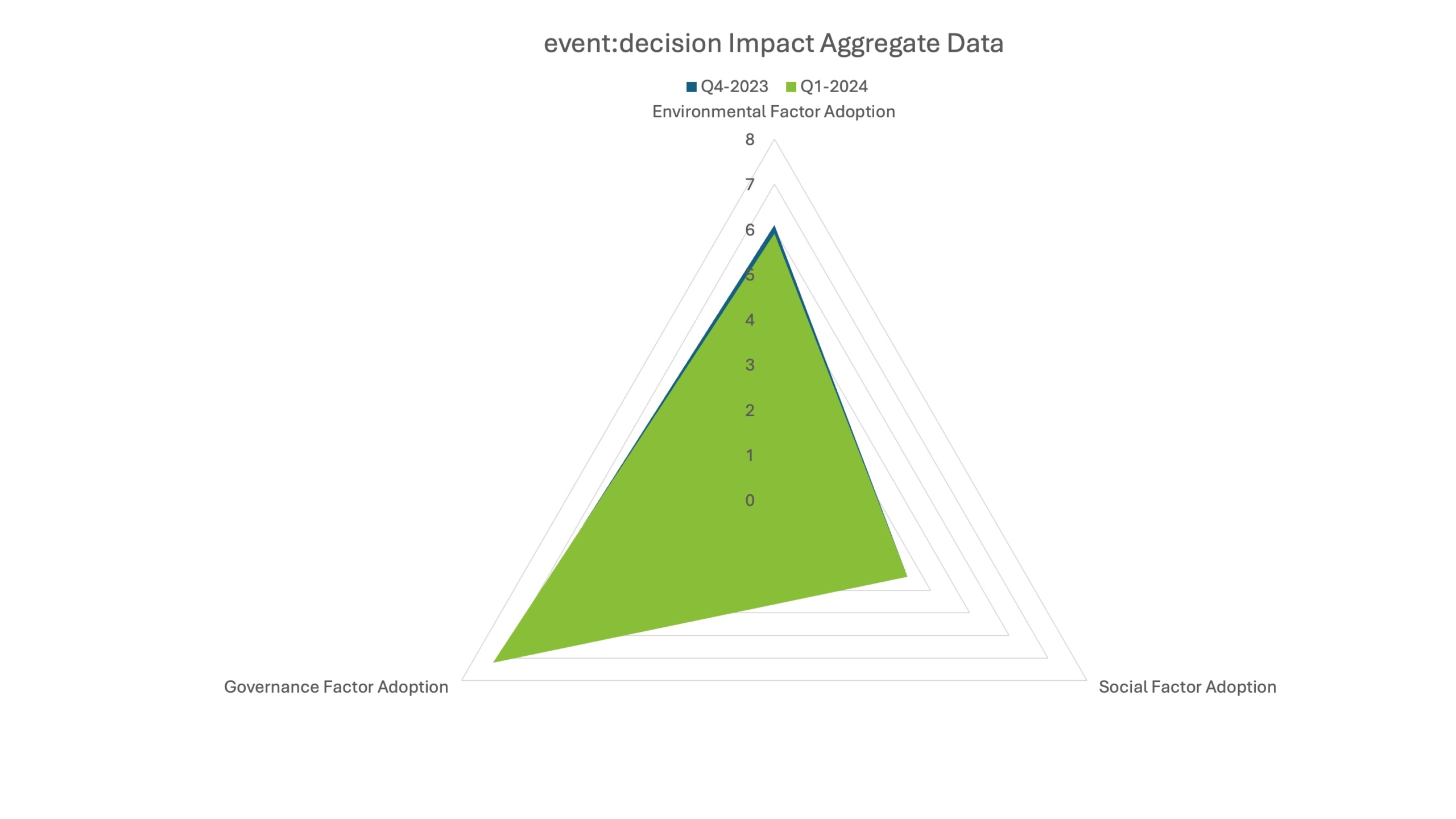
The event:decision Impact tool quantifies event sustainability performance by the number of factors within each of Environmental, Social and Governance (ESG) that individual events are actioning.

These statistics are the results of self-assessment by event owners, directors and producers, scoring if <30 factors across ESG are (1) being actioned (2) not being actioned or (3) not applicable to event type.

Here is where we stand across the event sector on ESG as a whole, from January to April 2024:

event industry sustainability


What does this mean?

Governance (event organising processes) ranks the highest, as befits a professional industry.

Environmental factors are ranking as more than 60% actioned, on average, likely the highest ever, given the surge in environmental consideration within the event sector since 2021.

Social factors are lagging. No surprise given the relative youth of serious discussion regarding the social benefit of events in many areas of our industry.

Focus

Each quarter we’ll highlight some of the most noticeable factors, by virtue of being well-covered by planners, or the opposite of such, as defined by Impact assessments.

Environmental factors

  • Local supply is sought by 86% of planners who have assessed their own events.
  • 33% of planners plan to offset some or all carbon emissions related to their event.

Social factors

  • 76% of planners state that their company has a Living Wage policy in place for event contractors and suppliers.
  • 20% of planners state they try to address at least one of the United Nations Sustainable Development Goals (SDGs) within their event scope.

Governance factors

  • 61% of planners state that their event client sits within scope of the EU’s CSRD carbon-reporting legislation.
  • 72% of planners state that their organisation already holds specific sustainability accreditation.

How do we improve both Environmental and Social metrics?

Take a look at the ESG metrics under assessment within the event:decision® Impact tool. You can do so with no commitment or financial charge, after all, our aim is to support the transition of the event industry toward a more sustainable future.

There are other resources available, both free and paid, including the UN SDGs and an updated ISO for event planners in 2024. To understand and benchmark your own events, event:decision provides proof points for responsible planning, by measuring your event sustainability performance.

For more details about both Track (carbon) reporting, Impact (ESG) Assessments and Evolve (Exhibition and Association events) get in touch.


https://eventdecision.com/wp-content/uploads/2024/04/eventdecision_blog_April.png 768 1024 eventdec https://eventdecision.com/wp-content/uploads/2022/07/mainlogo-ed.png eventdec2024-04-16 05:43:382024-05-13 12:26:51Impact Q1 2024 event industry sustainability performance
event sustainability

How is Event Sustainability Progressing?

November 28, 2023/in Impact, Track

It’s been an busy month for the team at event:decision in the world of event sustainability. Here’s our round-up of just two of the events we’re taken part in, so far, in November. More to come!

Event Sustainability Live

The inaugural two day event at London Excel where we exhibited our Track and Impact solutions and also took part in no less than three panels:

Stakeholder engagement : why does it matter? – alongside Carina Jandt (Event Cycle), Jennie Mossman (Amplify) and Meg Strahle (The Bulb). We spoke about how to tailor your conversation with stakeholders, to emphasise that there is no excuse to ignore sustainability and to demonstrate how events people are leading this internally, not sustainability teams. Above all we agreed that the sustainable event community and environment is changing and is growing and highlighted that legislation is coming for larger organisations.

“Don’t just do the wrong thing a little bit better, do the right thing”.

Matt Grey, event:decision

The next frontier in event food sustainability – with Jenner Carter and Jo Austin (Lime Venues Portfolio), where we discussed how chefs’ roles have changed to include sustainability, not just producing delicious good looking food. Yes, we acknowledged, food makes up a small proportion of an event’s overall carbon footprint, but it is one of most commented on and visible elements. Huge advances have been made in identifying and working with local and seasonal products but more education is needed.

“If you want to work in sustainability, you can.

If you want to make the world and the society a better place, you can.

Where better to do this, than both at the same time. In events”.

Matt Grey, event:decision


Where to start in ESG – this was a session where we broke apart each element of the E, S and G illustrating the importance of each and showing how to measure it.

You can explore the deck here. The audience wanted to know “How do we engage senior stakeholders who may not be interested?” Thoughts: leaders should be aware of the changing role of business in relation to a. environment and b. society. This is a fundamental change in the role of business. Business is the key driver in transformation, all businesses have innovation, more resources and a LOT more to gain than individuals or government.

Reimagine ‘Events as a Force for Good’

Hosted by the forward-thinking team at emc3, this event was a real highlight for us. It brought together a community of change-makers to talk about how we can harness the power of events, experiences, and campaigns to create strategic, sustainable change. We were invited to join a panel with Josh King, Lisa Sweeting (Green Sense Events) and Danielle Ward (reWARD Events) to discuss using events to create a wider positive impact.

We looked at not just the carbon emissions associated with events, but the societal benefits you can bring to your event with your value chain. Everything we discussed aligned perfectly with evet:decision’s tool Impact  – the ONLY ESG tool for event planners.


“What you can’t measure tends to get overlooked.”

Matt Grey, event:decision

It was a brilliant day. The energy was tremendous, the varied and engaging panel sessions and breakouts were inspiring. The day even ended with a customised song.…

🎶 It’s about improvement, not perfection, embracing flaws and real connection, experiences we can enjoy together, and creating a sustainable future forever. 🎶

Sam McNeill, SongDivision

Thanks, as always, Sam!

If you’d like to find out more about how we could measure and advise on your event ESG goals, including its carbon footprint and its social impact get in touch.


https://eventdecision.com/wp-content/uploads/2023/11/event-sustainability.png 480 640 eventdec https://eventdecision.com/wp-content/uploads/2022/07/mainlogo-ed.png eventdec2023-11-28 06:14:002023-11-29 13:55:43How is Event Sustainability Progressing?

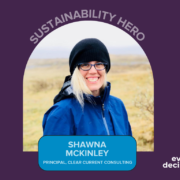
Event Sustainability Heroes: Shawna McKinley from Clear Current

November 14, 2023/in Impact

Introducing Shawna McKinley

Our event sustainability heroes series is all about introducing you to the people behind the drive to transition the event sector to a more sustainable future. We’re chatting to them about their own sustainability habits to see what tips and tricks they can share. Next up our series we’re delighted to introduce Shawna McKinley from Clear Current Consulting.

Q: How did you first become interested in sustainability?

“I wasn’t exposed to the idea of sustainability until I went to university. But knowing what I know about the concept now, I can see growing up ‘out in the sticks’, as my Dad called it, is what awakened my consciousness about it. Being one of a family of six living on a seasonal well, I learned very young that you could run out of water for a few months of the year. And fuel for heating was something you had to stretch through the winter. So, in a way, I was learning about how to manage environmental resource budgets at, well, five!”

Q: What sustainable habits are important to you?

“Transportation is my bugbear. One of the reasons I love the city I live in is that I can get anywhere on public transit. It’s easy, fast, clean, safe, affordable and integrated. Plus who can argue with not having to fight traffic and find parking? That said, I live in a country that has really under-invested in long-distance rail travel in recent decades. I’m envious of those regions where travellers can choose the train. I want to train-brag!”

Q: Have you any tips or tricks for living a more sustainable lifestyle that you’d recommend for others?

“I have a lot of hacks but honestly: learning to be content is the main thing I focus on. We get so many signals from so many channels that we need this, should buy that, have to go there. It’s constant! And while some things are worth doing and having, simply slowing down to ask if it is necessary or makes me happy helps me better spot hype, and take a pass on what I don’t need that doesn’t fulfil me.”

Q: Are there any new areas of focus you might have for your sustainable habits looking forward to 2024?

“I’ve been learning a lot recently about the Inner Development Goals. The IDG are the skills and qualities that help people lead purposeful, sustainable and productive lives. My learning is making me curious about how events can be harnessed to cultivate ideas that are central to the IDGs, like optimism, humility, trust and perseverance. It seems like a critical role we can play in the times we’re living in. Those are the kind of events and communities I am keen to engage in, and create.”

Thanks to Shawna for kindly chatting with us for our event sustainability heroes series. if any of you would like to find out more about how we could work with you to achieve all your event ESG goals, get in touch.


https://eventdecision.com/wp-content/uploads/2023/11/sustainability-hero-event-decision-web-sized-.png 768 1024 eventdec https://eventdecision.com/wp-content/uploads/2022/07/mainlogo-ed.png eventdec2023-11-14 06:22:542023-11-29 13:35:10Event Sustainability Heroes: Shawna McKinley from Clear Current

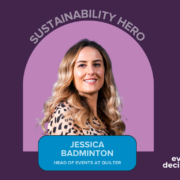
Event Sustainability Heroes: Jessica Badminton from Quilter

October 31, 2023/in Impact

Introducing some of our favourite sustainability champions

We’re constantly inspired by people we’re lucky enough to work with in the events industry and we’d like to introduce you to them too. In the first of an occasional series we’re chatting to our event sustainability heroes and finding out what motivates them to lead a more sustainable lifestyle. We’re kicking off with Jessica Badminton, Head of Events at Quilter.

Q: How did you first became interested in sustainability?

“The pandemic put a lot into perspective for me. I became acutely aware that even though we were in a rubbish situation, I’d never had to worry about having a roof over my head or food on the table. Going back to physical events I wanted to make sure that, whilst delivering incredible events, we were also putting a focus on those who needed help”.

Q: What sustainable habits are important to you?

“Reducing food waste is the biggest one for me. It’s such a simple concept and has such a direct and immediate impact on those less fortunate. There are so many layers to it from the sustainable angle and project drawdown showing reducing food waste as the number one way to reduce heat trapping gasses, to the societal angle with 14 million people in the UK struggling to feed themselves and their families”.

Q: Have you any tips or tricks for living a more sustainable lifestyle that you’d recommend for others?

“I’d like to think we all already do our bits at home, recycling everything we can, reusing plastic bags, turning appliances off when not in use. The sad reality is that those things only scratch the surface. I implore anyone in events to start looking at food waste, and food donation. The events industry is truly remarkable and we all hold such power to make a real difference”.

Q: Are there any new areas of focus you might have for your sustainable habits looking forward to 2024?

“Continuing food donation and reducing food waste. Having experienced challenges implementing this, I’m working really hard to make this easier for the events industry than it currently is and I look forward to the day when this is the norm”.

Hear hear Jessica! We look forward to that too. Thanks to her for kindly chatting with us for our event sustainability heroes series. if any of you would like to find out more about how we could work with you to achieve all your event ESG goals, get in touch.


https://eventdecision.com/wp-content/uploads/2023/10/sustainability_hero_-_event_decision_web_sized_.png 768 1024 eventdec https://eventdecision.com/wp-content/uploads/2022/07/mainlogo-ed.png eventdec2023-10-31 06:53:222023-11-29 13:35:20Event Sustainability Heroes: Jessica Badminton from Quilter
Page 4 of 512345

More News

  • What’s up in other sectors?March 12, 2026 - 8:13 am
  • So, how did it go?March 5, 2026 - 11:09 am
  • Accreditation or Performance Benchmarking? The Arguments.March 3, 2026 - 9:39 am
  • M&E: Crossing the accreditation / performance borderMarch 3, 2026 - 8:11 am
  • An RFP sustainability narrative generator?February 23, 2026 - 2:03 pm
  • High-Performing ESG Enhances Brand Value and Mitigates RiskFebruary 23, 2026 - 11:07 am
  • event:decision disrupts sector pricingFebruary 11, 2026 - 2:31 pm
  • It’s More Acceptable to Fart in a LiftFebruary 9, 2026 - 10:26 am
  • Putting ‘sustainability’ in a silo is costing you money (and clients)January 28, 2026 - 12:21 pm
  • How to win the gold rushJanuary 13, 2026 - 10:53 am
  • Where growth goes to die…January 6, 2026 - 6:51 pm
  • How to put a real number against the Social Value of your EventDecember 9, 2025 - 1:48 pm
  • About Us
  • Partners
  • Resources
  • Client Login
  • Create An Account
  • Track
  • Impact
  • Navigator
  • Evolve
  • Tel: +44 (0)333 202 6985
  • Email: hello@eventdecision.com
© Copyright 2024 Event Decision | Privacy Policy
  • LinkedIn
  • Instagram
Scroll to top