event:decision
  • Home
  • Our Products
    • Track
    • Impact
    • Navigator
    • Evolve
  • About Us
    • Our Company
    • Clients
  • Resources
    • Quiz
    • Blog
    • Most Sustainable Agencies
  • Contact Us
  • Client Login
  • Search
  • Menu Menu
  • LinkedIn
  • Instagram

The client never asks….(which is why you should)

June 2, 2026/in event:decision, Impact

The client will never ask. That’s exactly why you should.

There is a comfortable lie the events industry tells itself about sustainability measurement, and it goes like this:

“We’ll do it properly when a client asks for it.”

It sounds responsible. Commercially sensible, even – why carry a cost the market hasn’t demanded yet? But it rests on a prediction that almost never comes true. The client, in the form you’re imagining, doesn’t call. There is no inbound brief that opens with “before we go further, can you measure and independently verify the impact of our event programme?” That conversation, in that order, initiated by them, is not coming.

And once you accept that – really accept it – the logic flips entirely. If you wait for the question, you wait forever.

The agencies pulling ahead aren’t the ones who answered the question. They’re the ones who walked in already holding the answer.

Why the question never arrives

It’s worth being precise about why clients don’t ask, because the reasons are structural, not temporary.

Clients assume you’ve handled it. To a corporate buyer, “responsible delivery” sits in the same mental bucket as health and safety, insurance and AV that works – table stakes they expect a competent agency to have sorted, not a line item they need to specify.

Clients don’t know what to ask for. Environmental measurement is a specialist field with its own boundaries, scopes and verification standards. Social Value another ballpark entirely. A marketing or procurement lead commissioning an event knows they’re under pressure on sustainability; they very rarely know that “an independently verified Impact review” is the thing that would solve it. You can’t request a tool you don’t know exists.

The pressure reaches them through a different door. When the demand does land, it doesn’t arrive as a polite question to their agency. It arrives as a CSRD reporting obligation, a Scope 3 disclosure that pulls suppliers into the client’s own reporting boundary, or an RFP scoring matrix that now weights ESG and gates on supplier credentials. By the time it reaches the agency, it’s not a question – it’s a deadline. And a deadline is the worst possible moment to start measuring, because the data you need is retrospective and you don’t have it.

The agencies pulling ahead aren’t the ones who answered the question. They’re the ones who walked in already holding the answer.

What early adoption actually changes

Bringing Impact: Event (agency) or Impact: AdVantage (AV/production) into your business before anyone demands it isn’t an act of faith. It changes your commercial position in concrete ways, none of which depend on a single client ever formally buying a review.

You hold the baseline. Measure your book of work once and you have something you cannot retrofit: a defensible, independently verified position on the events you already deliver. When ESG appears in a tender – increasingly scored at a meaningful share of the total, sometimes as a pass/fail gate – you answer from data you already own. The competitor scrambling to estimate something credible in the week before submission simply loses (‘show your working’  they say at school). You can’t manufacture history at deadline.

You own an independent voice. The value of an Impact review isn’t the number.

Any agency can put “committed to sustainability” on a capabilities deck; most seem to.  It’s worth almost nothing precisely because everyone does.

An independently verified review is the thing a marketing department cannot manufacture – and clients, regulators and procurement teams know the difference. That independence is the asset. The agency that holds it has a credential its rivals can only hope for.

You turn delivery into reusable intelligence. Once measured, the data doesn’t expire with the event. It becomes sector benchmarks, year-on-year movement, pitch evidence and board-paper material you reuse for years – across clients, including clients who never commission a review of their own. One measured portfolio feeds every future conversation. That’s the compounding asset most agencies leave on the table by waiting.

You get to lead the conversation instead of survive it. This is the quiet one, and arguably the biggest. When you already hold the data, you introduce sustainability into the client relationship – on your terms, framed as value, positioned as leadership. You walk in and say “here’s what we measured, here’s how your programme compares, here’s where we’d improve it.” That is a categorically stronger position than receiving a procurement request and trying to look like you saw it coming. Adopting first doesn’t just prepare you for the question. It means you never have to be asked.

The agencies pulling ahead aren’t the ones who answered the question. They’re the ones who walked in already holding the answer.

The sequence that’s already working

This isn’t theoretical. The agencies moving on it are following the same sequence: the sustainability lead places the tool in front of commercial and board roles, the business adopts it across the portfolio, and the data then becomes the thing that opens client conversations rather than the thing that answers them. They commissioned the measurement themselves, treated it as a capability they own rather than a cost a client approves, and used it to demonstrate strategic value upward and outward. In every case the trigger was an internal decision, not a client request – because the client request was never going to come.

The agencies pulling ahead aren’t the ones who answered the question. They’re the ones who walked in already holding the answer.

The actual choice

Strip away the framing, and the decision in front of every agency is simple.

You can wait – and wake up one day to a client deadline, a tender gate or a disclosure obligation you have no historical data to meet, scrambling to produce in a fortnight what should have been accumulating for two years.

Or you can decide now, as a modest investment relative to a single won pitch – to hold the baseline yourself, own the independent voice, and lead the conversation before anyone forces it.

The comfortable lie says there’s no rush, because the client will ask when they’re ready.

They won’t. And that is the single best reason to move first.


event:decision is the responsible event performance platform for the global events industry – ESG measurement, benchmarking, independent verification and advisory. To talk about an Impact baseline across your portfolio, get in touch at hello@eventdecision.com.

https://eventdecision.com/wp-content/uploads/2026/06/theclientneverasks.png 600 1080 Matt Grey https://eventdecision.com/wp-content/uploads/2026/04/mainlogo-ed.png Matt Grey2026-06-02 14:59:432026-06-02 15:06:06The client never asks….(which is why you should)

Zurich Convention Bureau partners with event:decision

May 27, 2026/in event:decision, Impact

Zurich advances responsible event delivery with event:decision’s Impact

Zurich Convention Bureau today announces its partnership with event:decision as part of the destination’s ongoing commitment to driving a more sustainable visitor economy. The initiative supports Zurich’s wider strategy focused on decarbonisation, strengthening local supply chains, investing in people and communities, and preserving the region’s natural and cultural heritage.

Through this partnership, Zurich Convention Bureau and event:decision have developed a bespoke version of the Impact: Event platform. This tailored solution will provide event organisers with actionable insights on how to enhance the sustainability and social impact of their events in Zurich.

The platform offers a comprehensive framework for evaluating events beyond carbon emissions alone. Event organisers will be able to benchmark their performance against industry standards while gaining destination-specific guidance.

Organisers hosting events in Zurich will be able to input event data and receive tailored recommendations, including opportunities to collaborate with local institutions, engage in community initiatives, support food redistribution programmes, and explore local carbon reduction and offsetting options.

“We are delighted to partner with event:decision to provide our event organisers with deeper insights into the impact of their events in Zurich. This collaboration strengthens our commitment to sustainability and offers access to a trusted framework alongside connections to a strong local, responsible supply chain.”

Gregory Bauer of the Zurich Convention Bureau

“Together, we aim to showcase Zurich’s ability to deliver not only exceptional events, but experiences that create meaningful environmental and social value for organisers, delegates, and the local community”

Matt Grey, at event:decision.

This partnership further supports buyers as part of an already sustainable proposition offered by Zurich as a business event destination.

https://eventdecision.com/wp-content/uploads/2026/05/ZCB.png 600 1080 Matt Grey https://eventdecision.com/wp-content/uploads/2026/04/mainlogo-ed.png Matt Grey2026-05-27 08:09:572026-05-27 08:09:57Zurich Convention Bureau partners with event:decision

Bishop-McCann and event:decision to partner on making an Impact on US corporate events

May 27, 2026/in event:decision, Impact

Bishop-McCann and event:decision to partner on making an Impact on US corporate events

A new transatlantic alliance forms. UK consultancy to benchmark Bishop-McCann’s sustainability performance.
Press version.

UK-based event:decision, the specialist impact consultancy for the event sector, ha announced a strategic partnership with US full-service corporate event and meeting agency Bishop-McCann. The partnership establishes a structured programme to evaluate, evidence and advance the responsible event delivery performance of Bishop-McCann across its US and international portfolio.

Under the Impact: Event – event:decision’s proprietary RFP, benchmarking and gap-analysis framework designed specifically for the live events supply chain – Bishop-McCann will assess each event project against 30 defined criteria spanning environmental impact, social responsibility, and governance standards. The results will be used to benchmark performance against industry peers, identify the highest-priority areas for improvement, and build a credible, data-led narrative that Bishop-McCann can share with its clients, prospective partners and stakeholders.

“The events industry is at an inflection point. Clients are asking harder questions about the responsibility of the programmes they commission, and the agencies who can answer those questions with evidence – not just intent – will define the next decade of our industry. This partnership gives Bishop-McCann exactly that capability,” said event:decision CEO Matt Grey,

For Bishop-McCann, the partnership reflects recognition that the demand for verified performance is accelerating among its Fortune 500 and blue-chip client base.

The agency manages corporate meetings, incentive programmes, conferences, roadshows and experiential events across North America and globally, and Rob Adams, CEO, Bishop-McCann said the new partnership “gives us the tools, the rigour and the independent voice to demonstrate that commitment in a way our clients can trust and act on”.

The Impact programme will generate project-level scores for each Bishop-McCann event, benchmarked against the wider Impact partner network. Quarterly reporting will provide Bishop-McCann with a clear view of its performance trajectory and priority improvement actions.

https://eventdecision.com/wp-content/uploads/2025/09/Q1.jpg 361 542 Matt Grey https://eventdecision.com/wp-content/uploads/2026/04/mainlogo-ed.png Matt Grey2026-05-27 07:56:482026-05-27 07:56:48Bishop-McCann and event:decision to partner on making an Impact on US corporate events

The $260bn blind-spot

May 26, 2026/in event:decision, Event:Decision Content, Impact

An event:decision analysis of the 2026 EIC / Oxford Economics Global Economic Significance of Business Events Study.

The sector itself acknowledges its biggest sources of value go unmeasured.

The 2026 Events Industry Council Oxford Economics study is the flagship economic significance report for the global business events sector. It is rigorously researched, carefully sourced, and quantifies the industry’s scale to a degree that makes it the standard reference any operator can point a finance director or a policy team towards. 1.65 billion participants. US$1.3 trillion in direct spending. US$1.8 trillion in total GDP impact. 24.2 million jobs. If the business events sector were a country, it would rank 16th globally – bigger than Turkey, Indonesia, or the Netherlands. Impressive stuff, #EventProfs.

It is also, from a sustainability and responsibility perspective, almost entirely silent. No issue, that’s not the main purpose of the report, but perhaps missed a significant chunk of what can only be termed ‘value’.

If events can generate 10-30% of budgets in Social Value – that’s a $260bn value-add right there. A big number. That we don’t measure and don’t shout about.

What the study tells us about scale

Three numbers in the report are worth holding alongside each other – both for the value they represent and for the responsibility scale they imply.

First, the participant figure of 1.65 billion. These are individual attendances at business events – predominantly involving the kind of human contact the report’s own survey identifies as the single most valuable outcome of in-person gathering. 70% of respondents named building relationships through face-to-face interaction as the result most difficult to replace; a further 12% named community, trust, and emotional engagement. That’s the social-value side of the equation, and this can credibly reach 10–30% of total event value – alongside the direct economic contribution.

There is, of course, a carbon implication: moving 1.65 billion people predominantly by travel runs into the order of hundreds of millions of tonnes of CO₂e per year on standard DEFRA and ICAO factors. The opportunity for the sector is not to do fewer events – the value generated is too high – but to do them progressively better, with measured and reduced travel and energy intensity per participant.

Second, the direct-spending figure of US$1.3 trillion. The report compares this directly to other global sectors and finds the business events sector is now larger than the global air transport industry ($1.292T vs $1.285T). That is a meaningful milestone – for an industry that twenty years ago was treated as discretionary marketing spend by most boards, reaching air-transport scale on economic contribution is a maturing moment. Air transport, of course, is one of the most heavily emissions-regulated industries in the world; business events does not yet have the equivalent industry-level reporting infrastructure. That is not a failing – it is the next maturity step. The sector that has reached air-transport scale on economic contribution will, over the next decade, reach comparable expectations on disclosure. The window between now and that point is the window in which voluntary, structured measurement becomes competitive advantage.

Third, the workforce figure of 24.2 million jobs across nine ecosystem categories. Planners, exhibition contractors, venues, hotels, AV, transport, F&B, destination partners, specialised support. That is a substantial livelihoods footprint – broadly comparable in scale to the global automotive workforce – and one the report shows is growing in productivity rather than headcount as the sector matures, with direct spending forecast to grow 22% by 2028 against a 7% workforce uplift over the same period.

That productivity story is genuinely positive: more events delivered, more participants served, more value generated per employee. The responsibility question that sits alongside it – who that workforce is, how it is paid, how accessible the entry routes are, what wellbeing provisions are in place – is the kind of question a 24.2-million-person industry can credibly start to answer at scale. It is the maturity question, not the deficit one.

What the study does not measure

A word-frequency check across the 38-page executive summary returns the following:

Term Mentions in 38-page exec summary Context
Carbon / emissions / net zero 0 No reference to climate impact of an industry that moves 1.65 billion people internationally
Sustainability 0 The word itself does not appear once
Inclusion / diversity / equity / DEIA 0 24.2M-person workforce; no analysis of who that workforce is
Accessibility 0 1.65bn participants; no measure of who can or can’t attend
Fair pay / living wage / wellbeing 0 Jobs counted only as economic units, not as people
Waste 0 F&B, materials, freight quantified by spend only
Responsibility 0 No environmental, social & governance framing of the sector at all
Legacy 0 ‘Catalytic effects’ covered – but only economic ones
Environment 1 Used metaphorically – ‘in this environment’ – not in ecological sense


This is not a criticism of methodology – the report was commissioned to measure economic significance, and it does that very well. It is an observation that the industry’s most authoritative annual self-portrait still treats environmental and social impact as outside the frame. For an audience of policymakers, investors, and community stakeholders – the report’s named audience – the absence of sustainability data is a meaningful gap. A reader could finish the study believing the only material question about the business events sector is what it adds to GDP.

The ‘catalytic effects’ opening

The closest the report gets to non-economic value is its section on catalytic effects – defined as ‘the broader impacts that occur as the result of business events’. It lists: new business opportunities, partnerships, customer leads, training, health and technical advances, R&D, innovation, knowledge transfer, productivity gains, human and organisational capital.

Critically, the report concedes – verbatim – that ‘many catalytic effects are difficult to measure and quantify. This presents the key risk that much of the true significance of business events goes unmeasured, unreported, and therefore undervalued.’

This is the exact gap the event:decision Impact suite was built to close. The factors the report flags as ‘difficult to measure’ – partnerships, knowledge transfer, training, legacy, community impact, skills transfer – are named, structured factors inside the framework. So are the absent ones – carbon, accessibility, fair pay, wellbeing, waste, governance, public reporting.

The EIC report is, inadvertently, the strongest articulation of why a structured impact framework matters: the sector itself acknowledges its biggest sources of value go unmeasured.

Sector composition – where the responsibility sits

The report’s ecosystem map identifies four broad groups of organisations behind business events. Each maps cleanly onto one of the three event:decision Impact lenses.

Planners and organisers (event organisers, DMCs, corporate agencies) plus exhibitions and events organisations – these are the 67% of survey respondents and the buyers of the show. They sit inside the Impact: Event scope.

Specialised support, tech and production, transport and travel, food and beverage – AV companies, event management systems, network and connectivity, ground transport, catering, security, translation. These are the 12% supplier respondents in the report’s survey, and the suppliers building, powering and feeding the show. They sit inside the Impact: AdVantage scope.

Venues and lodging, destination partners – convention centres, hotels, resorts, banquet halls, DMOs, CVBs, national tourism boards. These are the 15% of venue / hotel respondents and the 6% of DMO respondents in the report’s survey. They sit inside the Impact: VenueLens scope.

Between them, those three groups represent 100% of the report’s surveyed audience – and approximately 98% of where the sector’s spend actually flows. The report tells us how much is being spent in each group; it doesn’t tell us what the sustainability or responsibility footprint of that spend looks like.

Two methodological observations worth flagging

First, the survey base. 1,605 respondents, of whom 86% are based in North America. The global figures are anchored to a respondent base that under-represents the regions – Europe, parts of Asia Pacific – where sustainability regulation and disclosure expectations are most advanced. The qualitative survey responses around ‘what matters’ in events should be read with that geographic skew in mind.

Second, the survey question set. The ‘ways of measuring the success of events’ question lists eight options. All eight are commercial: relationship management, awareness, new customers, sales leads, incremental revenue, cost-versus-revenue, lost revenue, average deal size. None of the eight is a sustainability, accessibility, inclusion or legacy metric. If ‘success’ is defined entirely commercially in the industry’s flagship survey, no operator has an incentive to optimise – or even report – against any other dimension.

The 2025 → 2028 forecast – and the responsibility pressure it implies

The report forecasts direct spending to grow from US$1.3 trillion in 2025 to US$1.6 trillion in 2028 – a 22% nominal increase over three years, or a 6.7% CAGR. Direct jobs grow by only 7% over the same window (9.7M to 10.4M), with the report attributing the gap to productivity gains, skills uplift, and technology integration (we all know what that means).

Translated into responsibility terms, that forecast says: more events, more participants, more spend, broadly the same workforce, no decline in resource intensity per event implied by the data. Without explicit decarbonisation, accessibility, and fair-pay targets across the sector, the trajectory the report describes is one in which the absolute footprint of the industry grows faster than its workforce.

That is a structural challenge that no individual operator can solve alone.

So what?

The EIC has produced the definitive answer to ‘what is the business events sector worth?’ US$1.8 trillion of GDP, 24.2 million jobs, the 16th-largest economy on earth. The question the report does not address – and which the next phase of industry credibility depends on answering – is what is the business events sector responsible for?

https://eventdecision.com/wp-content/uploads/2026/05/blindspot.png 600 1080 Matt Grey https://eventdecision.com/wp-content/uploads/2026/04/mainlogo-ed.png Matt Grey2026-05-26 09:57:162026-05-29 11:27:51The $260bn blind-spot

Is event planning a science or an art?

May 25, 2026/in event:decision, Impact, Third-party Content

Is event planning a science or an art?

There’s a long-running discussion in the industry that splits neatly down the middle. One camp insists event planning is an art – that the people who do it best work on instinct, simply create emotions within the room and craft moments of magic from a feel for narrative, design, and human energy. The other camp insists it’s a science – that great events come from logistics, measurement, frameworks, and discipline, and that the people who do them best are operations professionals who happen to work in marketing.

Both camps are right, of course. But neither is enough on its own.

The art case

The art is real, and it matters. A good event opens with a precisely judged silence; a great one ends with a moment guests are still talking about, perhaps years later. That doesn’t come from a checklist. It comes from creative direction, narrative instinct, an eye for room dynamics, and the kind of taste that takes a decade to develop. Events that win awards win them on these grounds.

Without the art, you have a meeting.

The science case

But art alone doesn’t get you to smooth, engaging events. Art alone doesn’t tell you whether your suppliers pay a living wage, whether your delegate travel mix is improving year-on-year, or whether your sustainability narrative is something you can defend in front of a client’s ESG team. Art alone doesn’t survive a Freedom of Information request from a sustainability journalist or a procurement question from a Fortune 500 buyer. For that, you need science: measurement, evidence, frameworks, repeatable methods.

We had a bit of fun recently – laying all of our responsible-delivery factors out in the style of the periodic table of elements. Ninety factors, three rows of thirty, colour-coded against the three ESG pillars. It looks the part. It is also, deliberately, a joke at our own expense – nobody is going to use a wall chart to plan a conference. But the chart makes a point that’s harder to argue with once you see it written out: there are ninety different things that quietly underpin a single sentence in a sustainability report. Carbon and travel. Power and lighting. Local supply chain and food approach. Locality and accessibility, wellbeing and fair pay. KPIs and risk assessment and named accountability and lessons learned. That’s the size of the science problem – across the whole event ecosystem.

Now both the art and the science can be measured.

But here’s the relief: no single person is running ninety decisions. The ninety divide cleanly into three sets of thirty, and which thirty you own depends on your role. An event planner owns one set. An AV or production supplier owns another. A venue operations or sales planner owns the third. If you’re any one of those people, you’re running thirty small decisions, not ninety. Which is a much more manageable science problem to start with.

Three lenses on the same event

The ninety factors don’t all sit with one team. They sit with three. event:decision’s Impact suite is structured as three lenses on the same event – each tool covering one of those three sets of thirty factors, each pointed at one function:

Impact: Event is the lens for the event itself. Carbon, attendee and crew travel, waste, food approach, biodiversity, locality and inclusion, wellbeing, legacy, KPIs and ROI, sustainability leadership, governance and accreditations. This is the tool for event organisers, in-house event teams, brand experience leads, and the agencies running events on their behalf. If you commission, design, or run the event, Impact: Event is for you.

Impact: AdVantage is the lens for the Technical Production and AV chain. Power and lighting specification, project carbon, vehicle movements, reusable build, subcontractor briefing, welfare provisions, local crew, fair pay, working hours, RAMS, compliance documentation, named accountability. This is the tool for production agencies, exhibition contractors, AV suppliers, stand builders, freight and logistics partners – the people who turn the brief into a physical reality. It gives suppliers a structured way to evidence what they’ve done, and gives organisers a clear standard to procure against.

Impact: VenueLens is the tool for the venue. Mass transport access, renewable energy, water management, single-use plastics, F&B approach, delegate accessibility, venue fair pay, inclusion hiring, community projects, surplus distribution, public reporting, supplier due diligence, ESG targets. This is the tool for venues themselves – operators, conference centres, hotels, stadiums, exhibition halls. It lets venues show with evidence what they actually deliver, and gives organisers a like-for-like way to compare venues at the procurement stage.

Why three tools, not one

Because both spend and responsibility in events don’t sit just with one party. The event organiser commissions and pays for the show. The suppliers and agencies deliver it. The venue hosts it. Each controls a different slice of the impact picture, and a single tool aimed at any one of them would miss most of the footprint.

Between them, the Impact suite covers approximately 98% of event spend – the client commission, the supplier delivery, and the venue cost together account for nearly every pound that flows through an event. The remaining 2% is the long tail of incidental costs that, even if measured, would not materially change the conclusion.

So — science or art?

Both. Always both.

The art is what makes an event worth attending. The science is what makes it responsible and sustainable. The art delivers the moment of magic in the keynote, the goosebump from a perfectly cued lighting state, the gasp at the reveal. The science delivers the carbon report your client’s CFO can put in their annual filings, the accessibility statement your delegate community can trust, the legacy figure your sponsor can quote to their board.

You don’t choose between them. You do both – or you fall behind the audiences, the clients, and the regulators who increasingly expect both.

And it turns out that both looks a lot like thirty small decisions for the planner, thirty for the supplier, thirty for the venue – and ninety in total across an event that used to run on instinct alone.

Get in touch at hello@eventdecision.com.

https://eventdecision.com/wp-content/uploads/2026/05/artorscience.png 600 1080 Matt Grey https://eventdecision.com/wp-content/uploads/2026/04/mainlogo-ed.png Matt Grey2026-05-25 18:59:182026-05-25 18:59:18Is event planning a science or an art?

Answers to your own questions (yes, really…)

May 18, 2026/in event:decision, Event:Decision Content, Third-party Content

At the Event Industry News Sustainability Breakfast, in April 2026, as expected, the panel ran short of time answering audience questions.

As promised, we asked panel to come back with their thoughts to every question posed.

Here are the panel’s responses.

  • Matt Grey Founder & Director at of event:decision
  • Chrissie Beck, Founder & Sustainability Director at Worlds Better
  • Aarron Mcgurk, Culture & Operations Lead at agency Chorus, now part of Brands At Work.


What if your client isn’t really interested in sustainability?

Matt:    If the commercial sense, optics and audience engagement metrics on a sustainable experience are not enough, it’s entirely your choice as to whether you want to work with that client?

Chrissie: Try to understand your client’s goals and objectives and then tweak your response to speak their language. Try to influence their decision by explaining the strategic importance of sustainability (whether that’s brand differentiation, reputation management, risk mitigation, ROI, cost efficiencies) – depending on their role and goals. Explain that there’s an expectation now that events are delivered sustainably. This isn’t a ‘nice to have’ anymore, it’s a strategic necessity.

Aarron: Sustainability doesn’t have to be an add on, you and your business can still operate sustainably. This would mean the operations in Scope 1 and 2 (which are controlled by you) can still be done sustainably with out needing client buy in.


What’s your take on “greenwashing”? Too many people act to look good in public, but have very little or no positive impact.

Matt:    I think this is a valid point, and applies to all channels, not just events. Legislation is coming on Green Claims, but I suspect despite a lot of noise, that few events will be impacted.

Chrissie: Like Matt has said there’s a new piece of legislation coming in September 2026 (Empowering Consumers for the Green Transition Directive/ECGTD) that has been developed to eliminate greenwashing. You won’t be able to claim you have ‘delivered a sustainable event’ or are a ‘sustainable supplier’ without having robust data or (audited) certifications to back it up.

Aarron: I don’t come across greenwashing that much to comment. Which could be positive?


For venues with low budgets where there isn’t resource for measurement, consultancy, certification, training & where management say no due to cost. What do you do?

Matt:    Measurement or certification by an external party will cost money, of course. But you could start by simply counting the number of meetings & events at which you deliver sustainability service a, b or c, and demonstrate this as a % of your portfolio?

Chrissie: There are a lot of (free) resources and tools available online that you can investigate (SDG’s, SME Climate Hub, event:decision, Greengage, isla, Sustainable Event Guide etc) – these might include industry white papers, toolkits, webinars – educate yourself to understand what makes sense for you to focus on first and start there. Also keep coming to events like the Sustainable Events Lounge to meet others in your position and hear what they’ve done! Worth noting to management that you’re likely losing business to other venues that have solid sustainability strategies/credentials.

Aarron: This sounds like there is not much wriggle room. It might be that your only choose is to make some positive steps independently which could be small for now. Things like a roster of equipment and energy ratings, how often appliances like dishwashers run and how much water is used and start to build these things as a business case to take to management eventually and try and get buy in then.


You asked before who was responsible for calling out supplier claims that may not be true. My question is how we can do that robust verification as an agency?

Chrissie: As part of your procurement process you should be conducting supplier assessments when you start working with them (check their documentation & commitments). When you work with them conduct regular reviews of their services and progress towards their targets – this may need to include on site audits of their facilities, or of them delivering services for you on site to check they are doing what they claim. The reality is; as an agency you are responsible for your supply chain. You should have processes in place to assure your suppliers are verified.

Aarron: Less about calling out and more about bringing in and alongside. Work closely with procurement and specifically obtain evidence of claims e.g. full policy or certificate. After review of these which can be a bi monthly cadence you can either rank suppliers and change approach or meet with them to see how things are developing.

Matt:    Some agencies we work with deliver just this. Gathering certifications and metrics on delivery at project-by-project level. If you’re a client or agency, using Impact: AdVantage and (shortly) Impact: VENUEmark will aid this process greatly.


What do you think is the best way to educate clients about sustainability before starting event planning?

Aarron: Use their orgs ESG statement and create approach to helping the marketing or other department align with the overarching goals, include in pitches etc. Explain how you are solving their problem with the event you are producing at the same time how the way you work aligns them with their own ESG. Sort of flipping it on the head a bit.

Matt:    Embed a measurement, benchmark or certification within your process. Likely you won’t have time to deliver education to clients on each & every project?


Would love to hear panel’s thoughts on getting the ‘badge’ and progress then slowing down. Is that true?

Matt:    I mentioned this in the keynote. There is evidence that the achievement of higher-level accreditations (gold, silver, bronze level etc.) is not increasing amongst the agency sector. See the Most Sustainable Agencies 2026 campaign. I would say there is evidence of increasing numbers of accreditation across the agency sector, yet less evidence of associated behavioural change in event outcomes.


What do you think is the biggest current challenge in the events industry regarding sustainability?

Matt:    Understanding that sustainability is a growth and resilience driver, not a cost-center


The problem is you all assume everyone thinks like you. Insulting everyone who doesn’t won’t help your cause.

Matt: I’m sorry if you feel insulted. If you would like to put forward an alternative view of sector behaviour in sustainability please get in touch separately & we’ll be glad to give you a platform?

Aarron: I hear you, the session was a little less 101 this time around – with some more advanced thinking. Our intention was to shake things up a little to make the sessions more engaging and offer more value, please do reach out to us for more help and resources that could match where you are on your journey.


What’s happening with recycling? It seems hotels and venues have regressed since Covid. Shouldn’t guests have multi-colored bins in their rooms.

Matt:    Not an area of expertise for me, but one hopes that bedroom waste is streamed at contractor level within the process & that separation of streams at a bedroom level is not cost effective.

Aarron: Recycling is a bite archaic now and invisible. As Matt said its happening at service level, e.g. first mile sorting center. Its quite hard to know exactly what makes it through the process especially when some types of packaging are not washed or bagged incorrectly.


If you had a magic wand, what is one thing you would like to see change, or be implemented in 2026/2027?

Matt:    Opening the eyes of event sales and account directors that they can use existing tools to drive new and retain business.

Aarron: Slow down! Making travel part of an experience.


Where does human sustainability stand in your business and for your clients?

Matt:    A vital part of the responsible event mix, I believe the S in ESG is hugely underplayed and under-reported.

Aarron: Front and centre. Its People, Planet, Partners & Profitability. People kind of top of the hierarchy but it is a blend. We can do anything if the people aren’t trained, rested or understood.


Is [the above] in conversations and being actioned for clients and your internal teams?

Matt:    Not as much as it should be, suspect it is an expected function of event supply. The tools are ready for you to start quantifying Social Value.


In a smaller company it can be harder to make sustainable choices when you’re working on tight financial boundaries, esp from Senior management.. any advice?

Matt:    There’s always an easier and cheaper way to do things. Ultimately it’s up to you to be accountable for the product you want to deliver. I would challenge whether margins are necessarily tighter in a smaller company than a larger one – overheads can be fewer in smaller entities.


Is it wise to assume everyone shares your perspective on sustainability or what it looks the same to them? If prescription doesn’t work, what would you suggest?

Matt:    Sustainability perspectives differ as much as views on any subject, but there does appear to be a direction of travel.  If prescription doesn’t work, probably best to engage in constructive dialogue. Not all suppliers and clients are meant for each other? That said, many of the decisions in event sustainability align strongly with commercial decisions, so you may be delivering some pretty good outcomes already?


Sustainability is a matter of culture. How can we influence decision makers to see sustainability as an added to our offer?

Matt:    I think sustainability and responsibility is more than culture, it’s a proposition and a function of the service or product you offer. It’s hard to argue against delivering a responsible product and demonstrating so, with tools such event:decision’s Impact.


You mentioned food leftovers during the events. Many clients don’t allow bringing food to anyone due to potential issues. Is there any way to work around this?

Matt:    Yes. Professional (whether charity or for profit) organisations that deliver food redistribution service should have indemnity policies, ask them, this hurdle has been overcome many times.


As a venue, especially without budget for formal tools or consultancy, how do you realistically measure sustainability and track progress?

Matt:    Measurement or certification by an nexternal party will cost money, of course. But you could start by simply counting the number of meetings & events at which you deliver sustainability service a or b and demonstrate this as a % of your portfolio?


The new 20211encourages us to align our goals with the UNSDG that we can support. Do you align your offerings accordingly? What has been the client response?

Matt:    Yes. event:decision’s Impact: Event directly references UNSDGs.


The menu thing is annoying. Loads of places have decided to impose vegan menus on clients who are paying. Have the option but don’t force it on people.

Matt: Exactly, forcing choices is not a choice at all.


Any ideas for sustainable event gifts/ swag?

Matt:    There are many options and suppliers who offer them – but a popular one is to give away digital memberships, publications or donations to a cause the user can choose, rather than physical items that may (or not) have a use and a lifecycle.


https://eventdecision.com/wp-content/uploads/2026/05/answers.png 600 1080 Matt Grey https://eventdecision.com/wp-content/uploads/2026/04/mainlogo-ed.png Matt Grey2026-05-18 14:52:332026-05-18 14:52:33Answers to your own questions (yes, really…)

The Story of the Empty Table

May 14, 2026/in event:decision, Impact

The fundamental opportunities at the heart of event sustainability

At an industry event in the US this week, the room was set with breakout session tables. Each had a small card on it naming the topic of conversation: AI, RFPs, talent, M&A, you know the drill. Every table had fifteen plus people crowded around it.

Except one.

The one marked “Sustainability” had a host, a coffee, and no one else. For the entire double session.

That image is the most honest summary of where event sustainability sits in 2026 that I have seen all year.

Not because the industry doesn’t care – plenty of people in that room genuinely do.

But because the industry has misunderstood what sustainability actually is, where it lives in the value chain, and why it matters commercially. And until that misunderstanding is corrected, the sustainability table will keep being the empty one.

So let me say the thing the industry keeps tiptoeing around.

An event is a product. And a well-delivered product is worth more than a poorly delivered one. An agency with data on a well-delivered portfolio is worth more than one without. Sustainability – or responsibility –  is not separate from product quality – it is part of it.

Every other misunderstanding flows from getting that wrong.

Opportunity 1: sustainability is not a department, it’s an outcome

Walk into most agencies and “sustainability” sits in a slide deck, a policy document, or a single person’s job title. It is treated as a parallel workstream – something the operations team does alongside delivering the event, in the same way they might do GDPR compliance or insurance.

That framing is why the table was empty. If sustainability is a side dish, of course people would rather talk about the main course.

But events aren’t built that way. The carbon, the social value, the supplier choices, the venue, the catering, the travel pattern, the freight – these aren’t bolted on to the event after the fact. They are the event. The product and its responsibility are the same thing, made of the same decisions, signed off by the same producer.

Treating sustainability as a department is like treating “tasting good” as a department in a restaurant.

Opportunity two: a badge is not the same as an outcome

This is the trap we wrote about recently – and it is the single most expensive misunderstanding in the sector right now.

A buyer plans a Sustainability Summit. They shortlist three accredited venues at (maybe) two to three times the price of capable alternatives. They feel good about the credentials on the wall. And then they realise the cheapest “uncertified” option happens to sit directly on a tube/subway/rail line, while the gold-tier venue is a fifteen-minute cab ride from anywhere useful.

For a corporate audience, between 70 and 90% of the event’s footprint will come from how the attendees travel to it. The well-connected venue, with no badges over the door, will almost certainly produce the lower footprint. And the budget saved against the inflated “accredited” price can then be spent on catering, fair supplier pay, food redistribution and proper measurement – the things that actually move the dial.

Common sense beats badge-chasing. Every time. Not because accreditation is worthless – it is a useful starting point – but because outcomes are what the event is being judged on, not the décor of the procurement process.

If you find yourself paying a premium for a logo on a website while making your attendees’ lives harder, you are buying the wrong product.

Opportunity three: being responsible is a value, not a cost

This is the one that hurts agency owners most – because it is silently shaving multiples off their businesses.

We made the case here. The short version: responsibility data is no longer a reporting obligation. It is a valuation asset. Two or three years of structured, benchmarked, independently verified evidence of how an agency performs across its portfolio is now one of the most underleveraged levers an owner has before a sale, a raise, or a strategic conversation. PwC, EY, KPMG and Deloitte are all saying the same thing in different words: buyers price ESG evidence into multiples, and they discount the absence of it.

In other words, the agencies treating sustainability as a cost are funding the multiple expansion of the ones treating it as a product feature.

If you want to know whether your agency has understood this yet, try a simple test.

When you describe a recent event to a client, do you describe what you delivered – the experience, the engagement, the room, the moments – and stop there?

Or do you describe how well it was delivered, how the event delivered positive outcomes, not just in the quality of powerpoint and video and indoor fireworks (all very good, I’m sure), but also for the local area & team. How you brought the food growers into the room, allowed junior crew to gain experience and delivered hands-on workshops to local partners? That the event generated $435k in social value and was still described as ‘the best ever’, with the same confidence?

The latter is the product spec of a modern event. The former is an event from 2005 wearing a 2026 jacket.

A well-delivered event is one where the experience landed, the budget was respected, the supply chain was treated fairly, the footprint was measured, the social value was celebrated, and the outcomes were reported back. That is not six things. That is one thing: a great product.

A poorly delivered event is one that looked great on the night and left no evidence behind. There is a market for that product. It is a smaller market than it used to be, and it is shrinking.

So why was the table empty?

Because the industry has been told for a decade that sustainability is hard, clients don’t want to pay, it’s really technical, and ultimately just find an accredited supplier (read: someone else’s problem).

None of which is true. It is none of those things when you treat it as part of the product.

The agencies that have understood this aren’t sitting at the sustainability table at industry events. They are at every table – because they have stopped treating it as a topic and started treating it as a property of the work.

That is the shift.

Events are products. Responsibility is a product feature. Measurement is the receipt. And the agencies that get this first will be worth materially more than the ones still arguing about which logo to put on the website.

The badge on the door doesn’t deliver the event.

You do.


event:decision helps event agencies and corporate event teams measure, benchmark and improve the environmental and social outcomes of their events – building the evidence that turns good intentions into a better product, and a better product into a more valuable business.

Further reading:
– Badges or reality?
– Agency owners. Your worth could be more than you think.

https://eventdecision.com/wp-content/uploads/2026/05/Untitled-803-x-2003-mm-1080-x-800-px-1080-x-600-px.png 600 1080 Matt Grey https://eventdecision.com/wp-content/uploads/2026/04/mainlogo-ed.png Matt Grey2026-05-14 15:40:102026-05-21 08:03:00The Story of the Empty Table

Badges or reality?

May 11, 2026/in event:decision, Impact

The badge trap: why “sustainable” badges can mislead event buyers – and what to look at instead


A venue or agency with the best certifications isn’t automatically the best choice. For most corporate events, the biggest sustainability decision you’ll make has nothing to do with badges on the wall.

Earlier today, we spoke with a Head of Events planning a Sustainability Summit in London. She was looking at venues with strong sustainability credentials and had hit a wall: the accredited options were coming in at two to three times the price of perfectly capable alternatives. She wanted to do the right thing. The budget didn’t.

The honest answer caught her off guard.

For a London audience, the single biggest sustainability decision she would make is whether the venue sits on a Tube line.

That may sound reductive, but it points to a bigger issue across the events industry:

Badges measure inputs. Buyers should be paying for outcomes.

Sustainability badges and accreditations have proliferated across the events sector, and many of them are genuinely useful. They signal that a venue has policies, systems and operational processes in place around energy, waste, water use or procurement. That tells you something important about how the building is run.

But it tells you remarkably little about the actual impact of your event.

For most events, between 70–90% of total carbon impact comes from attendee travel, accommodation and logistics – not the venue’s lighting system or recycling programme. A venue can hold every certification available and still host an event with a significantly higher footprint than a less “decorated” alternative.

We still smile wryly at the request on a well-known online forum for a “sustainable venue with 300+ car parking spaces”.

Back to today. This Sustainability Summit was a perfect example.

A ‘gold-tier’ accredited venue, a 2-3x the price – sat awkwardly for public transport. The alternative venue, with fewer visible sustainability credentials, is directly connected to a major public transport interchange.

If even a proportion of attendees end up taking taxis because a venue is difficult to reach, no amount of efficient HVAC systems or reusable signage will offset the emissions that follow. In practical terms, the more accessible venue was likely to produce the lower overall event footprint.

And it would free up budget for the interventions that genuinely move the dial:

  • Lower-impact catering choices
  • Fairly paid crew and suppliers
  • Local sourcing
  • Food redistribution and waste reduction
  • Better event measurement and reporting

Because responsibility is bigger than carbon alone.

A truly responsible event isn’t just one that emits less. It’s one whose supply chain treats people fairly, creates positive local impact, and leaves something behind in the community it visits.

That’s where many badge-led procurement processes fall short. They focus heavily on venue operations while ignoring the wider outcomes generated by the event ecosystem itself.

So instead of asking:

“Is this venue sustainable?”

Event organisers should start asking:

1. How will attendees actually get there?

What percentage can realistically travel by public transport? How much travel-related carbon will the location create or avoid?

2. What does the event supply chain look like?

Who is catering the event? Are suppliers local? Are staff paid fairly? Are there positive social outcomes attached to procurement decisions?

3. Will the outcomes of this specific event be measured?

Not the venue’s annual sustainability report – the actual environmental and social outcomes generated by your event.

This shift matters because buyers are increasingly being asked to report against real outcomes, not good intentions. Stakeholders, procurement teams and ESG reporting frameworks are all moving in the same direction: evidence over perception.

That doesn’t mean badges and accreditations are useless. Far from it. They remain valuable indicators that a venue takes sustainability seriously and can help buyers complete initial due diligence more quickly.

But they should be a starting point – not the decision itself.

Used incorrectly, certifications can distort purchasing decisions, pushing organisations to spend disproportionately on visible credentials while overlooking the factors that actually determine impact.

The events industry doesn’t need more logos on venue websites.

It needs better measurement. Better mirrors. Better decision-making. Better outcomes.

Choose the location that makes the responsible choice easiest. Invest in a budget that creates measurable environmental and social value. Then measure the results properly.

The shortest version: badges tell you what a company wants to be. Measured outcomes tell you what it actually delivers.

When you decide whether to buy a product from an online retailer, do you look at the vendor accreditations or the product reviews?

That’s what a responsible event buyer should look for – however many badges appear over the front door.


event:decision helps organisations measure, benchmark and improve the environmental and social outcomes of their events through independent responsibility measurement, verification and advisory services.

https://eventdecision.com/wp-content/uploads/2026/05/badge-trap.png 600 1080 Matt Grey https://eventdecision.com/wp-content/uploads/2026/04/mainlogo-ed.png Matt Grey2026-05-11 16:01:072026-05-18 11:59:06Badges or reality?

Are you measuring inputs or outcomes?

May 1, 2026/in event:decision, Impact

Measuring outcomes provides a fundamentally different and arguably more valuable form of insight than measuring inputs such as accreditations, certifications, or policy documents.

Here’s why.

Inputs measure intent and infrastructure. An accreditation tells you that an organisation has met a defined standard at a point in time, has the right policies in writing, has trained staff, or has been audited against a framework. This is genuinely useful as a baseline of credibility and demonstrates commitment, but it tells you very little about what an organisation is actually delivering in practice. Two organisations with identical accreditations can produce wildly different real-world outputs depending on the events they choose to run, the clients they serve, and the operational decisions they make day to day.

Outcomes are reality.

When you measure the carbon footprint, social value, or overall impact of delivered events, you are capturing what genuinely happened in the world rather than what was supposed to happen on paper.

This shifts the conversation from compliance to consequence. An organisation may hold every accreditation available and still deliver less sustainable and responsible events. Conversely, an organisation without formal certification may consistently deliver great impact work because of the decisions they make.

Outcomes create accountability and learning loops. Once you have output data event by event, you can identify which decisions moved the needle, benchmark your performance over time, set evidence-based targets, and hold yourself and your supply chain to account against real numbers. Inputs cannot do this; an accreditation does not get better or worse based on the next event you deliver.

Outcomes are client-meaningful & event-specific.

Clients increasingly need to report their own Scope 3 emissions, social value contributions and ESG performance. They cannot put your accreditation into their carbon report, but they can put the measured tCO2e of the event you delivered for them. They can demonstrate that their event outperformed industry norms or generated $x in social value. Output measurement plugs directly into the client’s own disclosure obligations in a way inputs simply cannot.

Outcomes reveal the gap between policy and practice.

This is perhaps the most important point. Responsible business is ultimately judged by what is delivered, not by what is promised. Measuring outcomes surfaces the honest truth, drives continuous improvement, and protects organisations from accusations of greenwashing because the claims being made are evidence-based and specific to each event.

Inputs and outcomes are best understood as complementary rather than competing. Accreditations demonstrate that the foundations are in place; output measurement demonstrates that those foundations are translating into real-world impact. But if forced to choose, outcome measurement is the more powerful tool because it captures what is actually delivered: the events themselves, in both the footprint and value they leave behind.

https://eventdecision.com/wp-content/uploads/2026/05/oputcomes.png 600 1080 Matt Grey https://eventdecision.com/wp-content/uploads/2026/04/mainlogo-ed.png Matt Grey2026-05-01 08:35:272026-05-01 08:43:05Are you measuring inputs or outcomes?

The restaurant is certified. The burger is not.

April 23, 2026/in event:decision, Impact

event:decision  ·  Blog  ·  April 2026

A burger company probably has everything. Supplier accreditation schemes, signed off by auditors. Staff training programmes. Management apprenticeships. Internal quality-assurance teams. A sustainability report with cover photography and a pull-quote from the CEO. Multi-million-pound sponsorship of youth sport, grassroots charities and environmental partnerships. A CSR page longer than most company websites have in total. Every box on every procurement questionnaire, ticked.

All of it is real. None of it is theatre. The company genuinely invests in those things and has the paperwork to prove it.

And yet the product – the thing the customer actually bought and ate – can often be bottom row.

That is the interesting point. It is not the cynical “advertising is misleading” one. It is a structural one: a business can have every credential at the organisational level and still deliver a weak product at the customer level. The two things are not the same question.

The events industry has the same problem – and hasn’t noticed yet

Walk the floor of any major event-industry expo and the credentials tell one story. ISO 20121. B Corp. EcoVadis. Living Wage Employer. Member of MPI, EIC, ICCA, ABPCO, Signatory to the Net Zero Carbon Events pledge. Science-Based Targets committed. Sustainability report, version three, on the stand. DE&I policy version four on the intranet. Unconscious-bias training for every account director. A booth dressed with real plants and a QR code to the supplier code of conduct.

All of it is real. None of it is theatre. The people on those stands genuinely care, and the investment is substantial.

Now sit in the room for one of the events those same organisations actually delivered last quarter. 70%+ of the footprint is attendee travel that nobody logged. A welcome dinner where the “locally-sourced” menu was signed off by an agency F&B manager in a different country. Crew on fourteen-hour shifts at less than a living wage. A diversity commitment on the brief that didn’t make it onto the stage. Branded lanyards heading unseen straight to landfill on load-out. Single-use stage scenery built, shipped, installed and binned inside seventy-two hours.

The event, in other words, is the bottom-row burger.

Why the gap exists

It exists because every one of those credentials measures the organisation, the policy, the system or the input. None of them measures the event as delivered.

ISO 20121 certifies that you run a management system for responsibility. It does not certify that last Tuesday’s conference in Cape Town was responsibly delivered.

B Corp certifies aggregate practice across a whole company. It does not certify the specific supply chain you assembled for one client’s Q4 summit.

A Science-Based Target is a commitment about 2030. It does not score the carbon profile of the event that took place last month.

A sustainability report describes the organisation, in aggregate, for last year. It does not describe the event that mattered to the client this year.

These frameworks are necessary. None of them is sufficient. They certify the restaurant.

They do not certify the burger.

What the event:decision Impact suite does differently

The event:decision Impact suite is the only measurement layer in the industry that operates at the product level rather than the organisational one. It scores the event as delivered, and the supply chain that delivered it.

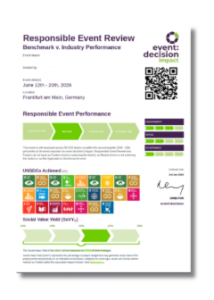
Impact: Event Review is a thirty-question, EIC, UNSDG-aligned E/S/G scorecard for the event itself. Nine minutes to complete. One event, one score. Transport, energy, food and beverage, waste, supplier choices, inclusion, crew welfare, living wage on site, safety planning, legacy. At the end: an independent, auditable number that describes how this event – not last year’s report, not the corporate policy – was actually delivered.

Impact: AdVantage applies the same treatment to the technical production supplier – the AV and staging partner whose load-in, rigging, crew and kit account for more of the footprint than most planners realise. Because the weakness in the burger is rarely in the restaurant’s ownership structure; it is in the kitchen on the night. AdVantage scores the kitchen.

SaVY – Social Value Yield – turns the social pillar from a policy claim into a delivered result. What percentage of the budget could have generated social value if spent optimally? Local suppliers, food surplus routed to community partners, apprenticeship hours, legacy programmes. An organisational DE&I policy gets a supplier onto the shortlist. SaVY tells the buyer whether the delivered event could actually generate the social value that the policy implied.

The benchmark dataset sits underneath all of it. An event is strong or weak relative to the rest of the industry; absolute scores in a vacuum mean very little. Every Impact review contributes; every participant sees where they land against sector peers. No certification provides – because certifications are binary on the organisation, not continuous on the product.

Why buyers are about to start asking this question

Corporate procurement is already moving past the accreditation question. “Are you ISO 20121 certified?” is becoming a tick-box rather than a discriminator. The new question, increasingly asked under CSRD Scope 3 disclosure and in ESG-weighted RFPs, is different: how will the event actually delivered, and can you show me a benchmark?

An organisation with every certification on the wall cannot answer that using the wall. It needs a product-level measurement. The client is not asking about the restaurant. The client is asking about the burger.

The point

Responsibility at the corporate level and responsibility at the event level are two different things. The first is necessary. The second is the one the client actually needs.

A burger chain with fifty certifications and a weak burger is still a chain that served a weak burger. An event agency, venue or production partner with fifty certifications and a weak event is still delivering a weak event. The certifications are not wrong. They are simply measuring a different object to the one the client actually experiences.

Impact measures the product you actually deliver.


Impact: Event Review and Impact: AdVantage are event:decision’s independently administered, EIC & UNSDG-aligned responsibility scorecards for events and event production suppliers. They work alongside every organisational accreditation you already hold, and answer the question those accreditations were never designed to answer. Contact eventdecision  for a pilot on an upcoming event.

https://eventdecision.com/wp-content/uploads/2026/04/Untitled-803-x-2003-mm-1080-x-800-px-1080-x-600-px-1.png 600 1080 Matt Grey https://eventdecision.com/wp-content/uploads/2026/04/mainlogo-ed.png Matt Grey2026-04-23 09:57:172026-04-27 07:00:06The restaurant is certified. The burger is not.
Page 2 of 10‹1234›»

More News

  • The Value You’re Already Creating (And Can’t See)July 29, 2026 - 9:14 am
  • We’re already doing these things…July 20, 2026 - 1:10 pm
  • Shout about your (social) value. beam Annual Forum 2026July 16, 2026 - 4:30 pm
  • The Global Destination Report Just Confirmed What We’ve Been Measuring All AlongJuly 13, 2026 - 3:19 pm
  • Beyond the big numbersJuly 7, 2026 - 12:42 pm
  • Hey venues! Buyers are losing faith in venues. Here’s how to win it back.July 1, 2026 - 2:19 pm
  • Credibility can’t be bought. But you can earn it.June 29, 2026 - 11:36 am
  • The Impact: suite now aligns every event decision with the UN SDGsJune 16, 2026 - 2:36 pm
  • The Average Event Leaves 100% of Social Value UnclaimedJune 11, 2026 - 2:08 pm
  • Exhibitor Benchmarking – recognise real effort.June 11, 2026 - 9:13 am
  • The client never asks….(which is why you should)June 2, 2026 - 2:59 pm
  • Zurich Convention Bureau partners with event:decisionMay 27, 2026 - 8:09 am
  • About Us
  • Partners
  • Resources
  • Client Login
  • Create An Account
  • Track
  • Impact
  • Navigator
  • Evolve
  • Tel: +44 (0)333 202 6985
  • Email: hello@eventdecision.com
© Copyright 2024 Event Decision | Privacy Policy | Website Design by Lemongrass Media
  • LinkedIn
  • Instagram
Scroll to top