event:decision
  • Home
  • Our Products
    • Track
    • Impact
    • Navigator
    • Evolve
  • About Us
    • Our Company
    • Clients
  • Resources
    • Quiz
    • Blog
    • Most Sustainable Agencies
  • Contact Us
  • Client Login
  • Search
  • Menu Menu
  • LinkedIn
  • Instagram

Redefining Event Sustainability, ESG for Events is here

October 3, 2023/in event:decision, Impact

Redefining Event Sustainability, ESG for Events is here.

As sustainability principles proliferate through all industry sectors, the events industry is facing a paradigm shift. While everyone knows event sustainability is about more than calculating carbon, that’s the area that has received the most focus so far.

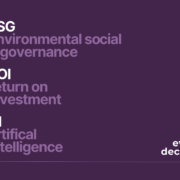
Until now, most ESG conversations — Environmental, Social, and Governance — have revolved around the ‘E’, overlooking the influence of the ‘S’ and ‘G’.

Still think ESG reporting is none of your business, only relevant to large corporations? The Event Industry Forecast 2022 reported that 97% of event planners believe that social responsibility will be an integral part of their future events.

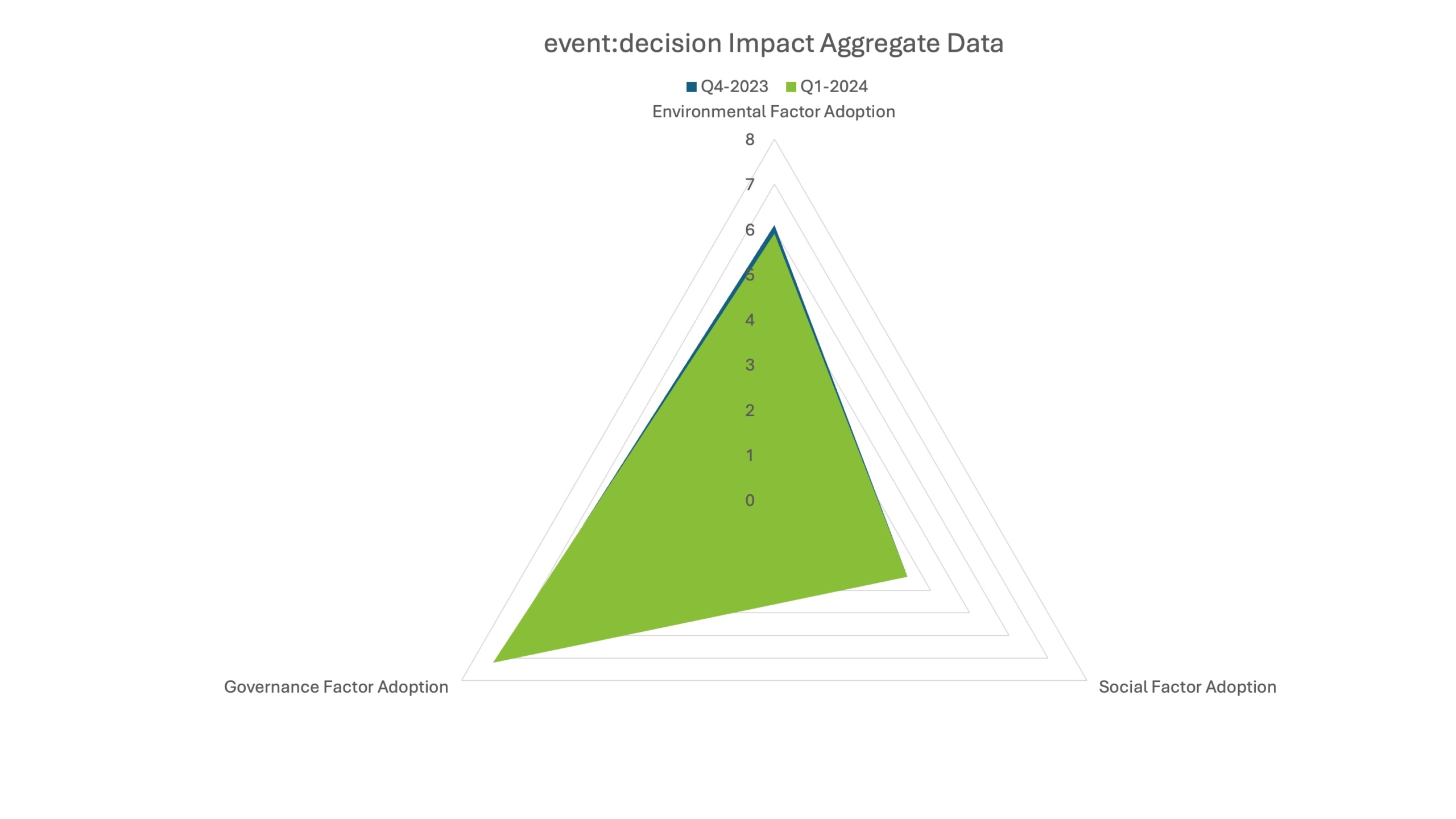
event:decision’s pioneering new product ‘Impact’ is changing that by enabling event owners & managers to check each of E, S & G on an event-by-event basis. This marks a groundbreaking moment for sustainability in our industry.

Impact will enable event planners to;

  • Ensure that you are at least considering the full array of ESG factors for each event within your portfolio.
  • See how you compare in each area with other brands’ events, with direct benchmarking by factor.
  • Certify that an event is assessed by event:decision impact.
  • Download certificates and view your assessed events in dashboard format.

Impact -the ESG for events tool

Elevating Social Responsibility

The ‘S’ in ESG stands for Social Responsibility, an aspect often overshadowed by environmental concerns but critical in creating balanced, equitable events. Impact ensures you are evaluating the socially beneficial elements of your events.

Diversity, Equity, & Inclusion

Impact promotes a more inclusive product by ensuring you consider diversity, equity, and inclusion within event operations, ensuring that every individual working on the event feels valued, respected, and equally represented.

Staff Living Wages & Wellbeing

Event teams form the backbone of any event. Impact ensures that you consider their wellbeing,  the provision of living wages, decent working conditions and a supportive environment, reflecting an ethical approach to staff treatment.

Community Engagement

Events can be pivotal in driving social change. Impact ensures you consider the engagement and beneficial contributions to local communities, reinforcing the event’s potential as a catalyst for positive societal transformation.

Strengthening Governance

Impact facilitates and ensures you consider proficient insurance & risk assessment, ensuring events are well administered with relevant insurances,  RAMS and ESMP’s and reducing potential operational risks.

Regulatory Adherence

A cornerstone for any event’s success is adherence to sector regulation. Impact ensures you consider compliance with sector-specific regulations and optimal cancellation terms, instilling confidence in both organisers and participants.

Reducing Environmental Impact

While Impact emphasises the ‘S’ and ‘G’, it also addresses the ‘E’, providing comprehensive insights into an event’s carbon emissions, making use of the features of our carbon footprint measurement sister tool ‘Track‘.

Resource Utilisation

Impact scrutinises the re-purposing of both event materials and distribution of unwanted food, making events more sustainable and reducing wastage.

Carbon Calculation

By offering precise carbon footprint evaluations, Impact aids event managers in implementing effective strategies for carbon mitigation and environmental preservation.

Transformation through Impact

Impact isn’t merely a measurement tool; it’s a catalyst for sustainable transformation in the events industry. By ensuring event managers are comprehensively aware of all ESG elements and benchmarking your events against others in the industry, Impact will propel events towards sustainability, inclusivity, and ethical governance, setting a new industry standard.

Industry Evolution

Impact’s groundbreaking approach marks the onset of an evolved event industry, one where every event contributes to societal well-being, environmental conservation, and ethical conduct.

Impact’s introduction is a huge step towards a balanced approach to event sustainability, emphasising the equal importance of social and governance considerations in event planning, alongside often more visible environmental concerns.

If you’d like to find out more about how we could measure and advise on your event ESG goals, get in touch.


https://eventdecision.com/wp-content/uploads/2023/09/1.png 480 480 eventdec https://eventdecision.com/wp-content/uploads/2022/07/mainlogo-ed.png eventdec2023-10-03 06:05:302023-10-24 09:34:46Redefining Event Sustainability, ESG for Events is here
event carbon footprint

The Anatomy of an Event Carbon Report

September 9, 2023/in event:decision, Track

There’s a lot of talk about carbon reports.

But what does an event:decision Track report actually show you?


Events have many moving parts, all inter-dependent; there’s no beating heart without all other parts working in harmony. Delivering that is the skill of an event manager. As you know, each element will have a carbon impact and you can influence nearly all of these, to one extent or another.

You assess the impact by measuring. You can measure before your event or after your event. Or both, to demonstrate your ability in planning more sustainably.

But is understanding a carbon footprint report easy? We’ll show you just how easy it is…

Your impact

In language you understand. Travel, accommodation, energy, materials and so on.

Not shown in Greenhouse Gas Protocol’s Scopes 1-3, but measured in tonnes of CO2e so that you can align your event’s footprint with that of your organisation (SBTi tracking, for example) and against other events.

Travel – whether by plane, train or automobile and whether you can control it or not, likely the most significant element of the event carbon footprint – and the one on which you can nudge your visitors and delegates to reduce their impact. Ask us about available tools that can help.

Accommodation – again, often in the hands of visitors – but where you can, choose those with sustainable credentials (GreenKey, GreenGlobe, Greengage) and book within walking distance of your meeting space.

F&B – probably entirely within your control as an event manager. Generally accepted in the sustainability world that you should try to move from red meat into white meat, fish and then vegetarian options where you can. Local is mostly better, as is seasonal. Challenge your chefs.

Energy – can be a major factor in venue emissions. Opt for venues with renewable if you have a choice, each and every time. Ask your venue contact at show-round time. The more we ask, the more likely they will change.

Transport / Freight – another chance for you to make a difference. Source local kit and people, wherever you can. Certainly within the country of the event for kit.

Materials – the most visible element on your event/show floor. Your guests will be able to see and touch this (and likely comment), so make them reusable or recyclable and label them as such if you can.

Waste – the invisible factor, which includes food and beverage waste. Source a partner who can distribute unwanted food. Make it easy for the waste contractor to stream your waste, request your suppliers to minimise plastic in packing and shipping. This can be done – several global events have banned plastic in freight.

Virtual – the easiest way to distribute content without a significant impact. And highly recommended, in certain instances.

Benchmark

Unique to event:decision Track reports. See how your event compares to other similar events. Aim for better next time. We’ll help you!

benchmarking


Mitigation

Top tips to mitigate the biggest hotspots in your event footprint – specific to your event and without ripping the legs off it. You may have little control over the size of format of your event, if you’re an agency, but you can always mitigate the impact to some extent.

mitigation


Offset value range

We’ll give you a range of prices for projects from reputable and certified offset providers, if this is a route you’d like to go down. Great for advance budgeting.


There’s a lot in a Track report – but it’s all simple to understand and take to your stakeholders. Chances are much of it will be news to them. We’re #EventProfs’ favourite partners in sustainability and there’s a reason for that. So if you’d like to find out more about how we could measure and advise on your event carbon footprint, get in touch.


https://eventdecision.com/wp-content/uploads/2023/09/carbon_footprint.png 480 640 eventdec https://eventdecision.com/wp-content/uploads/2022/07/mainlogo-ed.png eventdec2023-09-09 14:44:052023-10-24 09:51:59The Anatomy of an Event Carbon Report
sustainability

Get on board the sustainability train (or get left behind)

August 30, 2023/in event:decision, Track

Sustainability isn’t a bandwagon, it’s a train that’s leaving the station #eventprofs need to get on board, or get left behind!

Remember how things were shifting in late 2021?

As in-person gatherings began to return, it became critical for event organisers, digital platforms, and venues to move from merely talking about sustainability as their top focus to actually implementing sustainable practices. Many have started this transition to some degree.

To recap;

Why ‘sustainability’?

Sustainability is not ‘just’ an ethical choice; it’s a business imperative. Clients and attendees are increasingly discerning in their selection of events, looking for those that demonstrate a commitment to environmental and social responsibility. Taking sustainability seriously can be a USP, setting your event apart from the many others that have yet to adopt practices.

New advances in tech are helping to make events more sustainable much more easily. From virtual and hybrid event options that reduce travel-related emissions to smart waste solutions, embracing the latest tech solutions can significantly mitigate an event’s environmental footprint. Ignoring tech advancements is not only a missed opportunity for innovation but also risks rendering your events obsolete. The market is rapidly-shifting and sustainability is now seen as a key indicator of quality and responsibility.

Finally, cross-sector collaboration can’t be underestimated in driving the agenda forward. Industry associations, government bodies, and even competitors can offer valuable insights and resources for enhancing practices and solutions. Attending or organising events and forums (below) that focus on sharing best practices in sustainability can amplify collective impact, creating a more substantial change than any single entity could achieve on its own.

Room for improvement

There’s significant room for improvement in our industry. Notably, key players in the event sustainability landscape likely only engage with a fraction—perhaps less than 1%—of the entire event market. This implies that a large percentage of events are neither assessed for their environmental impact nor reported on.

Legislation is fortunately evolving.

Kudos to Prestige Events for spearheading the focus on sustainability with their first Sustainable Event Show at the Barbican in November 2021. event:decision contributed by measuring and reporting on the event; and by collating topics and panelists supporting the event’s subject matter and diverse range of speakers.

A variety of sustainable events and shows have been launched since then, and the current season is just kicking off.

Recent data from EY reveals that “36% of companies are well-progressed in their ESG commitments,” indicating an impending uptick in transparent reporting against ESG goals, stimulating business innovation, and bolstering supply chain sustainability.

For actionable insights, stay tuned with Event:decision in the upcoming months and consider attending:

– The CN Sustainability Summit

– Event Sustainability Live

– The Sustainable Event Show

There’s likely room for you at any of these events; make it a point to attend at least one.

The saying holds true: if you don’t make sustainability a priority, your competitors will.

So, it’s time to get on board; this movement is headed in only one direction—forward!

https://eventdecision.com/wp-content/uploads/2023/08/1.png 768 1024 eventdec https://eventdecision.com/wp-content/uploads/2022/07/mainlogo-ed.png eventdec2023-08-30 07:15:382023-08-30 07:29:45Get on board the sustainability train (or get left behind)
sustainability heroes

Nine Sustainability Heroes

July 25, 2023/in event:decision, Track

Who are the people the team at event:decision find the most inspiring in the sustainability space?

We’re constantly inspired by the pioneers and inventors in the sustainability space in the work that we do here at event:decision, but we’re aware that only some of them are as widely known as we think they deserve to be. So we thought we’d share with you nine sustainability innovators who have made significant contributions to the cause:

Sir David Attenborough World-renowned naturalist and broadcaster and widely regarded as a global voice for the natural world. With a career spanning decades, he has produced numerous documentaries highlighting the wonders of nature and the urgent need to protect it. Through his powerful storytelling and environmental advocacy, Attenborough has raised awareness about the impacts of climate change, plastic pollution, and habitat destruction and inspired millions to appreciate and safeguard the planet’s biodiversity. No-one tops David Attenborough in our list of sustainability heroes.
Wangari Maathai The late Wangari Maathai was a Kenyan environmental activist and the first African woman to be awarded the Nobel Peace Prize. She founded the Green Belt Movement, which focuses on reforestation, conservation, and women’s empowerment. Through tree-planting initiatives, she contributed significantly to restoring Kenya’s biodiversity and fighting against deforestation.
Mike Berners-Lee Expert in carbon foot-printing and sustainability and a professor and researcher at Lancaster University, he has focused on understanding the environmental impact of everyday activities. Through his book “How Bad Are Bananas?: The Carbon Footprint of Everything,” Berners-Lee has made complex climate issues accessible to the general public. His work has helped individuals and businesses make informed choices to reduce their carbon footprints and contribute to a more sustainable world.
Greta Thunberg The Swedish environmental activist gained international recognition for her dedication to addressing the urgent issue of climate change. At just 15 she initiated the “Fridays for Future” movement (also known as the School Strike for Climate), inspiring millions of students worldwide to strike for climate action. Her speeches and advocacy have brought global attention to the need for urgent environmental policies and actions.
Kevin Kumala Indonesian entrepreneur and biologist is the co-founder of Avani Eco, a company that focuses on producing eco-friendly alternatives to single-use plastics. He invented a sustainable bioplastic made from seaweed that is fully biodegradable and compostable. This innovative material has the potential to replace conventional plastic packaging, reducing plastic pollution and its harmful impact on the environment.
Dr. Jane Goodall Renowned for her work with chimpanzees, Dr. Jane Goodall is also a passionate advocate for environmental conservation and sustainability. Through her Jane Goodall Institute, she promotes community-centred conservation and empowers individuals to take positive action for the protection of wildlife and their habitats.
Boyan Slat Dutch inventor and entrepreneur, is the founder of The Ocean Cleanup, an organisation dedicated to developing advanced technologies to remove plastic pollution from the oceans. He designed a passive floating system that utilises ocean currents to capture and concentrate plastic debris, making cleanup operations more efficient. Slat’s invention has brought attention to the critical issue of ocean plastic pollution and inspired efforts to tackle this global challenge.
Hindou Oumarou Ibrahim The environmental activist from Chad who advocates for the rights of indigenous peoples and sustainable land management. An expert in indigenous knowledge and its connection to climate change adaptation. Ibrahim has been actively involved in global climate negotiations, ensuring that indigenous voices are heard and incorporated into climate policies. Her work has highlighted the importance of including indigenous perspectives in sustainable development and environmental conservation efforts. In 2016, Ibrahim was selected to represent civil society at the signing of the historic Paris Climate Agreement on April 22, 2016
Dr. Shuji Nakamura Japanese engineer and winner of the Nobel Prize for Physics and known for his pioneering work in developing blue light-emitting diodes (LEDs) and the blue laser diode. His breakthrough in the 1990s revolutionised lighting and display technologies, significantly improving energy efficiency compared to traditional incandescent bulbs. The widespread adoption of Nakamura’s LED technology has led to substantial energy savings globally and reduced greenhouse gas emissions.

Each of these sustainability heroes has demonstrated extraordinary dedication and commitment to the preservation of our planet, inspiring people from all walks of life to take action and contribute to a more sustainable future. We find them all incredibly inspiring and they remind us every day that individual actions can drive significant positive change for the environment.

To find out more about our own work, especially our carbon footprint measurement tool track and how it can help event planners measure the carbon impact of their events – get in touch.

https://eventdecision.com/wp-content/uploads/2023/07/sustainability-heroes.png 1080 1920 eventdec https://eventdecision.com/wp-content/uploads/2022/07/mainlogo-ed.png eventdec2023-07-25 06:10:572023-07-25 10:28:13Nine Sustainability Heroes
sustainable event venue

Venue Sustainability Spotlight: 73 Waterloo

July 18, 2023/in event:decision

A sustainable event venue like no other

In the first of our Spotlight series – introducing you to a different event venue which has sustainability at its core – we’re taking you on a tour of 73 Waterloo in London, the events venue of of St John the Evangelist at Waterloo, to explain you why this really is a sustainable event venue like no other.

About the venue

The Grade II* church of St John’s at Waterloo was built 1822-24 to designs by Francis Bedford as one of the original Commissioners’ Churches. 

During the Second World War, at the height of the Blitz, the church was completely devastated by a firebomb in late 1941. The crypt was actually being used as a bomb shelter at the time and did its job miraculously : the 150 people who were sheltering there were completely unscathed by the devastation of the church above them.

The church sadly then had to completely close for a huge programme of rebuilding and restoration which took over a decade, opening again in 1951 as the official church of the Festival of Britain. It was a hub for the Festival, and has remained a place where the arts, society and faith intersect ever since.

“We shape our buildings. Thereafter they shape us.”

Winston Churchill

An emphasis on sustainability

Not content with one reinvention – St John’s recently underwent a second significant phase of restoration and refurbishment in 2022, with its focus on aligning with the Church of England’s goal of achieving net-zero carbon emissions by 2030. St John’s is actually at the forefront of campaigning for climate justice as home to the multi-faith action group Faith for the Climate, and is working with the Council on Lambeth-wide initiatives. So naturally, they’ve put sustainability at the heart of everything they do in and around their building.

The restoration project fully embraced sustainable practices by incorporating 80 solar panels across most of the southern roof. To enhance energy efficiency, a new internal lobby space, separated from the nave by glass screens, was also constructed to improve the building’s airtightness and minimise heat loss through warm air circulation. The replacement of glazing and window repairs in the nave not only increased airtightness but also enhanced natural daylighting levels. Measures were taken to enhance the thermal performance of the building too, such as installing acoustic and thermal insulation and implementing double glazed thermally broken windows in the crypt. The entire renovation project also seized the opportunity to incorporate cutting-edge heat recovery ventilation units and infrastructure for air-sourced heat pumps in the nave, anticipating future advancements in technology and affordability to support their effective operation.

Support the ethos of the venue and the people it supports

As a venue, 73 Waterloo has at its heart support to the local community and it has a wide outreach programme supporting organisations such as; English for Refugees, the Ukrainian Chess Club; a Food Bank and a night shelter. The event spaces can accommodate from 25-500 and by choosing to use the space for your event you are in effect supporting everyone and everything within St John’s on an ongoing basis.

“We think this really is the true meaning of sustainability.”

event:decision

Contact 73 Waterloo to find out more about booking this fantastic venue.

https://eventdecision.com/wp-content/uploads/2023/07/Sustainable-Event-Venue.png 768 1024 eventdec https://eventdecision.com/wp-content/uploads/2022/07/mainlogo-ed.png eventdec2023-07-18 06:15:012024-04-30 11:02:16Venue Sustainability Spotlight: 73 Waterloo
consumer psychology for event profs

What #EventProfs can Learn From a Pineapple

June 27, 2023/in event:decision

What lesson does a tropical fruit hold for #EventProfs?

Consumer psychology plays an important role in influencing individual behaviour and decision-making. As #eventprofs look to promote sustainability among attendees, understanding how consumer psychology works can be a powerful tool. Two lessons from the retail industry — new approaches to selling pineapples and the success of ‘wonky veg’— offer useful lessons in what it takes to win over the consumer.

The Power of Perception: The Pineapple

In Costa Rica some pineapple growers found that cutting off the tops (‘crowns’) of pineapples allowed more fruit to fit in shipping crates, reducing their carbon footprint by more than 20%. Other growers and European supermarket chains all rejected the idea of adopting the approach as they felt consumers just wouldn’t buy the fruit without their distinctive tops. However, one retailer was persuaded to display the crown-free pineapples with signage explaining their sustainability benefits, and to their surprise – consumers bought as many crown-free pineapples as crowned ones.

The Lesson for #EventProfs:

If we want to encourage sustainable behaviour, we need to commit to education and use signage and visual cues to highlight the available sustainable choices at our events. We can’t assume that visitors will reject, or accept, sustainability efforts without telling them the why of the option we’re asking them to take. We may believe that human beings are inherently lazy and will prefer the familiar or the easy option – but if we take some time to explain the benefits, the pineapple story tells us we will indeed adopt alternatives. Don’t assume it always has to be done the way it’s always been done!

Social Norms: the ‘Wonky Veg’ Story

The ‘wonky veg’ phenomenon also demonstrates the power of social norms in consumer psychology. One supermarket started promoting misshapen vegetables, which would typically fail strict quality control, as a sustainable choice at a slightly lower price. By reframing the unusually-shaped vegetables as an ethical option, visually flagging that a deliberate choice had been made in the shoppers’ baskets and trolleys, they tapped into the desire for social acceptance, aligning sustainable behaviour with a positive image.

The Lesson for #EventProfs:

We can leverage the concept of social norms by highlighting and celebrating sustainable actions taken by others. For instance, recognising and rewarding attendees who actively engage in eco-friendly practices during the event, such as using reusable water bottles or participating in recycling initiatives, can create a positive social norm around sustainability. This approach taps into our inherent desire to belong and be accepted, increasing the likelihood of sustainable behaviour.

What it Takes to Encourage Sustainable Behaviour at Events:

Using crown-free pineapples and wonky veg as our inspiration how can we leverage consumer psychology in other ways to encourage sustainable behaviour at events? One example might be in the area of encouraging sustainable travel choices.

Encourage carpooling or public transport by incentivising more sustainable travel: additional digital swag, fast-track entry or free content for delegates or visitors travelling via public transport, or example, or offer subsidised tickets, WiFi or coffee vouchers for delegates adopting your sustainable credentials.

Using the same approach, also take the opportunity of highlighting to visitors what previous sustainability efforts have achieved by way of encouraging repeat behaviour. “At one event alone, we saved 33 meals which were shared with 7 local families. The environmental stats also add up, with 10,420 litres of water saved and 60kg of CO2 emissions avoided. Just think of the impact across our series of 10 events” is a genuine quote from a corporate planner in May 2023.

Understanding consumer psychology can be incredibly useful for event planners as we aim to promote sustainable behaviour. By applying lessons from other industries, event planners and owners can create environments that inspire and encourage sustainable choices. By choosing to educate everyone involved in the event on the benefits of sustainability, events can become powerful catalysts for positive change, promoting a more sustainable future.

If you’re interested in finding out more about sustainable event planning, why not use track  to calculate your own event’s projected carbon footprint? Do get in touch, we can give you a demo to illustrate just what it could do for you.

https://eventdecision.com/wp-content/uploads/2023/06/Pineapple.png 768 1024 eventdec https://eventdecision.com/wp-content/uploads/2022/07/mainlogo-ed.png eventdec2023-06-27 03:00:422023-07-10 13:36:28What #EventProfs can Learn From a Pineapple
event sustainability quiz

Are you an Event Sustainability Guru? [QUIZ]

June 13, 2023/in event:decision

How much do you really know about event sustainability?

We’ve been on a mission to educate everyone in the events industry all about sustainability for events. But we thought you might like to test your knowledge so far and find out just how much of a sustainability expert you are in the world of events

Our new quiz “Are You an Event Sustainability Guru?” will let you do just that!

The lighthearted side

Join the fun and test your knowledge

Buckle up, event planners, because this quiz is like no other. We’ve planned it to keep you engaged from start to finish. Get ready to explore a series of questions that will completely test your event sustainability IQ and uncover any preconceptions you may be harbouring about what sustainability really means. Whether you’re a seasoned pro or just dipping your toes into the world of all things event sustainability, our quiz is designed to entertain and challenge.

Find your event sustainability ‘type’

Are you a Green Guru or a Greenhorn? Are those around you consistently impressed by the depth of your sustainability knowledge or are you woefully under-informed? The quiz will tell you what your sustainability ‘type’ is (as well as telling you what you got wrong and pointing you in the direction of some useful information).

The serious message

Why event sustainability matters

Beyond the fun of our quiz lies a serious message – the vital importance of event sustainability. As event planners, we have a unique opportunity to create memorable experiences while minimising our impact on the environment. And, as we’ve shown before, sustainable events are efficient events so we can do all that while enhancing the bottom line too.

The power of (self) education

Becoming an event sustainability guru goes beyond acing our quiz; it involves continuous learning and staying up-to-date with the latest information. When we educate ourselves about sustainable event practices, we empower ourselves to make informed decisions that benefit both the planet, our clients, and ourselves.

The positive impact of sustainable events

Sustainable events not only help protect the environment but also create a positive impact on attendees, clients, and communities. By showcasing carbon-friendly practices, we can inspire and educate attendees and guests, raising awareness about the importance of sustainability in their own lives. And, hosting sustainable events can enhance our own reputations, attracting like-minded clients who prioritise minimising carbon emissions.

So, congratulations, event planners, on taking the first step towards becoming an event sustainability guru! Our quiz will take you on a journey that we hope is both entertaining and enlightening. By delving into the world of event sustainability, you’ll uncover a serious underlying message – the critical role we play in creating sustainable events. Remember, education is key, and staying informed about sustainable practices allows us to make a positive impact on the environment, our clients, and society as a whole.

Now, go ahead and take the quiz!

To find out more about our full suite of data and insight tools for event planners purpose, track and predict – and how they can help event planners and owners measure and track whether they’re delivering on their event objectives, get in touch.

https://eventdecision.com/wp-content/uploads/2023/06/Copy-of-Event-Sustainability-Guru-Quiz.png 768 1024 eventdec https://eventdecision.com/wp-content/uploads/2022/07/mainlogo-ed.png eventdec2023-06-13 08:08:502023-06-13 08:20:19Are you an Event Sustainability Guru? [QUIZ]
event profs book club

The Event Decision Book Club (2)

June 6, 2023/in Book Club, event:decision

The second in our series of recommended books for #Eventprofs

We’ve been delighted at how well our Book Club has gone down with event planners. We’ve had lots of feedback about the first instalment of our recommended books. So we’ve put together our next selection of books. All of them are chosen to help you think in more ‘big picture’ terms about your agency, business or event  – and to inspire you to think differently. And all the books have been read by our founder Matt, so we can personally vouch for them!

Here’s the June 2023 selection;

  1. The Sustainable Business Book: Building a resilient modern business in six steps, Sarah Duncan. A comprehensive guide to integrating sustainability into business practices. It covers topics such as environmental impact, ethical sourcing, and social responsibility. An absolutely brilliant bite-sized way to guide you through how to consider and implement more sustainable practice, whatever your business. How is this relevant for event profs? It offers valuable insights on creating eco-friendly events, reducing waste, and implementing sustainable strategies that align with the growing demand for environmentally conscious events.
  2. Priceless, William Poundstone. Explores the fascinating world of behavioural economics and the power of psychological pricing. Through captivating examples and case studies, Poundstone reveals how pricing strategies can influence consumer behaviour and drive sales. It’s a fun and insightful look at how brands price their products and services to make them look attractive to us. Lots of real world examples of how price in £ is linked to value…or is it? How is this relevant for event profs? Plenty of inspiration in this book to develop innovative pricing structures, optimise ticket sales, and leverage psychological techniques to enhance attendee experiences and increase event revenue.
  3. How to make a decision, Tanya Barad.  Decision-making is a key skill for event planners, and Barad’s book offers guidance on making informed choices, delving into various decision-making models, techniques, and biases, empowering readers to navigate complex scenarios with confidence. It’s a nice little read on how decisions get made, what you need to make them and how/why you may not! How is this relevant for event profs? We all need to make decisions don’t we? This book can help when working out how to make effective decisions around choosing event venues, selecting suppliers, solving logistical challenges – and many other event-specific scenarios.
  4. The Future We Choose, Christiana Figueres & Tom Rivett-Carnac. The key architects of the Paris Agreement, present a compelling call to action for combating climate change. They outline practical solutions and inspire readers to create a sustainable future. Quite practical, optimistic and empowering. It shows us steps we can all take to renew our planet and create a better world beyond the climate crisis: today, tomorrow, this year and in the coming decade. How is this relevant for event profs? By incorporating sustainable practices into events, raising awareness about climate change, and inspiring clients and event attendees to take action.

Four thought-provoking books in our event profs book club we think will inspire you to think a bit differently about your events and empower you in your work. Whether you’re looking to make better decisions, think more creatively about pricing or build truly sustainable and climate-friendly events, each of these books has something for you.

To find out more about our data and insight tools for event planners purpose, track and predict – and how they can help event planners and owners measure and track whether they’re living up to their event objectives, get in touch.

https://eventdecision.com/wp-content/uploads/2023/06/Correct-Book-Club.png 768 1024 eventdec https://eventdecision.com/wp-content/uploads/2022/07/mainlogo-ed.png eventdec2023-06-06 10:45:492023-06-12 13:08:05The Event Decision Book Club (2)
books for event profs

Introducing The Event Decision Book Club

April 18, 2023/in Book Club, event:decision

Sometimes you need to look at the bigger picture: the first in our series of recommended books for #Eventprofs.

As an event owner or event planner, you know that organisation, planning and measurement are key elements to success. From choosing the right venue to coordinating the perfect schedule, every detail matters. However, there could be a ‘big picture’ view that you might be missing out on that could take your events to the next level. Fortunately, there are some great books out there to help you think more broadly about event, your business, and inspire new thinking. In the first of an occasional series; here are five books that we recommend for any event owner or event planner looking to elevate their game. Compulsory reading if you run an event measurement consultancy!

  1. The Day the World Stops Shopping: How to have a Better Life and a Greener World, J.B. Mackinnon A look at consumption around the world, in material terms. How we support our economies by buying and using ‘stuff’. Includes an interesting look at what effect the pandemic had on links to happiness. How much is ‘enough’? Is GDP even a good measure of success? In a nutshell, the books shows through variety of research and studies that that more ‘stuff’ does not equal happier lives, in fact almost the opposite.  How is this relevant for event profs? In a world where sustainability is such a buzzword, a great book to think more widely about what sustainable really means and how it could be applied more meaningfully to events. (To be really sustainable, try and get this from a library and not Amazon!).
  2. How To Measure Anything: Finding the Value of the Intangibles in Business, Douglas Hubbard A seminal text, explaining how anything can, in fact, be measured. It’s not too complex on explaining a variety of different approaches to measurement, with fascinating real-life examples on the measurement of risk, qualitative data, other intangibles and cross-industry case studies (from piano-tuners to dam-builders). If it matters, the book explains, you can measure it….and as we all know, what gets measured gets done! How is this relevant for event profs? Measuring success is a key part of delivering any event, but are we always measuring the right things? And are we missing some things that could be measured which might more effectively demonstrate success? Definitely worth a dip into.
  3. Buy-ology: How Everything we Believe About Why We Buy is Wrong, Martin Lindstrom Another look at the accumulation of ‘stuff’ but this time why we as consumers buy things and how brands use this to sell more things to us. A fascinating dive into marketing by brands and why we buy them, with case studies from Pepsi vs.Coke, McDonalds and others. If you’ve ever wondered quite why you bought that extra pair/set/thing from a brand, this book will explain the extraordinary lengths brands will adopt to get us to buy their stuff! How is this relevant for event profs? Do we really know why a visitor might choose our event and not another? What does our brand say to them about the choice they are making? A chance to step back and really thinking about how effectively we are selling the promise of our event.
  4. Overthrow: 10 Ways to tell a Challenger Story, Adam Morgan & Mark Holden We all love a good David vs. Goliath story don’t we? Here the authors outline real-life examples of how brands deliberately position themselves as challengers, up against the big brands, in order to win over their customers. Using the ten categories of challenger brands identified in their previous book Eat Big Fish, they show us how brands have successfully adopted these stand-points, in some cases even eventually becoming the Goliath themselves. How is this relevant for event profs? If your event is new to the market or up against a stronger and more dominant one, a great stimulus to think about how you could make that work to your advantage and think like a challenger.
  5. Stolen Focus: Why You Can’t Pay Attention, Johann Hari An immensely enjoyable look at why all our attention spans are currently so fragile, looking at a variety of possible culprits, not just social media and the digital world. A call for how, if we can just re-learn how to focus, we could be happier, more content and more productive. How is this relevant for event profs? We all have pressured lives but if we can’t take the time to sit and think deeply from time to time about some of the challenges ahead, we’re simply going to find ourselves running to stand still. A thought-provoking read and a manifesto for finding more time to pick up a book!

Five starter books that we think are essential reads for event owners and event planners looking to inspire their thinking and elevate their events. Whether you are looking to create a sustainable business model, think about measurement more holistically, take a lateral look at the branding of your event, or find time to focus deeply, these books all offer inspiration to help you achieve your goals. We recommend picking up a copy of one of them to take your business to the next level.

To find out more about our measurement, data and insight tools for event planners purpose, track and predict – and how they can help event planners and owners measure and track whether they’re living up to their event objectives, get in touch.

https://eventdecision.com/wp-content/uploads/2023/04/Event-Decision-blog.png 768 1024 eventdec https://eventdecision.com/wp-content/uploads/2022/07/mainlogo-ed.png eventdec2023-04-18 07:08:322023-06-06 11:41:05Introducing The Event Decision Book Club

The Critical Importance of Measurement for Event Planners

January 31, 2023/in event:decision

The most important tools in an event planner’s toolkit are the ones that help you measure your event.

As the events industry continues to grow and evolve, the use of data and insight tools has become increasingly important for event managers striving for success. Insight tools allow event managers to make data-driven decisions, measure the effectiveness of your events, and gain a deeper understanding of your audiences, as well as measure the environmental impact of the event and how well it reflects and enhances company values.

A key benefit of using data and insight tools is the ability to make informed, data-driven, decisions. By collecting and analysing data on past events, event managers can identify patterns and trends that can inform the planning and execution of future events. This leads to more effective and efficient event planning, as well as increased ROI for event organisers.

Data and insight tools also allow event managers to measure the effectiveness of their events. This includes tracking attendance, engagement, and feedback from attendees. By measuring these metrics, event managers can determine which aspects of their events are resonating with attendees and which need improvement.

Data and insight tools can also help event managers gain a much deeper understanding of their audiences. By collecting data on demographics, interests, and behaviour, event managers can create more targeted and personalised experiences for attendees. This can lead to increased engagement and satisfaction among attendees, as well as opportunities for upselling and cross-selling.

Measuring the environmental impact of an event is becoming almost the norm. With rising public sustainability concerns, measuring and reducing an event’s carbon footprint is crucial for event managers to meet the expectations of attendees and stakeholders.

There are hundreds of data and insight tools that event managers can use to measure their events. Some starting examples might include:

  1. Google Analytics: This allows event managers to track website traffic and engagement, including page views, bounce rates, and time on site. This data can be used to optimise website design and better target digital marketing and content to improve the user experience and engagement.
  2. Bespoke Forms: (SurveyMonkey, Typeform, Jotform for example) These allow event managers to collect feedback from attendees through surveys. The data can be used to improve the overall event experience and make changes for future events.
  3. Eventbrite Insights: This allows event managers to track attendance, ticket sales, and revenue for their events. This data can be used to inform pricing and marketing strategies and measure the overall ROI of an event.
  4. Track by event:decision This allows event managers to measure an event’s carbon footprint by tracking either pre- or post-event, the emissions of travel, accommodation, F&B, materials, freight & energy associated with the event. The tool also provides recommendations on how to reduce the environmental impact of the event, a benchmark against other similar format events and the potential offset value.

The use of data and insight tools is an essential component of event managers’ success. Tools like those above – and many others – allow event managers to make data-driven decisions, measure the effectiveness of your events, gain a deeper understanding of their audiences, and measure and reduce the environmental impact of the event. With the right data and insights, you can create more engaging, sustainable, and successful events, resulting in increased ROI and more satisfied attendees.

To find out more about our data and insight tools for event planners purpose, track and predict – and how they can help event planners and owners measure and track whether they’re living up to their event objectives, get in touch.

https://eventdecision.com/wp-content/uploads/2023/01/11.jpg 768 1024 eventdec https://eventdecision.com/wp-content/uploads/2022/07/mainlogo-ed.png eventdec2023-01-31 07:10:422023-04-14 12:09:58The Critical Importance of Measurement for Event Planners
Page 7 of 8«‹5678›

More News

  • Enhance your RFP score by up to 25%April 22, 2026 - 8:30 am
  • Agency owners. Your worth could be more than you think.April 20, 2026 - 10:15 am
  • Eventprofs Hackathon ResultsApril 20, 2026 - 8:11 am
  • We painted a changing room…April 16, 2026 - 10:58 am
  • That box is now on fire…April 8, 2026 - 8:58 am
  • Ten reasons why measurement gives better outcomes than certificationMarch 30, 2026 - 11:11 am
  • Think CSRD is just about carbon?March 23, 2026 - 8:51 am
  • Table Stakes?March 20, 2026 - 11:59 am
  • What’s up in other sectors?March 12, 2026 - 8:13 am
  • So, how did it go?March 5, 2026 - 11:09 am
  • Accreditation or Performance Benchmarking? The Arguments.March 3, 2026 - 9:39 am
  • M&E: Crossing the accreditation / performance borderMarch 3, 2026 - 8:11 am
  • About Us
  • Partners
  • Resources
  • Client Login
  • Create An Account
  • Track
  • Impact
  • Navigator
  • Evolve
  • Tel: +44 (0)333 202 6985
  • Email: hello@eventdecision.com
© Copyright 2024 Event Decision | Privacy Policy | Bespoke Website Design by Lemongrass Media
  • LinkedIn
  • Instagram
Scroll to top